Mammal Study Merit Badge — Complete Digital Resource Guide
https://merit-badge.university/merit-badges/mammal-study/guide/
Introduction & Overview
Mammals are some of the animals Scouts notice first: deer crossing a trail, squirrels in camp, raccoon tracks in the mud, a bat flipping through the evening sky. Mammal Study teaches you how to look past the quick glimpse and start asking better questions. What makes that animal a mammal? Why does it live here? What signs did it leave behind? How do people help or harm its chances of survival?
This badge is part detective work, part science, and part outdoor observation. You will classify mammals, compare habitats, study life histories, think about conservation, and choose projects that get you outside paying attention. Once you start noticing mammal sign, the woods never look quite the same again.
Then and Now
Then
People have studied mammals for thousands of years, but early mammal study usually focused on hunting, trapping, or protecting livestock. Naturalists learned by collecting skulls, skins, bones, and written observations. Museums grew their collections one specimen at a time, and scientists compared body shape, teeth, fur, and skeletons to figure out how mammals were related.
For a long time, this was the main path to knowledge. If you wanted to compare foxes from different regions or figure out whether two mice were the same species, you often needed preserved specimens in front of you. Study skins, taxonomic keys, and field journals were the tools that helped scientists build the mammal family tree.
Now
Modern mammal study still uses museum collections, but it also includes camera traps, trail cameras, GPS collars, DNA testing, acoustic recorders, satellite imagery, and community science. A wildlife biologist can compare hair samples in a lab, a park ranger can monitor mammals with remote cameras, and a Scout can identify an animal by tracks, scat, chew marks, or a short glimpse at dawn.
Today, mammal study matters because habitats are changing fast. Roads divide wildlife travel routes. Cities expand. Climate shifts affect food and shelter. Good observation helps people make better choices about conservation, land management, and how humans share space with wild animals.
Get Ready!
Bring curiosity, patience, and a notebook. Mammals are often secretive, mostly active at dawn, dusk, or night, and better at noticing you than you are at noticing them. That is part of the fun. This badge rewards careful observers who slow down, look for clues, and keep good records.
Kinds of Mammal Study
Field Observation
This is the part most Scouts picture first: watching mammals in the wild or finding evidence that they were there. Tracks, scat, burrows, browse lines, nests, claw marks, and feeding signs all count as clues. You do not need a dramatic wildlife encounter to do real mammal study. A muddy creek bank can tell a whole story.
Classification and Identification
Scientists organize mammals into groups so they can compare them, talk about them clearly, and understand how they are related. That includes big groups like rodents, carnivores, and hoofed mammals, but also the smaller taxonomic levels that narrow one animal down to a species. This kind of study helps you move from “some kind of mouse” to a much sharper answer.
Museums, Specimens, and Records
Mammal study is not only outdoors. Natural history museums, study skins, photographs, books, and life-history reports all preserve knowledge. A carefully labeled specimen or field notebook entry can still teach people decades later. Good records are one of the most important tools in science.
Conservation and Management
Mammal populations rise or fall based on habitat, predators, food, disease, weather, and human activity. Studying mammals means paying attention to what helps them thrive and what puts them at risk. Sometimes that means restoring cover and food sources. Sometimes it means changing human behavior.
Ready to start with the big question behind the whole badge? First, learn what an animal is, where mammals fit among other animals, and which traits truly make a mammal a mammal.
Req 1 — What Makes a Mammal?
If you spot a track in wet sand or see a shadow cross the trail at dusk, this is the first question you need to answer: what kind of animal am I dealing with? Mammal Study starts by sorting living things into the right boxes. Once you understand those boxes, later requirements about classification, habitats, and life histories make much more sense.
Four Important Terms
Animal
An animal is a living thing that gets energy by eating other organisms or organic material. Animals do not make their own food the way plants do. Most animals can move at some point in their life, respond quickly to their surroundings, and have specialized body systems that help them survive.
Invertebrate
An invertebrate is an animal without a backbone. Insects, spiders, worms, jellyfish, and snails are all invertebrates. They make up most animal species on Earth. Some have hard outer shells or exoskeletons, but they do not have an internal backbone like mammals, birds, reptiles, amphibians, and fish.
Vertebrate
A vertebrate is an animal with a backbone or spinal column. Vertebrates also have an internal skeleton. Fish, amphibians, reptiles, birds, and mammals are the five major vertebrate groups most Scouts learn first.
Mammal
A mammal is a vertebrate animal that belongs to the class Mammalia. Mammals include mice, whales, bears, bats, dogs, elk, and humans. They come in many shapes and sizes, but they share a core set of traits that link them together.
How These Terms Fit Together
Think of these words like nested circles:
- All mammals are animals.
- All mammals are vertebrates.
- Not all vertebrates are mammals.
- Invertebrates are animals too, but they are outside the vertebrate group.
| Term | What it means | Example |
|---|---|---|
| Animal | Any member of the animal kingdom | snail, hawk, deer |
| Invertebrate | Animal without a backbone | beetle, earthworm, spider |
| Vertebrate | Animal with a backbone | trout, turtle, owl, fox |
| Mammal | A vertebrate in class Mammalia | raccoon, bat, beaver |
Three Traits That Distinguish Mammals
To satisfy this requirement well, do not stop at “warm-blooded” or “live birth.” Those traits are useful, but they are not unique enough by themselves. Birds are also warm-blooded, and not all mammals give live birth. Instead, focus on traits that really separate mammals from all other animals.
1. Hair or Fur
All mammals have hair or fur at some point in life. Sometimes it is obvious, like on a rabbit or black bear. Sometimes it is subtle, like the whiskers on a whale or the tiny hairs on a human arm. Hair helps with warmth, camouflage, touch, and protection.
2. Mammary Glands That Produce Milk
Female mammals produce milk to feed their young. That is where the word mammal comes from. Milk gives young mammals water, fat, protein, sugar, and immune support during early growth.
3. Specialized Ear and Jaw Structure
Mammals have three middle-ear bones and a single lower jaw bone. That sounds technical, but it matters because it is one of the clearest traits scientists use to separate mammals from other vertebrates. You do not need to become an anatomy expert, but it helps to know that some mammal traits are inside the body, not just visible on the outside.
Traits People Mention That Need a Little More Care
Warm-blooded
Mammals are warm-blooded, which means they regulate their body temperature internally. That is true and important, but birds do this too, so it does not distinguish mammals by itself.
Live birth
Most mammals give birth to live young, but not all do. Monotremes such as the platypus and echidnas lay eggs. That is why “mammals give live birth” is a good general rule, but not a perfect defining trait.
Breathing air
All mammals breathe air with lungs, even whales and dolphins. But reptiles and birds have lungs too, so this is useful biology, not a unique mammal-only trait.
A Fast Way to Explain This to Your Counselor
If your counselor asks for a short answer, you can organize it like this:
- Define animal as a living thing that eats other organisms.
- Define invertebrate as an animal without a backbone.
- Define vertebrate as an animal with a backbone.
- Explain that a mammal is a vertebrate in class Mammalia.
- Name three distinguishing mammal traits: hair or fur, milk production, and specialized ear/jaw structure.
Official Resources
These short videos are useful for hearing the vocabulary explained several different ways. Watch one or two, then practice saying the definitions out loud in your own words.
🎬 Video: Characteristics and Categories of Mammals (Video) — https://www.youtube.com/watch?v=jscSDZG1nFo
🎬 Video: 10 Traits of Mammals (Video) — https://www.youtube.com/watch?v=JOqVQ3m-bDQ
🎬 Video: Mammals - Traits and Groups of Warm-Blooded Animals (Video) — https://www.youtube.com/watch?v=n9ud5ZPu2Po
🎬 Video: Vertebrate Diversity in Mammals (General Characteristics) (video) — https://www.youtube.com/watch?v=mXs71vqrvqI
Now that you know what counts as a mammal, the next step is to see how scientists organize mammals within the larger animal kingdom.
Req 2 — Classifying Mammals
A raccoon, a moose, and a bat do not look much alike, but classification helps scientists explain why they are still related. Taxonomy is the system used to organize living things into groups based on shared traits and evolutionary relationships. In Mammal Study, classification helps you move from general observations to precise identification.
The Main Classification Levels
A common school-level sequence is:
- Kingdom
- Phylum
- Class
- Order
- Family
- Genus
- Species
As you move down the list, each group gets narrower and more specific.
| Level | What it tells you |
|---|---|
| Kingdom | Broadest major group |
| Phylum | Basic body plan and major structure |
| Class | Large shared features |
| Order | Smaller branch within a class |
| Family | Closely related group |
| Genus | Very closely related organisms |
| Species | One exact kind of organism |
Where Mammals Fit
Mammals fit into animal classification like this:
- Kingdom: Animalia
- Phylum: Chordata
- Class: Mammalia
That means mammals are animals, they belong to the phylum that includes animals with a notochord or backbone-related structure, and they are one class within that phylum.
From there, mammals split into many orders such as:
- Carnivora — dogs, cats, bears, raccoons, seals
- Rodentia — mice, rats, squirrels, beavers, porcupines
- Chiroptera — bats
- Lagomorpha — rabbits and hares
- Artiodactyla — deer, elk, bison, pigs, antelope
- Primates — humans, monkeys, apes
Three Example Classifications
You will probably choose mammals that live in or near your own area, but these examples show what a full classification looks like.
| Common name | Phylum | Class | Order | Family | Genus | Species |
|---|---|---|---|---|---|---|
| Raccoon | Chordata | Mammalia | Carnivora | Procyonidae | Procyon | Procyon lotor |
| White-tailed deer | Chordata | Mammalia | Artiodactyla | Cervidae | Odocoileus | Odocoileus virginianus |
| Big brown bat | Chordata | Mammalia | Chiroptera | Vespertilionidae | Eptesicus | Eptesicus fuscus |
How to Classify Your Own Three Mammals
Step 1: Pick mammals you can actually research well
Choose species with reliable sources. Local field guides, state wildlife agency pages, museum collections, and university resources are strong choices.
Step 2: Start with the easy shared levels
If your animal is definitely a mammal, the first three levels are usually the same:
- Kingdom Animalia
- Phylum Chordata
- Class Mammalia
Step 3: Find the exact order, family, genus, and species
This is where careful research matters. A coyote and a fox are both in order Carnivora, but not in the same genus. A deer mouse and a house mouse may look similar, but they are not the same species.
Step 4: Write scientific names correctly
Scientific names use two parts:
- Genus capitalized
- species lowercase
They are usually italicized in print, like Canis latrans for coyote.
Good Classification Habits
Use these to avoid common mistakes- Use the exact common name, not just “mouse” or “bat.”
- Double-check that your source is talking about the same species in your region.
- Make sure genus and species match each other.
- Keep the classification levels in the right order.
- Bring your sources so you can explain where your information came from.
Why Classification Matters in Real Life
Classification is not just memorization. It helps people:
- compare animals with similar body plans
- predict behavior or diet from related groups
- understand disease and parasite relationships
- track endangered species accurately
- organize museum and wildlife records
In Req 3c and Req 4c, good classification will make your life-history work much stronger because it helps you put one species in the right biological context.
Official Resources
These official resources are best used to reinforce the structure of classification and to help you verify the three mammals you choose.
🎬 Video: The 5 Kingdoms in Classification (video) — https://youtu.be/oID1h-zL-uw?si=jHkAIYYgKaxKTZwG
🎬 Video: Animal Classification (video) — https://youtu.be/L6anmd7DnYw?si=tVuoSQOwEYpKbYO7
🎬 Video: The Three Types of Mammals, Differences, and How to Tell (video) — https://youtu.be/YAgjPwiSbvA?si=gwU-5Y3dVcmjt8Z7
Classification gives you the map. Next, you will choose a field-study path that lets you use those ideas with real mammals or real mammal evidence.
Req 3 — Choose Your Field Study
This requirement gives you three very different ways to study mammals. You will pick exactly one option. One path emphasizes comparing habitats, one rewards repeated visits to the same place, and one is a research-based life-history project.
Your Options
- Req 3a — Two Habitats, Six Hours: Visit two different habitats or elevations, record mammals by sight or sign, compare what you found, and explain why species do not all live in the same place. This option builds observation and comparison skills.
- Req 3b — Five-Day Observation Log: Return to the same 4-acre area on five different days for a longer total of 15 hours. This option teaches patience, repeat observation, and how mammal activity changes over time.
- Req 3c — Nongame Mammal Life History: Research one nongame mammal in your area and write about how it lives, what it eats, how it reproduces, and how it relates to people and its ecosystem. This option is best if you enjoy reading, writing, and connecting facts into a bigger story.
How to Choose
Choosing the Right Option
Match the option to your situation- Time outside: Option 3a takes two longer outings; Option 3b takes five separate visits; Option 3c can be done mostly through research.
- Access to habitat: Option 3a works well if you can reach two clearly different places such as woods and wetland, or valley and ridge. Option 3b works best if you have one safe area you can revisit easily.
- Best for note takers: Option 3b is excellent if you like keeping a log and spotting patterns over time.
- Best for strong readers and writers: Option 3c fits Scouts who enjoy research, comparing sources, and writing a structured report.
- What you gain: Option 3a strengthens habitat comparison, Option 3b builds long-term observation habits, and Option 3c develops research and ecological storytelling skills.
A closer look at the trade-offs
Option 3a is often the most balanced choice. You get real field experience without needing five separate trips. It is especially strong if your area has easy access to different habitat types.
Option 3b is great for Scouts who want to understand one place deeply. Returning to the same area teaches you that wildlife changes with weather, time of day, season, and human disturbance.
Option 3c is a strong option when travel is limited or when you already have a favorite local species you want to understand better. It also prepares you well for Req 4c, which uses a similar life-history approach for a game mammal.
Start with the first option page even if you may choose a different one. It will show you the kind of careful observation this badge values.
Req 3a — Two Habitats, Six Hours
This option turns you into a field detective. You are not just making a list of mammals. You are comparing two places and asking why different species show up in one habitat but not the other. That is the heart of ecology.
Choosing Two Good Study Areas
Pick places that are clearly different. Good pairs include:
- stream corridor and dry upland woods
- meadow edge and dense forest
- suburban greenbelt and marsh
- lower elevation trail and ridge overlook
The stronger the contrast, the easier it will be to explain differences in mammal presence.
What to Record in Both Habitats
Bring the same level of detail to each outing- Date and start/end time
- Weather and temperature
- Habitat type and major plants
- Mammals seen directly
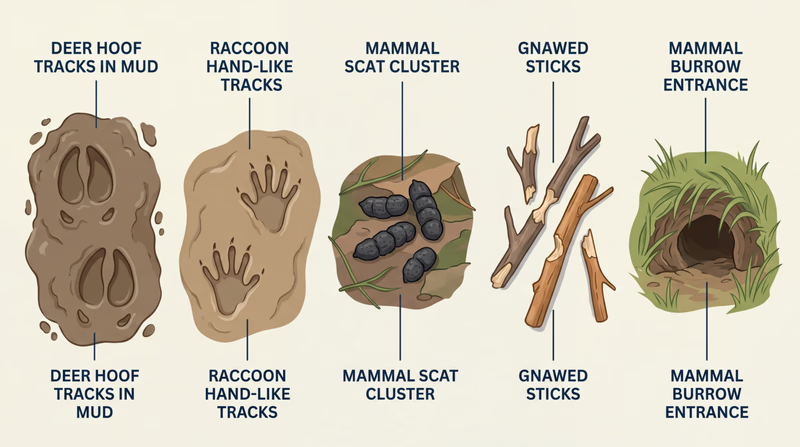
- Signs found: tracks, scat, burrows, browse, chew marks, fur, beds, trails
- Estimated count of each species or sign set
- Human disturbance such as roads, dogs, noise, or buildings
Sight or Sign Still Counts as Evidence
Many mammals are active when you are not. That means sign is just as important as direct observation. A deer may be gone, but fresh tracks, clipped browse, and droppings tell you it used that area. A beaver may be hidden, but cut sticks and a lodge are strong evidence. A small mammal may never show itself, but a burrow entrance, seed husks, and a runway through grass reveal its presence.
Why Mammals Do Not All Live in the Same Habitat
This part is the real science question in the requirement. Mammals differ because they need different combinations of:
- food
- shelter and nesting sites
- water
- cover from predators or weather
- room to move
- temperature conditions they can tolerate
A meadow vole thrives where there is thick grass cover. A flying squirrel needs wooded habitat with trees for shelter and movement. A muskrat is strongly tied to wetlands. A pronghorn needs open country. Habitat is not random. It matches a species’ body design, behavior, diet, and survival strategy.
A Simple Way to Organize Your Report
For each habitat, make a table or neat list.
| Habitat | Mammal or sign | Count | Evidence |
|---|---|---|---|
| Creek edge | Raccoon | 2 track sets | Tracks in mud near water |
| Creek edge | Beaver | 1 active area | Cut saplings and lodge |
| Dry ridge | White-tailed deer | 4 | Direct sighting at dusk |
| Dry ridge | Eastern gray squirrel | 6 | Sightings and feeding sign |
Then finish with a comparison paragraph:
- Which mammals appeared in both places?
- Which showed up only in one place?
- What habitat features explain those differences?
Official Resources
Use these resources to sharpen your track and sign skills before you head out.
🎬 Video: How to Find Mammal Signs (video) — https://www.youtube.com/watch?v=x8DfP0Nh7kA
After comparing two habitats, you may decide you prefer repeated visits to one place. The next option shows how to do that well.
Req 3b — Five-Day Observation Log
A single visit gives you a snapshot. Five visits give you a pattern. This option is about learning one place well enough that you start noticing changes in timing, behavior, weather effects, and signs that a quick walk would miss.
Why Repeat Visits Matter
Mammals do not use a landscape the same way every day. Rain can erase tracks. A cold snap can change activity. Human traffic on a Saturday may push animals into cover. Dawn, midday, and dusk can feel like three different worlds in the same four-acre space.
That is why this option is so valuable. By returning again and again, you build a stronger record than a one-time outing can give you.
What Counts as a Good Study Area
Your area should be at least four acres and should have enough variety to hold mammal activity. Good sites include:
- a section of local park with woods and edge habitat
- a scout camp field-and-forest boundary
- a creek corridor behind a school or neighborhood trail
- a wetland edge with brush and nearby cover
Try to use the same boundaries each time so your observations are comparable.
Build a Repeatable Observation Routine
Use the same route and note-taking structure each visit. That makes your data more reliable.
Observation Routine
Follow the same system each time- Walk the same loop or transect if possible.
- Start at roughly the same time on some visits, but vary time of day on others.
- Pause at the same spots to scan, listen, and look for sign.
- Record fresh and old sign separately when you can.
- Note weather, wind, ground condition, and human activity.
Sight and Sign Ideas
Since the requirement allows sight or sign, your list can include mammals identified through evidence such as:
- tracks in mud, sand, or snow
- scat shape and placement
- burrow entrances and runways
- gnawed nuts, cones, bark, or saplings
- beds, tunnels, slides, or trails
- fur caught on fences or brush
In Req 3a, you compared habitats. Here, you are comparing time.
A Good Field Log Format
| Visit | Conditions | Mammals or sign found | Notes |
|---|---|---|---|
| Day 1 | Cool, calm, damp ground | Deer tracks, squirrel sightings | Fresh hoofprints near stream |
| Day 2 | Warm, windy | Rabbit pellets, chipmunk | Less activity in open area |
| Day 3 | Light drizzle | Raccoon tracks, mole mound | Mud made tracks easier to read |
At the end of all five visits, make one final species list from your notes.
Patterns to Watch For
Look for questions like these:
- Were some mammals active only near dawn or dusk?
- Did certain signs appear after rain or in soft soil?
- Did edge habitat hold more activity than open ground?
- Did you notice the same species repeatedly in the same places?
Those patterns make your report stronger and show your counselor that you observed carefully instead of just filling time outdoors.
If you would rather build your evidence from books and research than repeated field visits, the next option shows how to write a strong life history.
Req 3c — Nongame Mammal Life History
This option is less about spotting one animal in the wild and more about telling that animal’s story accurately. A strong life history explains how a species survives, what it needs, how it reproduces, and how people have changed its world.
Start With a Good Species Choice
Pick a nongame mammal that actually lives in your area and that has enough reliable information available. Good choices are often species such as bats, squirrels, opossums, muskrats, beavers, or shrews, depending on your region.
Avoid picking a species that is so rare in your area that reliable local information is hard to find.
The Sections Your Report Should Cover
1. What the mammal was like before major human impact
This part asks you to think historically. What did the species’ habitat look like before cities, highways, farms, dams, logging, drainage, or other big human changes? Did the species once have more range, different food sources, or more connected habitat?
2. Reproduction
Explain how the species mates, when breeding happens, how many young are typical, how long the young depend on the parent, and how fast the species matures.
3. Food and feeding behavior
Tell what it eats and how it gets food. Is it an herbivore, omnivore, insectivore, or carnivore? Does it forage alone, cache food, graze, hunt, or scavenge?
4. Natural habitat
Describe where it lives and why. Be specific. “Forest” is broad. “Mature hardwood forest with den trees and access to water” is better.
5. Dependency relationships
Explain how the mammal depends on plants, prey, predators, decomposers, shelter sites, and even people. Then reverse the question: how do plants, other animals, or humans depend on it?
6. Human benefit and mutual impact
Has the species helped humans through pest control, seed dispersal, fur, tourism, research, or ecosystem engineering? Has the species benefited from humans through barns, crops, bird feeders, suburbs, or artificial water sources? Or has association with humans mainly hurt it?
A Strong Report Structure
Use headings so your counselor can follow your thinking.
- Introduction to the species
- Historical habitat before major human change
- Reproduction
- Diet
- Natural habitat
- Ecological relationships
- Human benefits and human impacts
- Conclusion
Make the Report Specific to Your Area
This is where many Scouts can improve. Do not write a generic report that could apply anywhere in North America. Add local context:
- which habitats in your region the species uses
- whether it is common or rarely seen locally
- which seasons matter most
- what local human development has changed
Life History Quality Check
Use this before you turn it in- Did you choose a nongame mammal from your area?
- Did you describe life before major human habitat changes?
- Did you explain reproduction, food, and habitat clearly?
- Did you include two-way dependency relationships?
- Did you explain whether humans and the mammal benefit each other, harm each other, or both?
- Did you use more than one reliable source?
If you enjoy this style of work, keep it in mind. Req 4c asks for a similar life history, but this time for a native game mammal.
The next major requirement gives you seven new investigation options, from museum work to photography to food chains.
Req 4 — Choose Your Investigation
This requirement is a choose-your-own investigation. You will pick exactly one option, and the choices range from hands-on museum specimen work to field photography to book analysis. Each one teaches a different way scientists and naturalists learn about mammals.
Your Options
- Req 4a — Museum Study Skins: Work under expert guidance to prepare two study skins of rats or mice and explain how study skins differ from mounted specimens. This option teaches specimen-based science.
- Req 4b — Wildlife Photography Log: Photograph two wild mammals and record the field conditions that may have influenced their behavior. This option builds observation, patience, and photo-documentation skills.
- Req 4c — Game Mammal Life History: Research and write a life history of a native game mammal, then list your sources. This option is strong for Scouts who like reading and structured writing.
- Req 4d — Tracking Pit Investigation: Build and bait a tracking pit, then report what animals visit. This option is excellent for Scouts who enjoy field experiments.
- Req 4e — Natural History Museum Visit: Visit a museum, learn how specimens are prepared and cataloged, and explain why museums matter. This option connects science, history, and collections work.
- Req 4f — Mammal Book Report: Read a book about a mammal species and write a 500-word report. This option works well for Scouts who like thoughtful reading and summary.
- Req 4g — Food Chains to a Carnivore: Trace two food chains from the soil through four stages to a carnivorous mammal. This option teaches ecosystems and energy flow.
How to Choose
Choosing Your Investigation
Compare effort, access, and what you will learn- Need expert supervision? Option 4a requires guidance from a nature center or natural history museum.
- Want outdoor action? Options 4b and 4d put you in the field.
- Prefer research and writing? Options 4c and 4f are strongest fits.
- Have a museum nearby? Option 4e can be a great choice if you can visit a real collection.
- Want ecosystem thinking? Option 4g is best if you like seeing how soil, plants, prey, and predators connect.
- What you gain: 4a teaches specimen methods, 4b teaches careful wildlife documentation, 4c and 4f strengthen research writing, 4d teaches field experimentation, 4e teaches museum science, and 4g teaches ecological reasoning.
One important decision factor
Choose the option you can finish with strong evidence, not the one that sounds most dramatic. A well-documented museum visit or book report is better than a rushed wildlife photography attempt with poor notes.
Start with the first option page. Even if you choose a different path, it helps to understand how specimens contribute to mammal science.
Req 4a — Museum Study Skins
This is one of the most specialized options in the badge. It should only be done with trained guidance, but it gives you a real look at how museum mammalogy works. Study skins are not decorations. They are research tools.
What a Study Skin Is
A study skin is a carefully prepared specimen that preserves the outside of an animal for scientific study. It is usually arranged in a compact, standardized position so it can be stored efficiently in museum drawers and compared to many others.
A study skin is different from a taxidermy mount. It is made for measurement, identification, and record keeping, not for lifelike display.
Why Scientists Use Study Skins
Study skins help scientists:
- compare size, color, fur, and body proportions
- confirm species identification
- study geographic variation
- preserve a record of where and when an animal lived
- connect specimens to skulls, tissues, parasites, or genetic samples
If a specimen was labeled well, it can still answer new scientific questions decades later.
How Mounted Specimens Are Different
Mounted specimens are designed to look lifelike for display and education. You might see them in dioramas, classrooms, or museum exhibits. Their main purpose is interpretation for the public.
A quick comparison looks like this:
| Type | Main purpose |
|---|---|
| Study skin | Scientific comparison, measurement, storage, research |
| Mounted specimen | Display, teaching, public interpretation |
What Your Counselor Wants to Hear
You do not need to become a museum preparator in one afternoon. Your goal is to understand why the process is done carefully and why guidance matters. Pay attention to:
- labeling
- measurements
- specimen handling
- how preparation protects useful features
- how records stay attached to the specimen
Official Resources
These official videos help you see the process and the scientific purpose behind it.
🎬 Video: Skinning Your Rat (video) — https://youtu.be/m93WO9praZE?si=DG3Wt7aD9EBE-Zma
🎬 Video: Preparing Mammal Specimens (video) — https://www.youtube.com/watch?v=dBk9jwQBiuA
If you want a field-based option instead, the next page focuses on photographing mammals in the wild and recording the conditions behind the image.
Req 4b — Wildlife Photography Log
A good wildlife photograph is more than proof that you saw something. For this requirement, the picture is only half the job. The other half is documenting the conditions that may explain what the mammal was doing.
What Counts as a Strong Observation Record
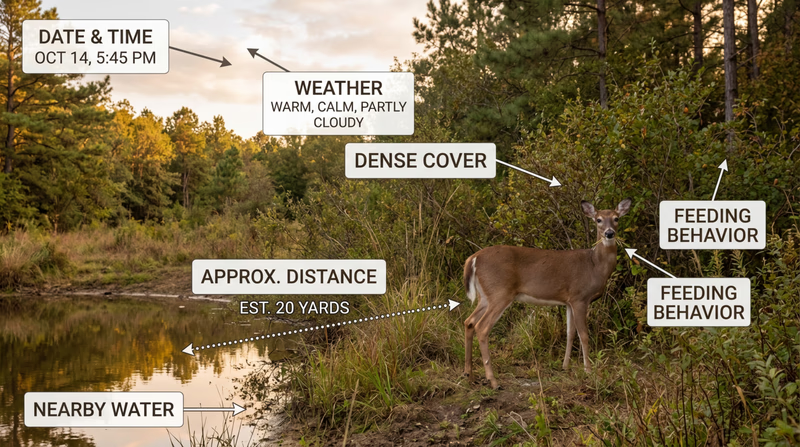
For each of the two mammals, record:
- date
- time of day
- weather
- approximate distance from the animal
- habitat conditions
- other factors that may have influenced behavior
That last part is where your thinking shows. Was the animal feeding at the edge of cover? Was it active because the evening cooled down? Did it freeze when hikers passed? Did wind, shade, or water access matter?
Focus on Behavior, Not Just Beauty
The goal is not professional-level photography. The goal is useful field evidence. A slightly imperfect photo with excellent notes can satisfy the requirement better than a beautiful image with no context.
Field Notes for Each Photo
Write these down as soon as possible- Species or best identification
- Exact or approximate location
- Date and time
- Weather and light conditions
- Distance from the animal
- What the animal was doing
- What in the habitat may explain that behavior
Ways Habitat Conditions Influence Behavior
Watch for clues like these:
- dense cover may make small mammals feel safe enough to feed
- water nearby may draw deer, raccoons, or muskrats
- open ground may keep prey species moving quickly
- cold weather can increase daytime basking or feeding activity
- human presence can make mammals freeze, flee, or become more secretive
Official Resources
These official resources focus on practical wildlife photography habits.
🎬 Video: Top 10 Wildlife Photography Shortcuts (video) — https://www.youtube.com/watch?v=r5liiAoUJ1Q
🎬 Video: The Most Important Wildlife Photography (video) — https://www.youtube.com/watch?v=wzuxDkmsZgM
If you would rather analyze one species in depth with research and writing, the next option focuses on a native game mammal life history.
Req 4c — Game Mammal Life History
This option builds directly on Req 3c, but now your subject is a native game mammal. That adds a management angle because game species are often studied carefully for population health, habitat use, seasons, and sustainable harvest rules.
Choose a Native Game Mammal Wisely
Pick a species that is both native to your area and recognized locally as a game mammal. Depending on where you live, examples might include white-tailed deer, cottontail rabbit, elk, black bear, squirrel, or pronghorn.
Before you start writing, confirm three things:
- it is native to your region
- it is considered a game mammal there
- you can find reliable local or state sources
Cover the Same Core Topics as Req 3c
Your report should still explain:
- historical habitat before major human changes
- reproduction
- food
- natural habitat
- dependency on plants, animals, and humans
- how humans benefit from it and whether it benefits from human association
But for a game mammal, it is smart to also notice:
- habitat management
- carrying capacity
- hunting regulations and seasons
- how agencies monitor populations
Do Not Confuse “Game Mammal” With “Common Mammal”
A game mammal is not just any mammal people know about. It is a species managed under hunting laws or wildlife regulations. That means state wildlife agency pages are often excellent sources because they combine biology with management information.
Strong Source Mix
Use more than one type of source- State wildlife agency species profile
- Field guide or mammal handbook
- Nature center or university extension page
- Conservation organization with species facts
- Book or article with clear publication information
Listing Sources Matters
Unlike Req 3c, this requirement explicitly tells you to list your sources. Do it clearly. A simple works-cited or source list is enough if it includes enough detail for your counselor to see where the information came from.
Good source details include:
- title
- organization or author
- website or publisher
- date accessed for websites
A different kind of field investigation comes next: building a tracking pit and letting mammals come to you.
Req 4d — Tracking Pit Investigation
A tracking pit is a simple field experiment. Instead of trying to chase wildlife, you prepare a surface that can record visits while you are away. When it works, you get a snapshot of what passed through and sometimes even how it moved.
What a Tracking Pit Does
A tracking pit creates a soft, readable surface such as smooth sand, sifted soil, or fine dust. Bait or scent attracts interest, and the surface records footprints. You are not trapping the animal. You are collecting evidence.
Picking a Good Site
The best sites are places animals already travel:
- edge of brush and open ground
- near a log, fence line, or game trail
- close to water or cover
- quiet backyard corners with little disturbance
Choose a legal, safe location where you can check the pit without damaging habitat.
What to Report
Your report should include:
- where you placed the pit
- what bait you used
- weather or surface conditions
- what tracks or other evidence appeared
- which animals likely visited
- how confident you are in each identification
Official Resources
These official videos show several ways to set up a track station and interpret what you see.
🎬 Video: Build Animal Track Station (video) — https://www.youtube.com/watch?v=rjg7FUw_5fM
🎬 Video: Creating a Backyard Animal Track Trap With Household Items (video) — https://www.youtube.com/watch?v=j_SPxHCvSYA
🎬 Video: Animal Tracking Basics - Track Traps, Measurements, Following Sign (video) — https://www.youtube.com/watch?v=i2SFVKWhIzY
Tracking Pit Notes
Record these so your report is useful- Date pit was made
- Exact location and habitat
- Surface material used
- Type of bait or scent used
- Dates and times checked
- Track sketches or photos
- Best identification for each visitor
The next option shifts from field evidence to collections work and asks what museums do with the specimens they hold.
Req 4e — Natural History Museum Visit
A natural history museum is more than a building full of displays. The exhibit hall is only the public face. Behind the scenes, many museums hold large research collections that scientists use to identify species, compare changes over time, and preserve records from places that may look very different today.
What to Look For During Your Visit
Pay attention to two big questions:
- How are specimens prepared and cataloged?
- Why does the museum keep them?
Preparation may include cleaning, preserving, labeling, measuring, photographing, and storing. Cataloging means assigning each specimen a permanent record so its information does not get lost.
What Good Cataloging Includes
A specimen is much more valuable when it comes with data such as:
- species identification
- date collected
- location collected
- collector name
- habitat notes
- measurements or condition notes
Without those details, a specimen loses much of its scientific value.
Why Museums Matter
Museums serve several purposes at once:
- Research — scientists compare specimens across time and geography
- Education — visitors learn about biodiversity, evolution, and conservation
- Preservation — physical records survive long after habitats change
- Reference — experts use collections to confirm identities and study variation
Official Resource
Use this official museum-focused video as one more reference point while you compare it to what you observed during your visit.
🎬 Video: What Is the Purpose of a Natural History Museum? (video) — https://youtu.be/sCm6JFBdWfM?si=abiHDMFT2hvlOGJS
If you prefer learning from reading instead of visiting a museum, the next option is a focused 500-word report on a book about a mammal species.
Req 4f — Mammal Book Report
This option sounds simple, but a strong book report does more than summarize chapters. It shows that you understood the species, noticed key facts, and can explain what the book taught you about the mammal’s life and environment.
Pick the Right Book
Choose a book that is truly about a mammal species, not just a general animal collection with only a page or two on your animal. You want enough detail to discuss behavior, habitat, diet, adaptation, and challenges.
Good choices often include:
- juvenile nonfiction species books
- field natural history books
- biographies of a species or population
- conservation-focused books centered on one mammal
What to Include in 500 Words
A useful report often includes:
- the book title and author
- which mammal species the book focuses on
- the main facts you learned about the species
- the habitat and survival challenges it faces
- what you found interesting, surprising, or important
Move Beyond Plot Summary
If the book tells a story, do not spend all 500 words retelling events. Keep the focus on what the book taught you about the mammal itself.
Book Report Structure
A simple outline that works well- Introduction: Name the book and species.
- Body paragraph 1: Habitat, diet, and adaptations.
- Body paragraph 2: Behavior, reproduction, or survival challenges.
- Body paragraph 3: What you learned and why it matters.
- Conclusion: Your overall judgment of the book.
Questions That Improve Your Report
Ask yourself:
- Did the book help me understand the species better?
- What was the most memorable fact?
- Did the author explain the mammal’s relationship with people or habitat change?
- Would I recommend this book to another Scout working on Mammal Study?
The next option returns to ecology and asks you to trace how energy moves through a food chain to reach a carnivorous mammal.
Req 4g — Food Chains to a Carnivore
A carnivorous mammal does not begin with meat alone. Its food chain starts much lower, with soil, nutrients, plants, and the animals those plants support. This requirement asks you to trace energy step by step until it reaches a mammal predator.
What “From the Soil” Means
Soil matters because it supports the plants at the base of the chain. Those plants feed herbivores or omnivores. Then a carnivorous mammal feeds on one of those animals. You are tracing energy upward through the ecosystem.
A Simple Example
One possible chain could look like this:
- Soil nutrients support grasses
- Grass feeds a vole
- Vole is eaten by a snake
- Snake is eaten by a fox
That reaches a carnivorous mammal in four stages after the soil.
Another might be:
- Soil nutrients support berry-producing shrubs
- Shrubs feed a rabbit
- Rabbit is eaten by a weasel
- Weasel is the carnivorous mammal
Your exact chains will depend on species and habitats in your area.
Make Sure the Chain Is Realistic
The best chains fit together naturally in one habitat. Do not force species from different ecosystems into the same chain just to fill the slots.
Food Chain Quality Check
Use this before you present your chains- Did your chain begin with soil-supported producers?
- Does each stage reasonably eat or depend on the stage before it?
- Is the final animal a carnivorous mammal?
- Could all these organisms occur in the same general habitat?
- Can you explain the chain out loud without stumbling over it?
Official Resources
These official resources help explain food-chain structure and give examples you can adapt to your own local ecosystem.
🎬 Video: Animal of the Week: Food Chains (video) — https://www.youtube.com/watch?v=FpVXlk_Z-4E
🎬 Video: Food Chains & Food Webs (video) — https://www.youtube.com/watch?v=JCl_yDf0Qok
The next requirement asks you to move from studying mammals to doing something that can actually influence their numbers.
Req 5 — Project for Mammal Numbers
This requirement is where Mammal Study becomes action. You are not just learning about mammals anymore. You are doing something that can help or influence how many mammals use an area.
What Kind of Project Works?
A strong project changes food, water, shelter, travel safety, or disturbance. Examples might include:
- building a brush pile for cover
- improving native plant habitat
- removing invasive plants that reduce food or shelter
- helping protect a travel corridor
- restoring a streamside area
- improving nesting or denning cover where appropriate
The exact project should fit local needs and your counselor’s guidance.
Think in Terms of Habitat Needs
Mammal numbers are influenced by the same basic survival needs you have been studying all along:
- food
- water
- cover
- space
- safe travel routes
A project does not have to guarantee more mammals immediately. It has to reasonably influence the conditions that affect their numbers.
Official Resources
These official resources show projects that improve habitat conditions for wildlife.
🎬 Video: Brushpiles With Game Commission Biologist Dan Mummert (video) — https://www.youtube.com/watch?v=pXTGUBPYwPo
🎬 Video: Create a Wildlife Habitat Garden (video) — https://www.youtube.com/watch?v=IOYDnuz0hA8
🎬 Video: How to Make a WILDLIFE GARDEN! The FOUR Things You MUST INCLUDE! (video) — https://www.youtube.com/watch?v=Vl0W8navRIg
Project Planning Questions
Answer these with your counselor before you begin- Which mammal or group of mammals could this project help?
- Which habitat need does the project improve?
- Is the location legal and appropriate for the work?
- How will you know the project was completed well?
- What evidence will you bring back to your counselor?
Once you start influencing habitat, ethics matter even more. The next requirement focuses on Leave No Trace and the Outdoor Code in real mammal-study situations.
Req 6 — Outdoor Ethics in Mammal Study
Mammal Study depends on good outdoor ethics. If your search for mammals damages habitat, stresses animals, or leaves a mess behind, you are working against the very thing you are trying to understand. This requirement asks you to connect ethical outdoor behavior to real field situations.
Why Leave No Trace Matters in Mammal Study
The Leave No Trace Seven Principles matter because mammals are often secretive, sensitive to disturbance, and tied closely to cover, trails, dens, and water sources. Even small actions can change their behavior.
Examples include:
- trampling vegetation around burrows or den sites
- leaving food or scent that changes animal movement
- getting too close for a photo or better view
- moving logs, rocks, or cover objects and not replacing them
- entering habitat illegally or off-trail where damage builds up
The Outdoor Code Matters Too
The Outdoor Code calls Scouts to be clean, careful, considerate, and conservation-minded. In Mammal Study, that means:
- leaving study areas better than you found them
- observing without harassing wildlife
- sharing space with other visitors respectfully
- thinking long-term about habitat health
Applying the Seven Principles
You do not need to recite them like a list only. You should explain how they change your behavior in the field.
Outdoor Ethics in Mammal Study
Real examples you can discuss with your counselor- Plan ahead and prepare: Bring notebook, water, map, and proper clothing so you do not make rushed decisions in the field.
- Travel and camp on durable surfaces: Avoid crushing fragile habitat while tracking or observing.
- Dispose of waste properly: Pack out trash and do not leave food scraps that attract wildlife.
- Leave what you find: Do not disturb dens, nests, bones, or natural cover without a clear reason and permission.
- Minimize campfire impacts: Keep fires from damaging habitat or attracting wildlife to human food smells.
- Respect wildlife: Observe from a distance and avoid stressing animals.
- Be considerate of others: Keep noise low and share trails respectfully.
Official Resources
Leave No Trace Basics (video) A video overview of Leave No Trace principles that can help you connect outdoor ethics to your own field behavior. Link: Leave No Trace Basics (video) — https://vimeo.com/1115216743/63b20c0b33?share=copy🎬 Video: Leave No Trace Outdoor Ethics (video) — https://youtu.be/jXO1uY0MvmQ
The last major requirement asks you to connect Mammal Study to your future, either as a career path or as a hobby and healthy lifestyle.
Req 7 — Choose Your Future Path
This final requirement asks you to look ahead. You will choose exactly one path: explore a career connected to Mammal Study or explore a hobby or healthy lifestyle that uses the same skills.
Your Options
- Req 7a — Mammal-Related Careers: Research one career, including training, education, costs, job duties, salary, job prospects, and advancement. This option helps you see how mammal knowledge becomes real work.
- Req 7b — Hobbies and Healthy Living: Research a hobby or healthy lifestyle that uses mammal-study skills, along with training, costs, organizations, and personal goals. This option helps you imagine how the badge can shape your life outside of school or work.
How to Choose
Career or Hobby?
Pick the path that gives you the most honest conversation with your counselor- Choose 7a if you want to learn how professionals use mammal knowledge on the job.
- Choose 7b if you would rather build a hobby, volunteer role, or outdoor lifestyle around these skills.
- Best gain from 7a: You learn how education, pay, and job duties fit together in the real world.
- Best gain from 7b: You learn how to turn this badge into a lasting personal interest or healthy habit.
Start with the career option page first. Even if you choose the hobby path, it helps to see what professional mammal work can look like.
Req 7a — Mammal-Related Careers
This option helps you connect a badge to the real world of jobs. Mammal knowledge can be part of careers in biology, wildlife management, rehabilitation, research, conservation law, education, photography, veterinary work, and museum collections.
One Good Career Is Better Than a Long List
The requirement asks you to research one career in depth. That means you should be able to explain:
- education and training needed
- what it costs to prepare
- job prospects
- salary
- daily job duties
- career advancement
Examples you might explore include wildlife biologist, park ranger, zoo educator, mammalogist, natural resources technician, wildlife rehabilitator, museum collections manager, or conservation officer.
Questions to Answer in Your Research
Training and education
Does the job require a high school diploma, technical certificate, two-year degree, four-year degree, graduate school, or special licensing?
Costs
What might someone spend on tuition, field gear, certifications, or travel? You do not need perfect math, but you should show that training has real costs.
Job prospects and salary
What is the demand for this work? Is it competitive? Seasonal? Government-based? Nonprofit? Private-sector? What is the pay range?
Job duties
What does a normal day look like? Does the person spend time outdoors, in labs, in offices, teaching the public, or writing reports?
Advancement
What could someone grow into after experience? Supervisor? Specialist? Research lead? Agency manager?
Official Resource
🎬 Video: 10+ Wildlife Biology Careers You Should Know About (& Salaries) (video) — https://youtu.be/AK2Onqx-ctM?si=LwrbzHPsoZ0MrkDp
Best Research Methods
Use at least one strong method and combine more if you can- Library or internet research from reliable sources
- Interview with a professional
- Visit to a workplace or organization
- Career profiles from government or university sources
If a full career path feels too far away right now, the next option shows how Mammal Study can still shape a hobby or healthy lifestyle today.
Req 7b — Hobbies and Healthy Living
Not every badge has to become a career. Sometimes the best outcome is a hobby that gets you outdoors, keeps you active, and gives you a lifelong reason to pay attention to the natural world. Mammal Study can lead naturally into wildlife photography, tracking, nature journaling, trail walking, habitat volunteering, citizen science, and wildlife rehabilitation support.
Good Hobby or Lifestyle Ideas
A few strong directions include:
- wildlife photography
- animal tracking and sign interpretation
- volunteer habitat restoration
- nature center volunteering
- trail hiking with field observation
- camera-trap monitoring programs
- wildlife rehabilitation support roles, where allowed
What the Requirement Wants You to Research
Even for a hobby, you should still think practically:
- What training or skills do I need?
- What will it cost to start?
- Which organizations support it?
- What are my short-term and long-term goals?
That turns the idea from “this seems cool” into a real plan.
Official Resources
🎬 Video: Top Tips to get into Wildlife Photography (video) — https://www.youtube.com/watch?v=C4HjfzY3z90
🎬 Video: A Look Inside the Life of a Wildlife Rehab Volunteer (video) — https://youtu.be/kgtt21yKZOw?si=f5yRyDVQYFQXD4YB
Goal Setting for This Requirement
Think short-term first, then long-term- Short-term goal: What can you try in the next month?
- Training: What skill or class would help you start well?
- Cost: What basic gear or fees are involved?
- Support: Which organization, club, park, or center could help?
- Long-term goal: Where could this interest lead in a year or two?
You have reached the end of the core requirements. The next page goes beyond the badge and suggests ways to keep exploring mammals after the counselor signs off.
Extended Learning
A. Congratulations
You have finished a badge that asks you to think like a naturalist, an ecologist, and a careful observer. Mammal Study is not just about learning names. It is about noticing patterns, asking why an animal lives where it does, and understanding how people affect the lives of wild mammals.
If this badge grabbed your attention, you are in good company. Many wildlife biologists, park naturalists, photographers, and conservation volunteers started by tracking animals, keeping notebooks, and getting curious about the clues left behind in mud, snow, grass, or bark.
B. Deep Dive: How Mammals Are Built for Different Lives
Mammals solve survival problems in many different ways. A mole is built to push through soil with shovel-like forelimbs. A bat uses wings and echolocation to hunt in darkness. A beaver reshapes streams with teeth and instinct. A pronghorn survives with speed and endurance in open country. Looking closely at body shape helps you predict how an animal moves, feeds, shelters itself, and avoids danger.
That is one reason mammal study is so interesting. You can often guess something important about an animal just by studying its teeth, feet, ears, tail, and body proportions. Sharp forward-facing teeth suggest meat eating. Broad grinding teeth point toward plants. Large ears may help with heat loss or hearing predators. Wide feet can help with snow or soft ground. Even a tail can tell you something about balance, signaling, swimming, or warmth.
When you keep learning after the badge, try comparing mammals that fill similar jobs in different habitats. A desert rodent and a forest rodent may both gather seeds, but they will solve shelter and water problems in very different ways. That kind of comparison turns basic identification into deeper biological thinking.
C. Deep Dive: Mammals and Changing Landscapes
One of the biggest modern questions in mammal study is how species respond to changing habitat. Roads divide travel routes. Cities create heat, noise, pets, traffic, and artificial light. Farms may remove cover in one place but create food in another. Climate change can shift water availability, snow cover, fire patterns, and plant communities.
Some mammals adapt surprisingly well. Raccoons, coyotes, and some bats often use human-shaped landscapes successfully. Others struggle when forests become fragmented, wetlands are drained, or migration corridors are cut off. That means the same human activity can help one species and harm another.
If you want to think like a conservation scientist, ask not only “Is this mammal present?” but also “What pressures shape its future here?” That question leads naturally to habitat restoration, wildlife crossings, native planting, and smarter land use. The more you understand those pressures, the more useful your observations become.
D. Deep Dive: Reading Sign Like a Story
Mammal sign is easy to underestimate. A beginner may see random prints and droppings. An experienced observer sees timing, movement, and behavior. Tracks can show whether an animal was walking, trotting, bounding, or pausing. Scat placement may mark territory or travel routes. Gnawed bark, clipped stems, beds, slides, and trails all reveal pieces of a larger pattern.
Snow, mud, dust, leaf litter, and sand all preserve sign differently. Learning to read those surfaces is like learning a new language. It takes repetition. The first dozen times may feel uncertain. Then you begin noticing details automatically: claw spacing, stride length, repeated pathways, feeding sign near cover, or the difference between old and fresh evidence.
This is one of the easiest ways to keep growing after the badge. You do not need rare animals or expensive gear. You need time outdoors, patience, and the habit of asking, “What happened here?”
E. Real-World Experiences
Visit a wildlife rehabilitation center
If your area has a licensed wildlife rehabilitation center, see whether it offers public tours, talks, or volunteer pathways for older teens and adults. You will learn how injured and orphaned mammals are handled responsibly.
Explore a natural history museum collection
A public exhibit is great, but if a museum offers behind-the-scenes collection tours, take that opportunity. Seeing drawers, tags, and catalog systems makes museum science feel real.
Join a guided tracking walk
Many parks, nature centers, and outdoor schools offer winter tracking or sign-identification walks. Going with an expert can speed up your learning dramatically.
Try a citizen-science project
Some regions have roadkill surveys, camera-trap projects, bat counts, or urban wildlife observations. These projects let ordinary people contribute useful data.
Revisit one site through the year
Pick one local place and observe it in spring, summer, fall, and winter. Seasonal change teaches more than a single visit ever can.
F. Organizations
American Society of Mammalogists
A professional scientific society focused on mammal research, conservation, and education. It is a strong place to see how mammalogists organize and share knowledge.
National Wildlife Federation
Offers wildlife education, habitat resources, and conservation information that can help you think about mammals in managed and backyard landscapes.
Leave No Trace
Provides outdoor ethics guidance that fits perfectly with careful mammal observation and habitat respect.
Your State Wildlife Agency
One of the best sources for local mammal information, regulations, conservation plans, and species profiles. This is often the most useful practical organization for a Scout.
Local Nature Centers and Museums
These are often the easiest places to find classes, tracking walks, volunteer opportunities, and experts who know the mammals in your exact area.