 Getting Started
Introduction & Overview
Overview
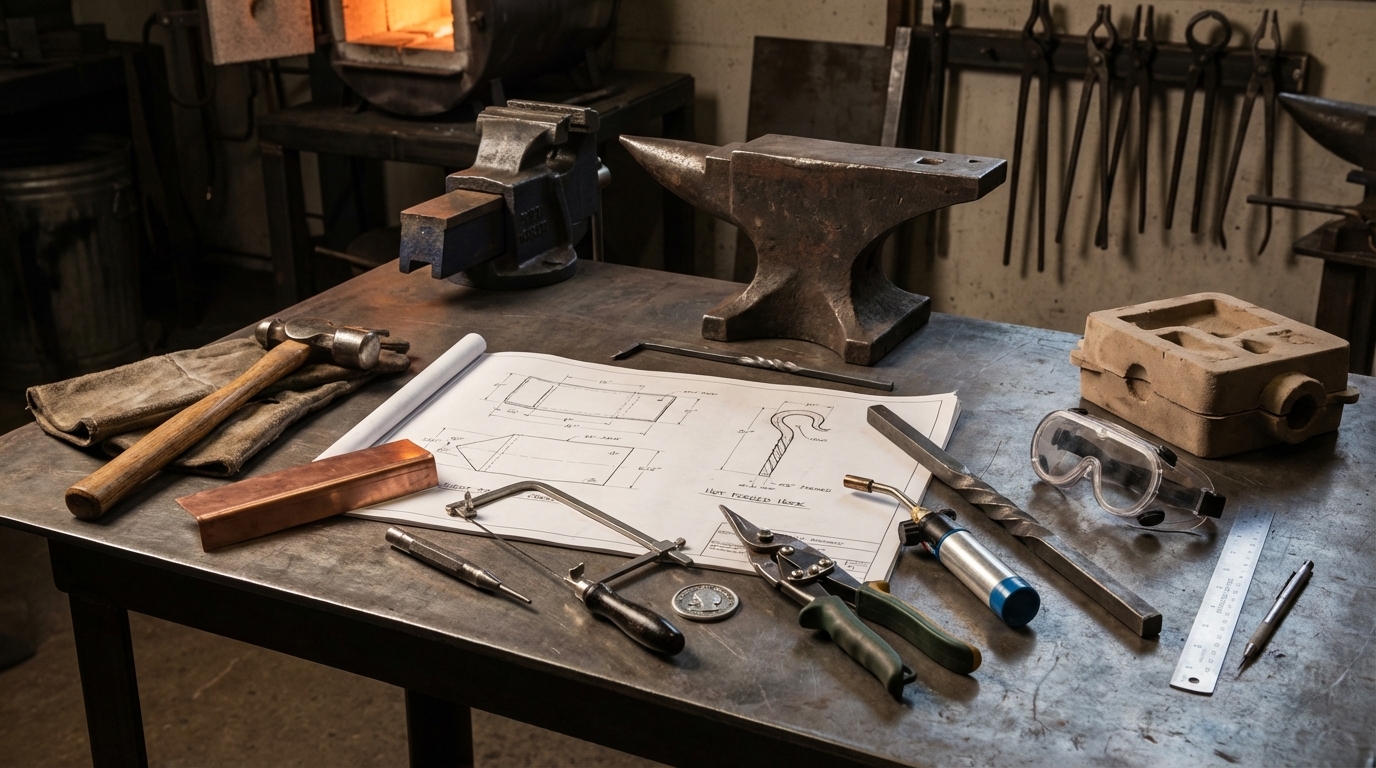
Metalwork is the art of turning hard, stubborn material into something useful, strong, or beautiful. A flat sheet can become a box, a soft alloy can become a casting, and a glowing bar can become a hook, hinge, or tool. This badge teaches you how metal behaves, how to work with it safely, and how different craftspeople shape it for real-world jobs and hobbies.
You will study the language of metals, practice changing hardness with heat and hammering, and then choose one specialty path to explore in depth. Along the way, you will start thinking like a maker: planning before cutting, paying attention to safety, and learning that small changes in heat, angle, and pressure make a big difference.
Then and Now
Then
Long before factories, people were already discovering that some metals could be shaped with stone hammers, charcoal fires, and patience. Early metalworkers began with native metals such as copper and gold because they could be found in nature and worked without giant furnaces. Over time, people learned how to combine metals into stronger alloys, cast shapes in molds, and forge tools that changed farming, building, trade, and warfare.
Bronze Age craftspeople made knives, jewelry, bowls, and fittings that were both practical and decorative. Blacksmiths later became essential members of nearly every town, repairing tools, shoeing horses, making nails, and building hardware for wagons and doors. For centuries, if something metal broke, a skilled craftsperson fixed it by hand.
Now
Modern metalwork still uses the same basic ideas: cut, bend, heat, join, cast, and finish. What has changed is the range of tools and materials. Sheet metal shops build ductwork, flashing, and custom enclosures. Jewelers and silversmiths create precise small objects with saws and solder. Foundries cast everything from art pieces to machine parts. Blacksmiths still forge useful hardware, but they also create architectural details, sculpture, and custom tools.
Even highly automated industries still depend on people who understand how metal moves, when it cracks, how heat changes structure, and how to finish a project so it lasts. That mix of science and hands-on skill is what makes metalwork so satisfying.
Get Ready!
This is a badge for Scouts who like making real things. You will measure carefully, sketch before you build, and pay close attention to heat, edges, and surfaces. Go slowly, ask questions often, and treat every tool as if it can hurt you if you get careless—because it can.
Kinds of Metalwork
Sheet Metal and Tinsmithing
This branch of metalwork starts with flat sheet stock. You cut patterns, bend edges, form seams, and join pieces into objects such as boxes, trays, scoops, and covers. Accuracy matters because even a small measuring error can throw off an entire project.
Silversmithing and Small Precision Work
Silversmithing focuses on thin metal, fine tools, careful layout, and clean joints. The work is smaller than blacksmithing, but not easier. A crooked saw cut or overheated solder joint shows up immediately, so patience and control matter.
Founding and Casting
Founders shape metal by pouring it into molds. This path teaches you to think in reverse: instead of hammering metal into shape, you create the empty space the metal will fill. Gates, vents, shrinkage, and mold quality all affect the final casting.
Blacksmithing
Blacksmithing uses heat and force to move metal while it is hot. At the forge, you learn how hammer blows stretch, bend, and twist steel. It is physical work, but it also rewards rhythm, timing, and careful observation of color and temperature.
Next Steps
Your first requirement is about the habit that makes every other metalworking skill possible: safe behavior. Before you cut, heat, file, or forge anything, you need to know how to protect your eyes, hands, lungs, and workspace.