Req 5d3 — Hot-Forging Exercises
These exercises are the forge equivalent of scales in music. They teach the basic moves that show up later in your finished projects. Do not treat them as throwaway practice. Each one teaches control over where the metal moves.
Requirement 5d3a
Drawing out means making the metal longer and narrower by concentrating blows where you want the material to spread. A taper teaches you how repeated hammering can move thickness into length.
Requirement 5d3b
The horn supports curved shaping. A U-bend teaches you how to wrap hot metal around a rounded surface without collapsing the shape or kinking the stock.
Requirement 5d3c
A twist teaches heat control and alignment. If the heated section is not even, the twist may distort or wander. If the bar is not held squarely, the pattern may look uneven.
Requirement 5d3d
The edge of the anvil gives you a more defined corner than the horn. That makes it useful when you want a sharper bend instead of a smooth curve.
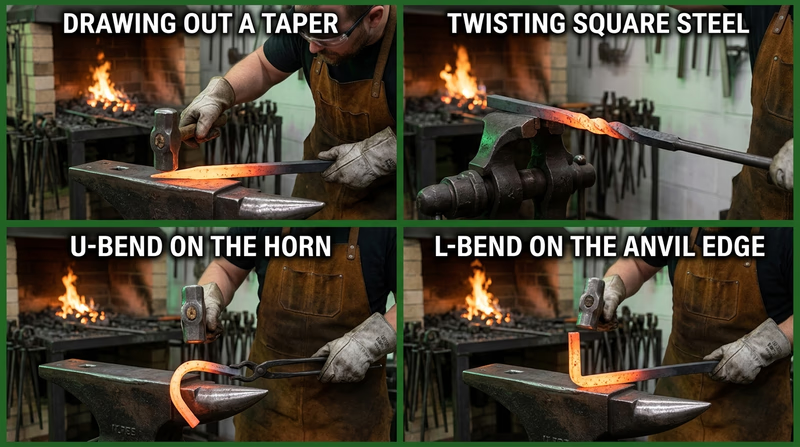
When you can explain what each exercise teaches, you are ready to apply those moves in finished work.