Req 1 — Minerals in Everyday Life
This requirement has three connected parts. You will build a mineral-to-product list, explain how mining supports things that are grown, and then trace the minerals you chose to the countries where they are found. Think of it as a chain: mineral → product → place.
- 1a helps you connect minerals to everyday objects.
- 1b shows that farming depends on mined materials too.
- 1c widens the view from your own list to the global supply of minerals.
Requirement 1a: Minerals and the products they make possible
The trick here is not to memorize a random list. It is to choose minerals from several different categories so you can show your counselor how broad mining really is. If all 10 minerals come from electronics, you will miss the bigger story. Try mixing building materials, metals, agriculture minerals, and minerals used in technology.
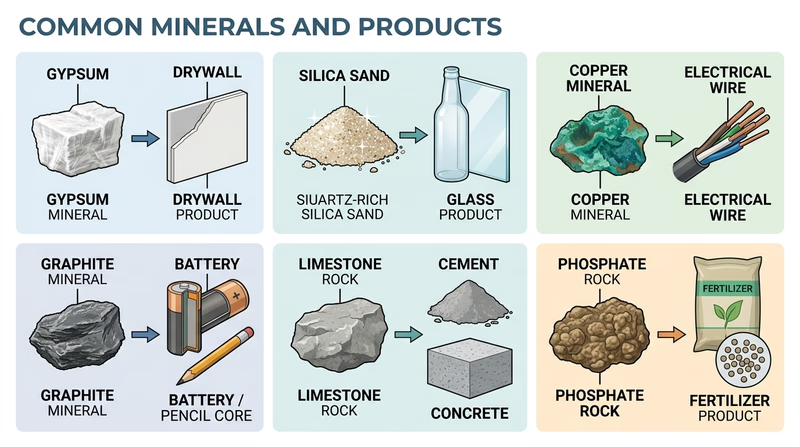
A strong list usually includes some materials you can see easily and some that hide inside finished products. Copper is easy to spot in wire. Silica is less obvious until you remember that glass begins with sand rich in quartz. Gypsum hides in drywall. Graphite works inside pencils and batteries. Phosphate shows up in fertilizers that help crops grow.
Build a balanced mineral list
Aim for variety so your examples show how wide mining reaches
- One or two construction minerals: Think about stone, gypsum, limestone, clay, or silica.
- Several metal-related minerals: Look for minerals that lead to metals used in wiring, tools, cans, vehicles, or electronics.
- One or two agriculture-related minerals: Fertilizer and soil treatment often begin with mined materials.
- One technology example: Batteries, chips, magnets, or screens are good places to look.
- One energy or transportation example: Consider steelmaking materials, cement ingredients, or minerals used in fuel production and infrastructure.
When you write your product for each mineral, be specific. “Electronics” is too broad. “Copper wiring in a house” is better. “Construction” is broad. “Drywall made from gypsum” is clear. Your counselor wants to see that you understand the connection between the mineral and a real use.
Requirement 1b: Mining and the things that are grown
At first glance, farming may seem completely separate from mining. Plants grow in soil, not in tunnels or quarries. But modern agriculture depends on mined materials at almost every step.
Fertilizers are the clearest example. Phosphate rock and potash are mined and processed into fertilizers that help plants build roots, stems, and fruit. Limestone may be crushed and spread to reduce soil acidity so crops can grow better. Sulfur and other mineral products are also used in agriculture and industrial chemistry.
Mining also helps with the tools and systems that make large-scale growing possible. Steel for tractors, combines, irrigation equipment, and grain bins depends on mined iron ore and other minerals. Copper is used in wiring, motors, and pumps. Sand and gravel help build farm roads, bridges, and foundations. Without these materials, planting, watering, harvesting, storing, and shipping food would be much harder.
Then there is processing. Grain may move through mills made from steel and concrete. Fruit may be sorted on conveyors driven by electric motors. Food packaging often uses aluminum, steel, glass, and mineral-filled paper coatings. Even the refrigeration systems that keep produce fresh rely on metal equipment, concrete floors, and electrical systems that all begin with mined resources.
A good counselor discussion explains that mining supports growing in three ways: it provides plant nutrients, it provides equipment and infrastructure, and it provides processing and packaging materials after crops are harvested.
Requirement 1c: Where minerals are found
Now you are taking your list from Req 1a and making it global. Different minerals occur in different geologic settings, so the world supply is spread unevenly. One country may produce a great deal of copper, another may dominate potash, and another may be known for bauxite, lithium, or phosphate. That matters because manufacturers and governments depend on reliable access to these materials.
The easiest way to research this is to use one trusted source consistently so your information is easy to compare. Look up each mineral, note the major producing countries, and write one quick observation. You might notice that some minerals are found on several continents while others are strongly associated with just a few countries.
For each mineral on your list
Capture the same details every time
- Write the mineral name clearly.
- Name one specific product it is used in.
- Record several countries where the mineral is found or produced.
- Add one sentence about what surprised you.
- Be ready to discuss whether the supply seems widespread or concentrated.
If your counselor asks what you learned, good answers might include ideas like these: some products depend on international supply chains, some minerals are common while others are concentrated in fewer places, and mining decisions in one part of the world can affect prices and manufacturing in another.
In Req 2, you will shift from the world map to your own state or region. That makes this global research a useful warm-up.
USGS Mineral Commodity Summaries A trusted source for mineral uses, production, and major producing countries. It is one of the best places to research both your product examples and where each mineral is found. Link: USGS Mineral Commodity Summaries — https://www.usgs.gov/centers/nmic/mineral-commodity-summaries Minerals Education Coalition — Minerals in Your Life Student-friendly examples of how mined minerals show up in everyday objects such as phones, homes, vehicles, and clean-energy technology. Link: Minerals Education Coalition — Minerals in Your Life — https://mineralseducationcoalition.org/mining-minerals-information/minerals-in-your-life/You now have minerals, products, and producing countries connected in one picture. Next, you will put mining on a map and see how deposits, transportation, and communities fit together in a real region.