Req 7a — Mining Beyond Earth
Space mining sounds like science fiction, but the ideas behind it are very practical. Launching every ounce of fuel, water, oxygen, shielding, and construction material from Earth is expensive. If future explorers can use resources already on the Moon, Mars, or asteroids, missions could travel farther and stay longer.
Why mine in space?
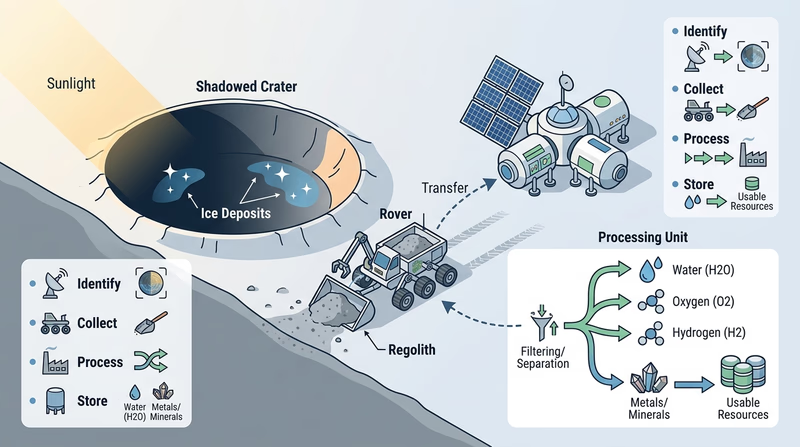
The biggest reason is not treasure. It is logistics. Water ice can be turned into drinking water, breathable oxygen, and hydrogen-based rocket fuel. Regolith, the loose material covering the Moon and other worlds, may be useful for radiation shielding or construction. Metals and other materials could eventually support tools, parts, or habitats.
How people might search and extract
NASA and other organizations study remote sensing, robotic prospecting, drilling, sampling, and in-situ resource utilization, often shortened to ISRU. That means using local material where you find it instead of hauling everything from Earth. Prospecting in space could involve orbiters mapping mineral clues, rovers examining surface chemistry, and robotic systems testing how easy it is to collect and process material.
How space mining differs from Earth mining
The geology is different, but the biggest differences are the conditions.
Why space mining is harder than Earth mining
These are great discussion points for your counselor
- Extreme distance: Rescue, repair, and resupply are much harder.
- Vacuum or near-vacuum conditions: Equipment must work without normal air pressure.
- Low gravity: Digging, anchoring, and moving material work differently.
- Harsh temperature swings: Machines must survive severe heat and cold.
- Communication delays: Some missions cannot be controlled instantly from Earth.
- Limited sample access: Scientists often work with very small amounts of returned material.
Collecting and analyzing samples
On Earth, geologists can often revisit a site, bring heavy tools, and send large loads to a lab. In space, every sample is expensive. Robotic probes may gather only tiny amounts. Dust behaves differently in low gravity and can interfere with seals and equipment. If a drill jams or a sampler misses its target, there may be no quick fix.
If you want a future topic with big engineering questions, this one is hard to beat. The next option stays much closer to home by looking at mineral resources in the oceans.