Req 4a — House in Miniature
An architectural model is your chance to think like both a designer and a storyteller. A good house model does not just show walls and a roof. It helps your counselor understand how the house is organized, what the outside feels like, and how carefully you can turn two-dimensional drawings into a clean three-dimensional object.
At 1:48 scale, every decision matters. A full-size doorway, window, roofline, porch, or chimney becomes much smaller, so you have to simplify without losing the character of the design. That balance between accuracy and readability is one of the most important skills in architectural modelmaking.
Start with Plans and Elevations
Before you build, draw the house from more than one view. A floor plan shows the arrangement of rooms and walls as if you sliced the house horizontally and looked down. Elevations show the outside faces of the building — front, rear, and sides. Together, these drawings tell you where doors, windows, roof edges, and wall heights belong.
If you skip this step, your model will usually start drifting. One wall will end up longer than another. A roof angle will not meet cleanly. Windows will line up on one side but not the other. Plans keep the project honest.
Architectural Plan Essentials
Make sure your drawings include these items
- Floor plan: Exterior walls, interior walls if used, door swings, and major openings.
- Elevations: Front and side views with roof shapes and window placement.
- Scale note: Clearly mark 1:48 on every drawing.
- Major dimensions: Overall length, width, wall height, and key opening sizes.
Choose Materials That Fit the Look
Architectural models are often judged by neatness. Foam board, illustration board, basswood, mat board, and styrene are popular because they create straight edges and clean planes. Clear plastic sheet can stand in for glass. Textured paper, painted card, or 3D printed parts can add shingles, doors, trim, or other details.
The best material choice depends on what you want to show. If the main goal is the shape and layout of the house, simple flat materials may be enough. If you want your model to feel more realistic, you can add exterior treatment such as sidewalks, shrubs, steps, fencing, or paint. Just do not let decoration hide poor scale control.
Include Structural Thinking
Even though this is an architectural model, the requirement also asks you to include structural elements. That means you should think about what holds the house together, not just what it looks like from the curb. Roof supports, wall thickness, floor alignment, and major framing ideas should make sense.
You do not need to expose every stud unless you want to, but your design should show that doors, windows, and walls are arranged in a believable way. A model becomes much stronger when appearance and structure support each other.
Outside Treatment and Color
Small details help a house model feel finished. A walkway shows how someone approaches the home. Shrubbery suggests scale and site layout. Paint or colored materials can separate roof, siding, trim, and foundation. Keep these choices simple and consistent. A few well-placed details usually look better than too many tiny decorations competing for attention.
If you are using computer tools, this is also where they can help. You might laser-cut repeated windows or 3D print a porch column set. Just make sure those parts still fit the same scale and style as the rest of the model.
Cooper Hewitt Smithsonian Design Museum Collection A rich source of design drawings and presentation ideas that can help you see how professionals communicate form and proportion. Link: Cooper Hewitt Smithsonian Design Museum Collection — https://collection.cooperhewitt.org/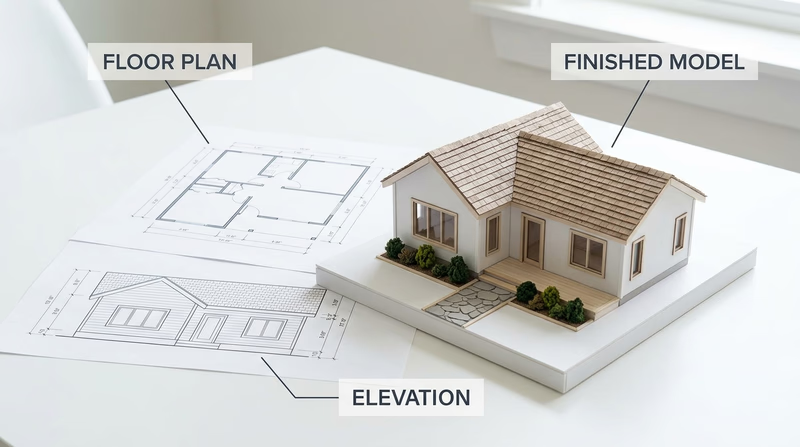
If you want to focus less on appearance and more on what keeps a building standing, the structural model takes you inside the skeleton of construction.