Req 5 — Designing for the Big Screen
This requirement takes everything you learned about real models and pushes it into imaginative design. Even though the spacecraft is fictional, it still needs to feel believable. That usually happens when the design borrows logic from real machines: clear purpose, sensible scale, visible systems, and shapes that look like they could actually operate.
You are not just doodling a spaceship. You are designing a vehicle for a film audience that will instantly ask, “What does that part do?” and “Could that thing really exist?”
Requirement 5a
The best fantasy spacecraft designs usually have a backbone of real engineering. Aircraft teach you about control surfaces, cockpit visibility, engines, and lightweight structure. Submarines teach pressure-hull thinking, tight interior planning, and the idea that external shape often follows mission. Naval ships teach deck arrangement, mass, layered systems, and how a large vehicle announces its purpose from far away.
As you research, look for patterns instead of trying to copy one vehicle exactly. Where are the crew spaces? Where are engines or propulsion systems located? What parts need access? What shapes look fast, stable, heavy, stealthy, or exploratory?
Requirement 5b
Break the spacecraft into functional zones. A cockpit is about visibility, controls, and crew access. Living areas are about rest, movement, and limited space. Engines are about power, heat, and thrust. Storage is about mission needs: cargo, supplies, tools, fuel, or escape gear.
Thinking in components keeps the design from becoming one vague shell. Even if your final model is small, the audience should feel like the ship has a real interior logic. Ask yourself where the crew enters, how they move through the craft, and what the ship is built to do. Is it a scout? A freighter? A patrol ship? A scientific survey craft? The mission should shape the design.
Designing Components
Give each major area a reason to exist
- Cockpit: Who sits there and what must they see?
- Living area: How does the crew eat, sleep, or work on long trips?
- Engines: Where does thrust come from and where does heat go?
- Storage: What must the ship carry for its mission?
Requirement 5c
This step turns your ideas into something another person can evaluate. Multiple angles are important because a great side view can hide a weak top view, and a cool front silhouette may not make sense from the rear.
Your final presentation should show enough views that the whole design feels consistent. Common choices are front, side, top, and three-quarter perspective. If you work digitally, use rendered views with clear lighting. If you work by hand, focus on clean lines, consistent shapes, and labels where useful.
Requirement 5d
This final discussion is where you prove that your design was thoughtful. Explain how your research influenced your choices, why the scale makes sense, which materials or software you used, and how you solved problems along the way.
A practical scale is one that lets you show the main forms and important details without creating a model too large to build or too small to understand. Your engineering choices should also make sense. Maybe you used foam board for the body shell, printed engine housings, and styrene for surface detail. Maybe you stayed fully digital and used rendering tools to communicate materials, lighting, and surface texture.
The difficulties you mention are often the most interesting part. Maybe the engines overwhelmed the body shape. Maybe the cockpit looked too small for the crew. Maybe the ship looked exciting from one view but awkward from another. Those revisions are not proof of failure. They are proof that you designed, tested, and improved.
NASA Glenn — Beginners Guide to Aeronautics A strong source for studying real vehicle design logic, propulsion ideas, and shape decisions that can inspire more believable fantasy spacecraft. Link: NASA Glenn — Beginners Guide to Aeronautics — https://www1.grc.nasa.gov/beginners-guide-to-aeronautics/ Stanford d.school — Design Thinking Bootleg Useful for understanding how professional designers iterate, test ideas, and improve a concept through multiple revisions. Link: Stanford d.school — Design Thinking Bootleg — https://dschool.stanford.edu/resources/design-thinking-bootleg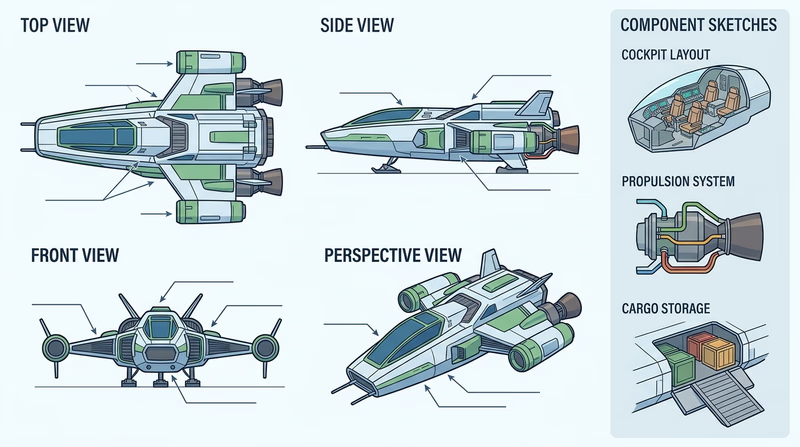
You have explored both practical and imaginative model design. The final requirement asks you to look beyond the badge at careers where these same skills matter every day.