Req 4 — Rules, Weather & Required Gear
This is the most seamanship-heavy requirement in the badge. It pulls together policy, law, equipment, weather, signals, and anchoring. In other words, it teaches you how a responsible operator prepares for a trip before anyone starts talking about fun.
Requirement 4a
Requirement 1c introduced Safety Afloat. Here, you are applying it like an operator. That means connecting the policy to actions you actually take before leaving the dock.
Applying Safety Afloat before launching
Start with the people. Is supervision in place? Are health concerns known? Does everyone have the right swimming ability and life jacket? Then shift to the plan. What is the route, the return time, the weather window, and the backup plan?
Applying Safety Afloat during the trip
Once underway, the policy is still active. Weather can change. Equipment can fail. Passengers can become tired or careless. The operator keeps reassessing instead of assuming that a safe start guarantees a safe finish.
Applying weather checks, equipment checks, and float plans
- Weather: Check before launch and keep watching during the outing.
- Equipment: Verify that required items are aboard and working.
- Float plan: Leave your route, timeline, and contact plan with someone on shore.
Pre-Departure Safety Afloat Review
A practical application of the policy
- People ready: Supervisor, swimmers, buddies, and passengers are prepared.
- Boat ready: Fuel, engine, lines, anchor, and required gear checked.
- Weather reviewed: Forecast, wind, storms, and local conditions considered.
- Plan shared: Someone not on the boat knows where you are going and when you should return.
Requirement 4b
Boating law is local in some details and national in others. Your state may set age limits, boater-education requirements, or permit rules. Federal rules affect navigation, required equipment, lighting, sound signals, and many safety standards.
Your counselor does not expect you to memorize every state’s boating code. The skill is knowing where to look and understanding that laws can change when you cross state lines.
What to know in your own state
Find out whether your state requires:
- a boater education card or permit
- a minimum operator age
- specific life-jacket rules for youth
- registration and numbering rules
- extra local equipment or operating rules
How to find laws in other states
Start with that state’s official boating or natural-resources agency. Then compare with authoritative national boating-law summaries. If you will actually boat there, always confirm with the official state source.
NASBLA — State Boating Laws A national starting point for finding boating-law information and education requirements by state. Link: NASBLA — State Boating Laws — https://www.nasbla.org/education/boating-lawsRequirement 4c
Weather changes how your boat behaves, how your passengers feel, and how much time you have to fix problems. Wind builds waves. Waves reduce visibility and increase fatigue. Rain hides hazards and makes surfaces slippery. Lightning changes the whole situation from inconvenient to dangerous.
Heavy water means rough, confused, fast-moving, or otherwise challenging conditions. In heavy water, the operator must work harder to control speed, angle, and balance. Passengers tire faster. Loose gear shifts. Simple turns become more serious decisions.
Weather hazards to discuss
- Thunderstorms and lightning
- Strong wind
- Fog or low visibility
- Cold fronts and fast changes in temperature
- Large chop, heavy wake, or current-driven rough water
🎬 Video: How to drive a boat in rough water | Big sea throttle techniques explained | Motor Boat & Yachting — Motor Boat & Yachting — https://www.youtube.com/watch?v=dAxC2xAi12c
Requirement 4d
This requirement asks for more than repeating the words. “Promise” matters because boating safety depends on habits you follow even when no one is checking.
Meaning of qualified supervision and health review
Scouting activities do not run on guesswork. A qualified adult leads, and the group knows about health issues that could matter on the water.
Meaning of swimming ability, life jackets, and buddy system
These three points assume that people end up in the water when they did not plan to. That is why they are non-negotiable.
Meaning of skill proficiency, planning, equipment, and discipline
Skill proficiency means you practice before conditions get harder. Planning means you think ahead. Equipment means you bring what the trip actually needs. Discipline means everyone obeys the safety plan when it counts.
Requirement 4e
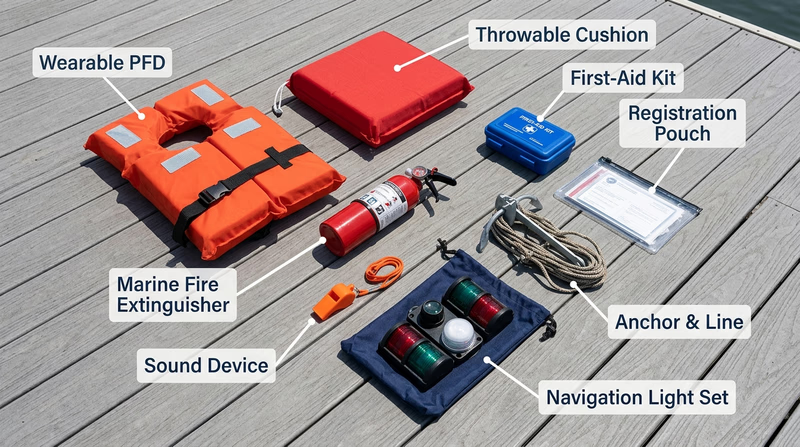
Required equipment varies by boat size, location, and state rules, but some categories are common. You should be ready to identify the equipment, explain what it is for, and show where it belongs on the boat.
Common required items include wearable life jackets, a sound-producing device, fire extinguisher, navigation lights, registration materials, and sometimes throwable flotation or visual distress signals depending on boat type and waters used.
“Explain and show” means more than naming
If your counselor asks about a fire extinguisher, do not just point. Explain where it should be stored, why it must be reachable, and what type of emergency it addresses. If asked about the sound signal, show how it is used to attract attention quickly.
Required Gear Mindset
Questions to ask about every item aboard
- Is it required here?
- Is it in working condition?
- Can I reach it quickly?
- Do I know how to use it without guessing?
Requirement 4f
Ventilation is about preventing explosive fuel-vapor buildup and reducing dangerous fumes. Some boats, especially those with enclosed fuel or engine spaces, need powered or natural ventilation systems by law or design standard.
The reason is simple: gasoline vapors can collect in low spaces and ignite violently. A proper ventilation system helps remove those vapors before engine start or while systems are operating.
When you explain this to your counselor, connect the rule to the hazard. Ventilation is not about comfort. It is about reducing fire and explosion risk.
Requirement 4g
Lights help other boaters know where you are, what direction you are facing, and whether you are visible in low light. Sound signals help communicate presence or intention when distance, traffic, or visibility makes voice communication impossible.
You do not need to become a professional navigator for this requirement, but you should understand that signals exist to prevent confusion. If two operators interpret a situation differently, risk rises fast.
Why they matter
- Navigation lights: Help others identify orientation and avoid collision.
- Sound signals: Help attract attention or communicate when visual clarity is limited.
- Consistency: Rules matter because all operators rely on the same shared system.
Requirement 4h
Anchoring sounds simple until wind, bottom type, and swinging room start working against you. A good anchor setup depends on matching the anchor style to the conditions and using patient technique.
Common anchor ideas
Different anchors hold differently in mud, sand, rock, or mixed bottoms. Some common recreational categories include lightweight fluke-style anchors, plow-style anchors, and utility-style anchors for small boats. Your counselor may have local preferences based on the waters where you boat.
Proper anchoring techniques
A good explanation should include these ideas:
- choose a suitable spot with enough depth and swinging room
- lower, do not throw, the anchor
- let out enough line for a solid hold
- back down gently to set it
- check landmarks or references to confirm you are not dragging
- raise and stow the anchor carefully before getting underway
Anchoring Sequence
A simple way to describe the process
- Pick the spot: Bottom, depth, wind, and traffic all matter.
- Lower the anchor carefully: Avoid tangles and sudden drops.
- Pay out line: Enough scope helps the anchor hold.
- Set and confirm: Check that the boat stays put.
- Recover safely: Bring the anchor up cleanly and stow it so it cannot shift.
You now know the policies, laws, and seamanship rules that support safe operation. Next comes the hands-on proof: boarding, launching, running a course, anchoring, docking, and tying the knots that make a boater dependable.