Req 5 — Boat Handling Underway
This final requirement is where knowledge turns into visible skill. The common thread through all eight parts is control. You are showing that you can handle the boat smoothly, keep people safe, and avoid creating extra problems while completing routine tasks.
Requirement 5a
Boarding safely
Boarding is one of the easiest times for a person to slip, grab the wrong part of the boat, or shift weight suddenly. Bring the boat alongside calmly, stabilize it as needed, and give clear instructions.
Assisting others in boarding
Have one person board at a time unless the situation clearly allows otherwise. Tell passengers where to step, what to hold, and where to sit once aboard.
Confirming life-jacket fit
Do not treat this as a quick glance. Check that each life jacket is the right size, fastened, and snug enough to do its job. This is where Requirement 2b becomes real.
Requirement 5b
Fueling the boat
Fueling should be orderly and distraction-free. Engine off, flames away, passengers managed, spills cleaned, and vapors respected.
Completing a safety check
Before launch, confirm fuel level, lines, gear, drain plug where applicable, life jackets, sound signal, anchor, and general readiness of the boat.
Quick Launch Safety Check
Items worth saying out loud before departure
- Fuel secure and caps closed
- No unusual odor or visible leak
- Life jackets on and fitted
- Required gear aboard and reachable
- Passengers briefed on seating and movement
Requirement 5c
Using the engine cut-off switch link
If the boat has one, attach it correctly before operating. This simple device can stop the engine if the operator is thrown away from the helm.
Starting the motor safely
Make sure the area is clear, passengers are in stable positions, and the boat is ready to move before starting. Listen for anything unusual.
Getting underway from dockside or beach launch
Move off gently. Control matters more than speed. Think about wind, nearby boats, shallow water, and the direction the bow will want to swing.
🎬 Video: Driving a boat: The basics — boatsales — https://www.youtube.com/watch?v=FjkVFTHBizI
Requirement 5d
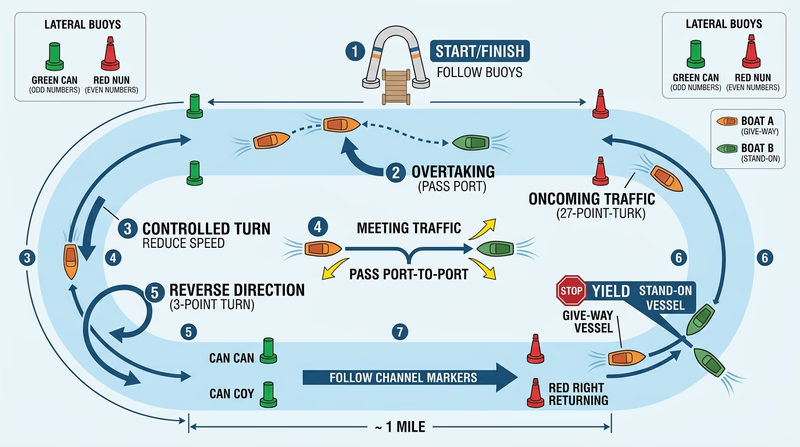
Running the course
A good course run looks smooth and predictable. Your counselor is watching for lookout, spacing, speed choice, and whether you make other operators guess.
Overtaking, yielding, and passing oncoming traffic
Keep enough separation to avoid crowding other vessels. Yield when required. Pass in a way that is obvious, not surprising. Oncoming situations are easier when both operators can predict each other.
Making turns, reversing direction, and using navigation aids
Turns should match conditions and passenger stability. Reversing direction takes awareness of traffic, wind, and wake. Navigation aids help you understand channels, hazards, or route guidance, but they only help if you notice them in time.
Requirement 5e
Stopping and securing with anchors
Bring the boat under control first. Choose your anchoring location with wind, depth, bottom type, and nearby traffic in mind. A rushed anchor job often drags or tangles.
Raising and stowing the anchor
Bring the line in carefully, avoid sudden jerks, and stow the anchor so it cannot shift or snag people when the boat moves again.
Getting underway again
Before applying power, make sure the anchor is fully clear, line is secure, and passengers are ready.
Requirement 5f
Landing or docking
Docking is about patience, not bravery. Reduce speed early, approach under control, and plan for wind and current.
Disembarking and assisting others
Once secure, help passengers leave one at a time. Just like boarding, clear instructions prevent slips and sudden weight shifts.
Requirement 5g
Securing the boat
However the boat is left — moored, docked, or beached — it should stay where you put it without damaging itself or other property.
Securing all gear
Lines, anchor, paddles, first-aid kit, throwable flotation, and personal gear should be stowed so nothing blows away, trips someone, or shifts when the boat is moved next.
Requirement 5h
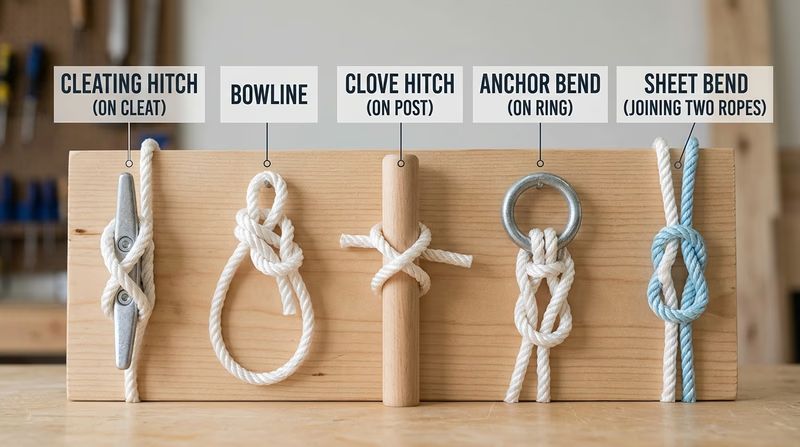
Boating knots are small skills with big consequences. A knot that slips at the wrong time can damage the boat, injure someone, or turn a simple landing into a mess.
What each knot does
- Cleating hitch: Fast, secure way to tie off on a cleat.
- Bowline: Creates a fixed loop that is easy to untie later.
- Clove hitch: Useful for temporary fastening.
- Anchor bend: Reliable way to attach line to an anchor or ring.
- Sheet bend: Joins two lines, especially when they differ in size.
Knot Practice Goals
What your counselor is really looking for
- You know the purpose of each knot
- You can tie it without panicking or guessing
- You dress the knot neatly
- You can explain when to use it on a boat
You have reached the part of the badge where safe habits, seamanship, and boat handling all meet. Extended Learning will show you where these skills can lead next — from advanced training to marine careers and real boating communities.