Req 1 — Film Language Basics
A good movie does not happen by accident. Every shot answers a question for the audience: Where should I look? What should I feel? What matters most right now? When you talk with your counselor about this requirement, think less about memorizing definitions and more about showing how each choice changes the story.
Visual Storytelling
Visual storytelling means the audience learns by what it sees, not only by what someone says. A Scout nervously tightening a backpack strap before a long hike tells you something even before any dialogue starts. A close-up of a shaking hand, a muddy boot print, or a torn note can move the story forward without anyone explaining it.
When you plan your own movie in Req 2a, ask yourself: what can the camera show instead of what a character can say? Movies become stronger when actions, objects, and faces carry part of the meaning.
Rhythm
Rhythm is the pace created by shot length, movement, and editing. Fast cuts can make a scene feel urgent. Longer shots can feel calm, awkward, or thoughtful. Rhythm is not just about speed — it is about matching the pace to the moment.
Imagine two versions of the same scene. In one, the camera cuts every two seconds as Scouts race to set up camp before a storm. In the other, the camera stays still while one Scout quietly studies a script before a presentation. Both can be good rhythm if the pace fits the story.
The 180-Axis Rule
The 180-axis rule helps viewers keep track of where people and objects are in relation to each other. Picture an invisible line running between two actors. If you keep the camera on one side of that line, one actor stays screen-left and the other stays screen-right. If you suddenly jump to the other side without a clear reason, the audience may feel like the characters swapped places.
This rule matters most during conversations, sports action, or any scene where direction matters. You can break the rule on purpose, but you should understand it first.
How to protect screen direction
Use these habits while filming conversations or action
- Choose the line early: Before filming, decide where the camera can safely move without crossing the action axis.
- Mark your positions: Use cones, sticks, or notes on the ground if needed.
- Add a neutral shot if you must cross: A centered shot looking straight at the action can help the audience reset.
- Review your footage: If screen direction feels confusing, the line may have been crossed.
Camera Movement
A moving camera changes energy immediately. A slow push in can make a moment feel more serious. A pan can reveal new information. A shaky handheld shot can feel urgent, but too much shake can distract the viewer.
Movement should have a reason. Ask what the motion adds. Does it reveal something? Follow an action? Make the audience feel closer? If the answer is “nothing,” a locked shot may be better.
Framing and Composition
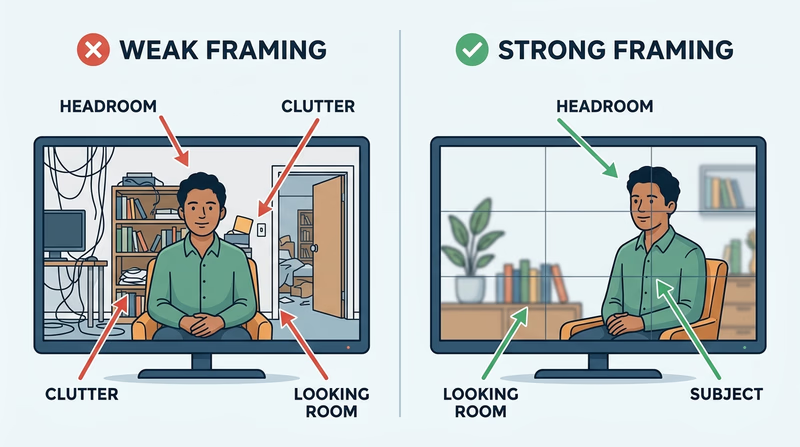
Framing is what you include inside the picture. Composition is how you arrange it. Good framing guides the viewer’s eye. You can use headroom, leading lines, foreground objects, and the rule of thirds to make the subject clear.
A common beginner mistake is centering everything at all times. Sometimes centered framing works, but often a subject feels stronger when placed slightly off-center with room to look or move into. If someone is walking to the right, give them space on the right side of the frame. If you cut off the top of someone’s head by accident, the shot feels careless.
Lens Selection
Different lenses change how a scene feels. A wider lens shows more of the environment and can make movement feel bigger. A longer lens narrows the field of view, brings distant subjects closer, and can make the background feel compressed. On phones, this often shows up as switching between wide, normal, and telephoto options.
Choose the lens based on the story:
- Wide for locations, groups, or action in tight spaces
- Normal for natural-looking interviews and everyday scenes
- Longer / telephoto for isolating a subject or filming from farther away
The best lens is not the most dramatic one. It is the one that helps the audience understand the scene.
🎬 Video: Film Making Basics (video) — https://youtu.be/BFwMRVwrKcA?si=uW4whxq0-SZjyFHJ
A Simple Way to Demonstrate This Requirement
When you meet with your counselor, choose one short scene and talk through it in plain language:
- What is the story moment?
- How is the subject framed?
- Does the camera move? Why?
- What rhythm does the scene use?
- Where is the camera in relation to the 180-axis line?
- Why was that lens or field of view a smart choice?
If you can explain those choices while also showing them with your own camera, you are doing exactly what this requirement asks.