Req 3 — Picking Your Event
This requirement helps you choose your path through the rest of the badge. You will look honestly at your experience, compare the three disciplines, gather the right gear, and decide which race format makes the most sense for you.
Requirement 3a
Start by being honest, not impressive. Your counselor does not need a speech about being “good at sports.” They need to understand what you have actually done.
For each discipline, think about questions like these:
- Have you done it recently?
- Do you feel relaxed, average, or nervous doing it?
- What distance feels manageable right now?
- What part feels strongest?
- What part needs the most work?
It also helps to know the order of events in the formats you may choose. In a triathlon, you swim first, then bike, then run. In a duathlon, you run, bike, and run again. In an aquathlon, you swim and then run. In an aquabike, you swim and then bike.
🎬 Video: Empowering Youth Through Multisport (video) — https://youtu.be/qmW51zdyduc
Requirement 3b
Everyone has a natural entry point. Some Scouts are calm and efficient in the water. Others have strong cycling confidence or a runner’s rhythm. There is no single “best” discipline. The best starting point is the one that helps you build confidence while still challenging you.
When you explain your strongest and weakest areas, think in terms of skills, not just speed:
- Swimming: breathing, comfort in water, sighting, pacing
- Biking: bike handling, balance, signaling, confidence around turns
- Running: pacing, form, recovery, consistency
Requirement 3c
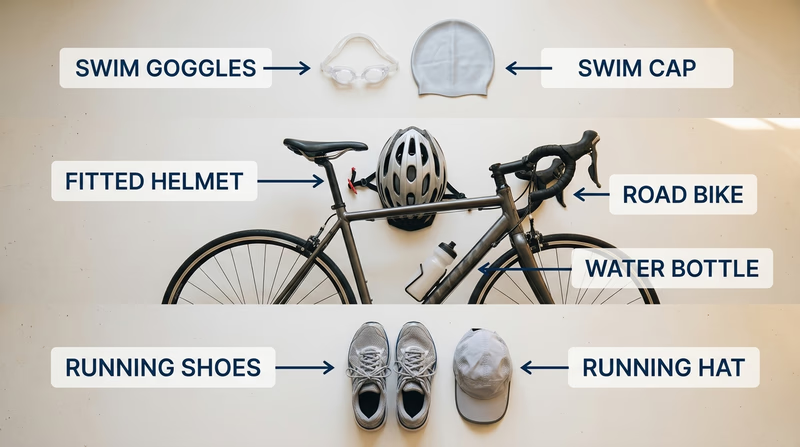
You do not need fancy equipment, but you do need the right basics.
Swimming basics
You need appropriate swimwear, goggles, and safe water supervision. Depending on conditions, you might also need a swim cap, towel, and a wetsuit.
Biking basics
You need a safe bicycle that fits you, a properly fitted helmet, and clothing that allows movement and visibility. Water bottles and basic repair supplies become more important as rides get longer.
Running basics
You need shoes that fit well, comfortable clothing for the weather, and a simple hydration plan for longer or hotter efforts.
USA Triathlon Youth Guide (PDF) This youth guide gives a beginner-friendly overview of gear, safety, and training expectations for young multisport athletes. Link: USA Triathlon Youth Guide (PDF) — https://assets.contentstack.io/v3/assets/blteb7d012fc7ebef7f/blteec8160c769bfc2e/648b54b80f2d9bd22bed580b/USAT_Youth_Guide_2019.pdf🎬 Video: Triathlon Equipment You Really Need (video) — https://youtu.be/kgbz_3B9dNA
Requirement 3d
This choice should match your current skills and your goal for the badge.
If you want the broadest challenge
Choose triathlon. You will work on all three disciplines and the most complete transition experience.
If you want to avoid making swimming the center of the event
Choose duathlon. It is still demanding, but it stays on land.
If you like moving from water to running
Choose aquathlon. It is a simpler setup with less equipment than triathlon.
If you want endurance without the final run
Choose aquabike. It still asks for smart pacing and a clean transition.
In the next section, you will follow the path for the format you chose. Start with the option that matches your counselor discussion.