Req 2 — Instrument Families and Sound
Every musical instrument starts with vibration. Something moves back and forth, pushes air, and creates sound waves that your ears can detect. The five general groups of instruments are really five different ways to make that vibration happen.
The Five General Groups
Strings
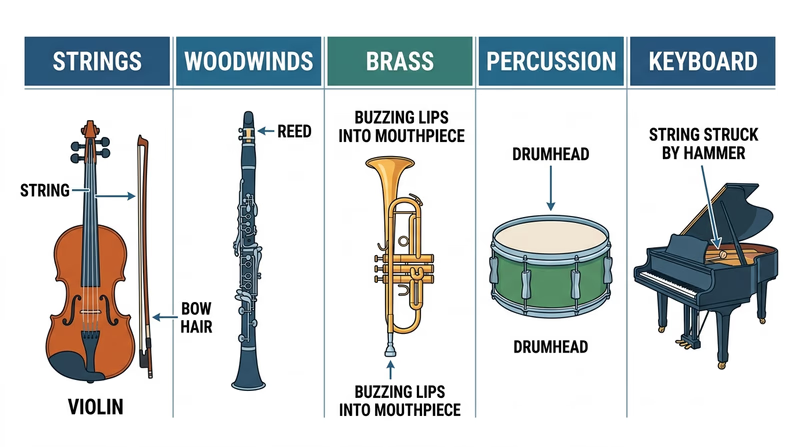
String instruments make sound when a string vibrates. You can bow it, pluck it, or strike it. Violins, guitars, cellos, basses, harps, and pianos all belong here. In a piano, the string is struck by a felt hammer. In a violin, the bow pulls the string sideways and releases it over and over.
Woodwinds
Woodwinds make sound when air vibrates inside a tube. Some use a reed, like clarinets and saxophones. Others, like flutes, use a stream of air split across an edge. Even though some modern woodwinds are made of metal, they still belong to the woodwind family because of how the sound is produced.
Brass
Brass instruments make sound when the player’s buzzing lips vibrate into a mouthpiece. Trumpets, trombones, tubas, euphoniums, and French horns all work this way. The tubing and valves or slide change the length of the air column and therefore the pitch.
Percussion
Percussion instruments make sound when they are struck, shaken, or scraped. Drums use vibrating membranes. Cymbals, triangles, xylophones, and marimbas use vibrating solid material. Some percussion instruments make definite pitches, while others create sounds without one clear pitch.
Keyboard
Keyboard is often treated as its own general group in school music because the keyboard layout controls many different sound-making systems. A piano uses strings. An organ uses moving air. A synthesizer uses electronics. The keys are the common feature.
How Tone Is Generated
When you create your illustration, show the exact thing that vibrates first.
What to Label in Your Illustration
Make the sound path easy to follow
- The vibrating part: string, reed, lips, drumhead, bar, or air stream.
- What amplifies the sound: body of the violin, tube of a trumpet, shell of a drum, or soundboard of a piano.
- How pitch changes: finger position, valves, keys, slide length, or bar size.
- How the player controls expression: breath, bow speed, strike force, pedal use, or articulation.
A strong illustration does not need to be fancy. It just needs to be clear. Arrows, labels, and a simple cutaway drawing can explain more than an elaborate picture with no notes.
Sound Waves, Pitch, and Volume
All five families follow the same basic sound rules.
- Faster vibrations create higher pitches.
- Slower vibrations create lower pitches.
- Bigger vibrations usually create louder sounds.
- The material and shape affect tone color.
That means two instruments can play the same pitch but sound very different. A clarinet and a violin might both play concert A, but the vibrating reed and vibrating string create different tone colors.
The official videos below are useful because they let you see and hear several families side by side.
🎬 Video: Classification of Musical Instruments (video) — https://youtu.be/WencyslK76o
🎬 Video: Orchestral Instruments and How They Sound (video) — https://youtu.be/Sr-l2m8twX0?si=6Fj8mHWGIRqhrhwi
Req 1 asked you to think about tone and expression. This requirement helps you explain where that tone comes from in the first place.
The Metropolitan Museum of Art Explore instrument collections and learn how design, material, and culture shape musical sound. Link: The Metropolitan Museum of Art — https://www.metmuseum.org/Next you will reach one of the choose-your-own sections of this badge and decide which music experiences fit you best.