 Getting Started
Introduction & Overview
Overview
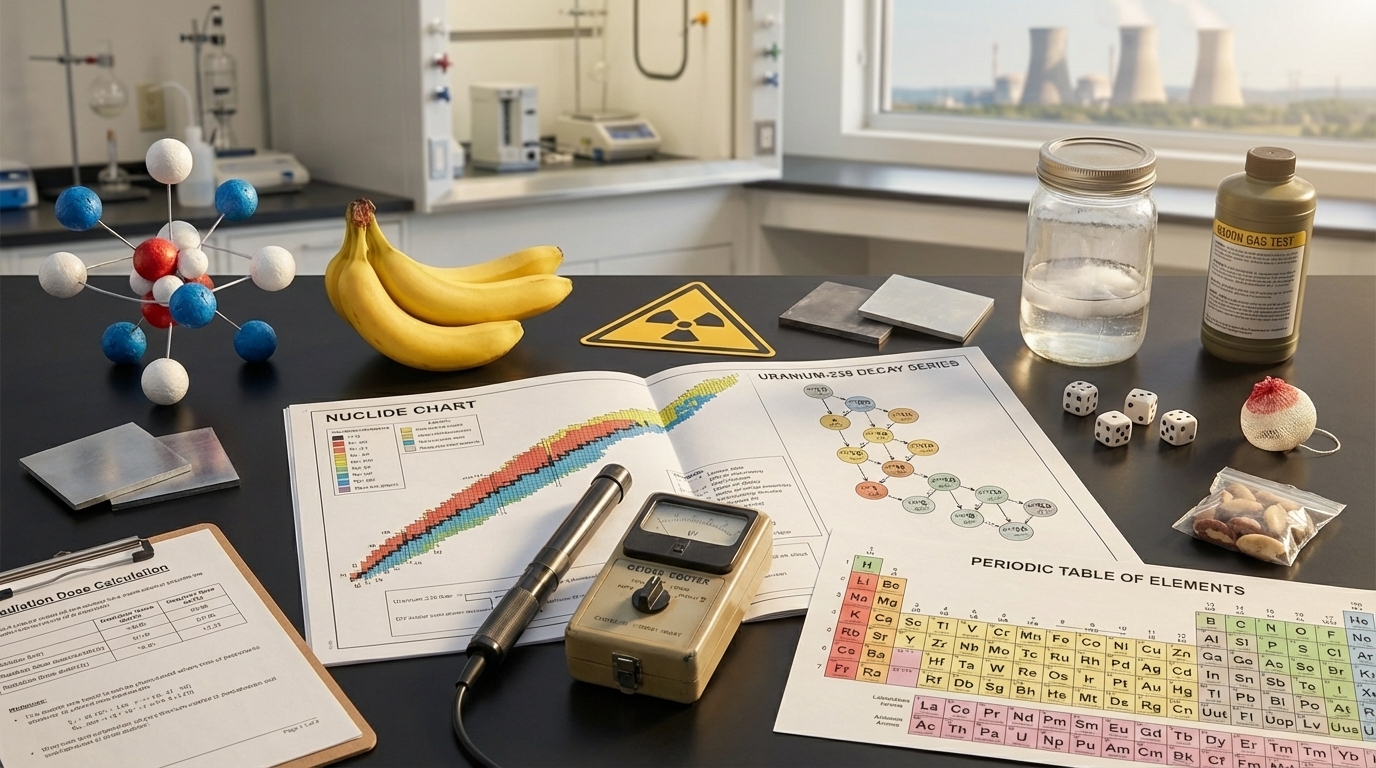
Nuclear science is the study of matter, energy, and tiny particles that are too small to see but powerful enough to light cities, diagnose disease, and help scientists understand how the universe works. This badge asks you to look past movie myths and learn what radiation really is, how atoms behave, and why careful measurements matter. If you like science that connects the invisible world to real life, Nuclear Science is full of moments that make you stop and say, “Wait, really?”
Then and Now
Then
People have always lived in a radioactive world. Long before anyone knew what an atom was, the sun, rocks, soil, and even the human body were quietly producing or interacting with radiation. The big change came in the late 1800s, when scientists such as Henri Becquerel and Marie Curie realized that certain materials gave off energy on their own. Soon after, Ernest Rutherford and other researchers began uncovering the structure of the atom and showing that matter was not solid and simple after all.
Early nuclear science felt mysterious because the tools were simple and the effects were invisible. Researchers used photographic plates, gold leaves, glowing screens, and careful counting to detect particles they could not see directly. Those classic experiments are still important because they show how scientists learned to trust evidence over guesses.
Now
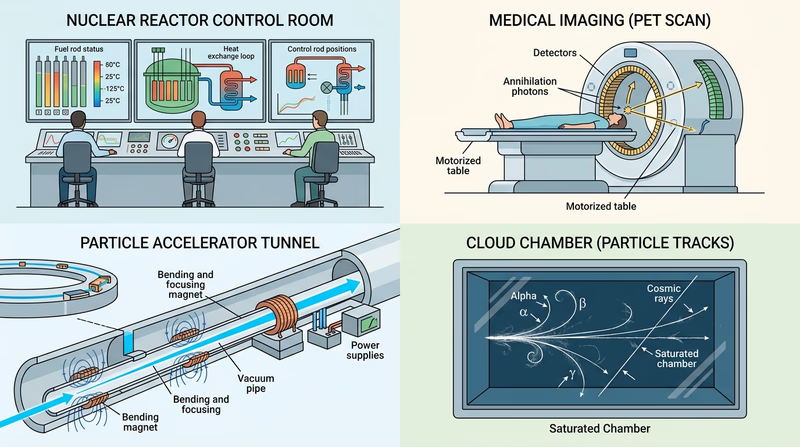
Today, nuclear science touches daily life in ways many people never notice. Doctors use radioactive tracers to look inside the body. Engineers use radiation to inspect welds and materials without cutting them open. Scientists use particle accelerators to study the building blocks of matter. Nuclear reactors produce electricity without burning fuel the way coal or gas plants do.
Modern nuclear science is also built on safety culture. The field depends on measurement, shielding, planning, and clear procedures. That is why this badge spends so much time on radiation basics and dose control before moving into experiments and energy.
Get Ready!
This badge rewards curiosity and careful thinking. You do not need to memorize every term on day one, but you do need to get comfortable asking good questions, drawing what you cannot see, and backing up your ideas with observations. By the end, you should feel more confident talking about radiation without fear or exaggeration.
Kinds of Nuclear Science
Radiation and Health
One part of nuclear science is learning what radiation is, where it comes from, and how it affects people and living things. This includes background radiation, contamination, dose, and medical uses such as imaging and treatment.
Atomic Structure and Isotopes
Another part of the badge is about the structure of matter itself: protons, neutrons, electrons, quarks, and isotopes. These ideas help explain why some atoms are stable while others decay and release radiation.
Particle Physics and Research Tools
Particle accelerators let scientists push particles to high energies and study what happens when they collide or pass through targets. This branch of nuclear science asks some of the biggest questions in physics: What is matter made of? How do forces work? What can we learn from nuclei and nucleons?
Energy and Useful Applications
Nuclear science is not only about reactors. It includes medicine, industry, food science, environmental monitoring, and space exploration. One reason this badge is interesting is that the same basic ideas can help both a doctor in a hospital and a scientist studying cosmic rays.
Ready to start with the most important foundation in the whole badge? Begin with what radiation is, where you meet it in everyday life, and how to think about it clearly.