Req 5c — X-Ray Room Safety
This requirement shows that radiation safety is often built into the room before the machine is ever turned on. The layout, barriers, procedures, and operator position all work together.
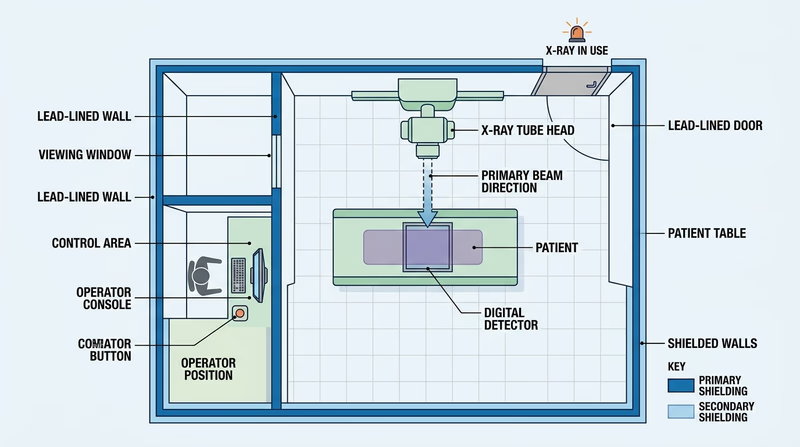
What your floor plan should show
Your drawing does not need to be artistic. It needs to communicate where people and equipment are during an exposure.
Include these on your floor plan
Make the safety features obvious
- The X-ray unit
- The patient location
- Where the operator stands during operation
- Protective barriers or control booth
- Doors, windows, and warning signs if they are part of the room layout
Common safety precautions
In many X-ray rooms, the operator stands behind a protective barrier or outside the room during exposure. The room may use lead-lined walls, lead glass, controlled distances, collimation to limit the beam, and shielding devices when appropriate.
These precautions matter because the operator may work around X-ray equipment every day. Even if each exposure is small, repeated unnecessary exposure is not acceptable. That is another real-world example of ALARA from Req 1b.
🎬 Video: X-Ray Room Tour || Ask the Rad Tech (video) — https://youtu.be/-pwY3-7lJJg?si=qctALb5U-IM9vG-K
You have now explored radiation protection from three different angles. Next, you will choose a path into nuclear energy.