Req 6a — Fission and Chain Reactions
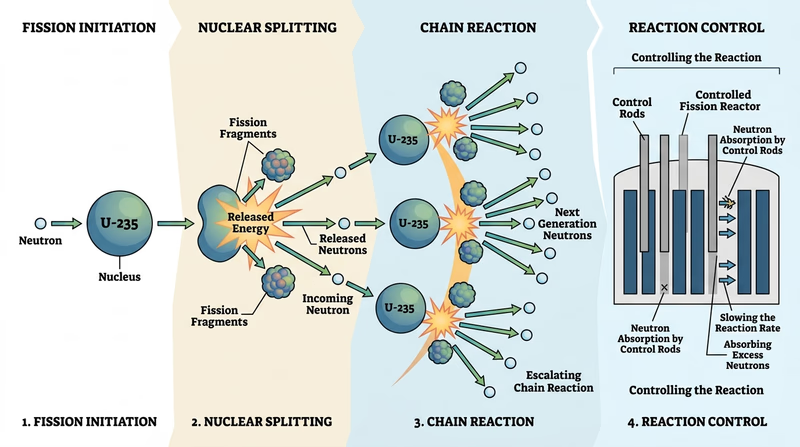
Nuclear fission happens when a heavy nucleus, such as uranium-235, absorbs a neutron and becomes unstable enough to split. When it splits, it releases energy, smaller nuclei, and more neutrons. Those neutrons can trigger additional fissions, which is how a chain reaction begins.
What your drawing should show
A clear fission drawing usually includes:
- the original heavy nucleus
- an incoming neutron
- the split into smaller nuclei
- released energy
- extra neutrons that can continue the process
How the mousetrap reactor helps
The mousetrap model is useful because it shows how stored energy can stay quiet until one event triggers many more. One launched ping-pong ball sets off multiple traps, which launch more balls, and the reaction grows quickly. It is not a perfect model, but it is a vivid one.
How a chain reaction is controlled
A reactor is designed so the chain reaction stays controlled instead of racing out of control. Engineers use control rods, moderators, coolant systems, and careful fuel arrangement to manage how many neutrons keep causing new fissions.
What critical mass means
Critical mass means enough fissile material is arranged so that, on average, each fission leads to one more fission and the chain reaction can continue. Too little material, or the wrong geometry, and too many neutrons escape.
🎬 Video: What Really Happened the First Time We Split a Heavy Atom in Half (video) — https://youtu.be/O2pyRDQgVjk?si=xYh6mItbfRQoaWqN
🎬 Video: What is Critical Mass | Nuclear Chain Reaction| Fission Chain Reaction| Critical Mass Of Uranium (video) — https://youtu.be/czjAtx8GjjA?si=l0xUwP2x5pJyQB85
🎬 Video: Mousetrap Fission (video) — https://youtu.be/vjqIJW_Qr3c?si=VFFlUgoPcuDMwqWh
The four ideas to explain clearly
These are the core teaching points of this requirement
- Fission releases energy and neutrons
- Neutrons can trigger more fissions
- A reactor must control the reaction rate
- Critical mass depends on having enough fuel in the right arrangement
If you want to move from the physics of fission to the big system that powers homes and cities, the plant-focused option is next.