 Getting Started
Introduction & Overview
The ocean covers more than 70 percent of Earth, shapes weather on every continent, feeds millions of people, and hides mountain ranges, trenches, and living things that scientists are still discovering. Oceanography is the science of all of that together — water, seafloor, chemistry, weather, and life.
This badge is fun because it makes you look at the ocean as one giant connected system. Even if you live far from the coast, the ocean still affects your climate, your food, and the air you breathe.
Then and Now
Then
People have studied the ocean for thousands of years, but early sailors mostly wanted practical answers: Where are the currents? Which winds can move a ship? How deep is the water near shore? Ancient Polynesian navigators read waves and stars to cross huge stretches of ocean. Later, explorers lowered weighted lines to measure depth and sketched coastlines by hand.
Ocean science changed in the 1800s when research expeditions began collecting water samples, recording temperatures, dredging up seafloor animals, and mapping the deep ocean. Instead of seeing the sea as a blank blue space on a map, scientists started discovering trenches, ridges, and entire ecosystems.
Now
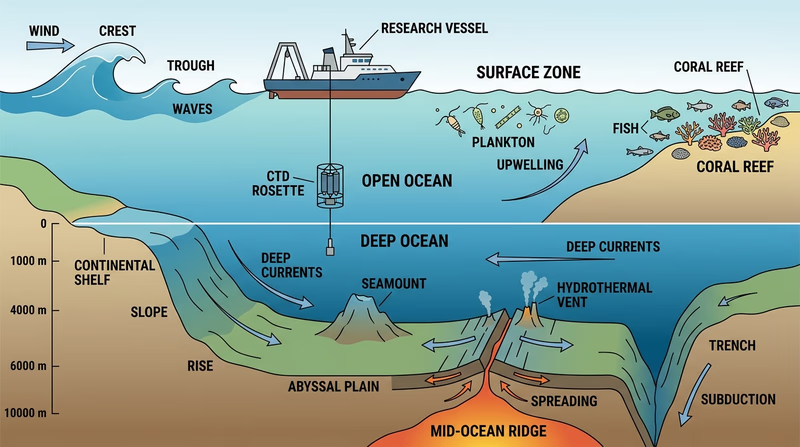
Today, oceanographers use satellites, drifting buoys, sonar, underwater robots, and research vessels to study places humans cannot easily reach. They track hurricanes from space, map the seafloor in detail, measure tiny changes in seawater chemistry, and explore deep-sea habitats that have never been seen before.
Modern oceanography matters because the ocean stores heat, moves carbon, supports food webs, and connects every coastline on Earth. A storm near one part of the world, melting ice in another, or a plankton bloom far offshore can all matter to people far away.
Get Ready!
You do not need to own a boat or live beside the ocean to start thinking like an oceanographer. Bring curiosity, clear notes, and a willingness to observe patterns. This guide will help you break a huge subject into manageable parts.
Kinds of Oceanography
Oceanography is really several sciences working together.
Physical Oceanography
Physical oceanographers study waves, tides, currents, density, and how the ocean moves heat around the planet. If you want to understand rip currents, storm surge, or how the ocean affects climate, you are thinking like a physical oceanographer.
Chemical Oceanography
Chemical oceanographers study what is dissolved in seawater and how ocean chemistry changes. That includes salts, gases like oxygen and carbon dioxide, nutrients, pollution, and how water chemistry affects marine life.
Geological Oceanography
Geological oceanographers focus on the seafloor and coastlines. They study trenches, ridges, sediment, underwater volcanoes, coral reef growth, and how waves and currents reshape coasts over time.
Biological Oceanography
Biological oceanographers study life in the ocean, from tiny phytoplankton to giant whales. They ask how organisms survive in seawater, where they live, how food chains work, and how ocean habitats change.
Now that you know the main branches of oceanography, you are ready to start with the big picture: what oceanographers study and why learning about the ocean matters.