Req 2 — Seawater, Currents & Climate
A glass of ocean water may look simple, but it holds clues about heat, salt, motion, and weather. This requirement is about the basic properties that help oceanographers explain why some water sinks, some rises, and some travels across whole ocean basins.
Three Key Properties of Seawater
Salinity
Salinity is the amount of dissolved salts in water. Ocean water is salty because minerals from rocks wash into rivers and eventually reach the sea. Water can evaporate, but the salts stay behind. Places with heavy evaporation often become saltier, while places with lots of rain, melting ice, or river input can become less salty.
Temperature
Temperature tells how warm or cold the water is. Surface water is usually warmed by sunlight, but deeper water can stay much colder. Temperature matters because it affects density, weather, and which organisms can live in different parts of the ocean.
Density
Density means how much mass is packed into a certain volume. In the ocean, colder water is usually denser than warmer water, and saltier water is denser than fresher water. Dense water tends to sink below less-dense water.
How Oceanographers Measure These Properties
Oceanographers use instruments, not guesswork.
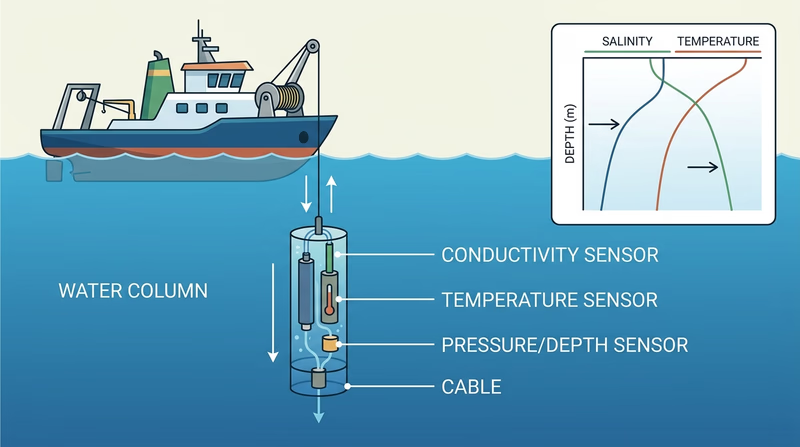
- Salinity is often measured with conductivity sensors. Saltier water carries electricity better, so conductivity helps scientists calculate salinity.
- Temperature is measured with accurate electronic thermometers or temperature probes.
- Density is usually calculated from temperature, salinity, and pressure rather than measured by one simple handheld tool.
One common package of instruments is called a CTD, which stands for conductivity, temperature, and depth. A CTD can be lowered from a research ship and record conditions from the surface to deep water.
🎬 Video: Temperature and Salinity (video) — https://youtu.be/jKWc5oy0NCQ?si=2B4crDCxvuYbGQce
Currents and Circulation
The ocean does not sit still. Surface winds push water, Earth’s rotation bends moving water, and differences in density help drive deep circulation.
Surface currents
Surface currents are driven mostly by wind. They form large circular patterns called gyres in major ocean basins. These currents help move warm water away from the equator and cooler water toward it.
Deep circulation
Deep circulation is driven mainly by density differences. In cold regions near the poles, very dense water can sink and begin long, slow journeys through the deep ocean. This global movement is sometimes called the global conveyor belt.
Why currents matter
Currents move heat, nutrients, organisms, and even floating debris. They can make one coast milder, another foggier, and another more productive for fishing.
🎬 Video: An Ocean in Motion (video) — https://youtu.be/R5-s6O8qyvE
What Drives Ocean Circulation?
Four forces to remember
- Wind pushes surface water.
- Earth’s rotation bends moving water through the Coriolis effect.
- Density differences make some water sink and other water rise.
- Continents and seafloor shape steer currents into patterns instead of straight lines.
How the Ocean Affects Weather and Climate
The ocean stores enormous amounts of heat. Water warms and cools more slowly than land, so the sea acts like a giant temperature buffer.
That means the ocean can:
- make coastal climates less extreme than inland climates
- feed moisture into storms
- strengthen or weaken hurricanes depending on sea-surface temperature
- influence droughts, rainfall, and seasonal weather patterns
- shape long-term climate patterns such as El Niño and La Niña
Warm ocean water adds energy and moisture to the atmosphere. Cold currents can cool nearby air and even help create fog. Because the ocean covers so much of Earth, changes in ocean temperature can influence weather far from the coast.
🎬 Video: Oceans and Climate (video) — https://youtu.be/zO2153cJORI
🎬 Video: How Do Ocean Currents Affect the Weather Pattern? (video) — https://youtu.be/T9LTtqcKDw0?si=qNZusyjB_bPjS0UQ
How to Explain This to Your Counselor
If you want a clear discussion, try this sequence:
- Define salinity, temperature, and density.
- Explain that salinity and temperature help determine density.
- Show how density differences help drive circulation.
- Connect circulation to heat transport.
- Connect heat transport to weather and climate.
That gives your explanation a chain of cause and effect instead of a list of unrelated facts.
Now that you understand how water properties and circulation work, you are ready to look at one of the ocean’s most visible forms of motion: waves.