Req 3 — Waves, Breakers & Rip Currents
Waves are moving energy, not giant lumps of water traveling unchanged across the sea. This requirement covers four important ideas: dangerous surge events, the difference between sea and swell, how breakers form, and how to stay safe around rip currents.
What to Watch When You Look at Waves
Four clues that tell you what the water is doing
- Height: How tall are the waves from trough to crest?
- Length: How far apart are crests?
- Period: How much time passes between waves?
- Shape near shore: Are they steepening, breaking, or reforming?
🎬 Video: How Do Ocean Waves Work? (video) — https://youtu.be/_LRc6k-clzE?si=_bP0nKjcposT5QV5
Requirement 3a: Storm Surge, Tsunami, Tidal Wave & Tidal Bore
What each one is
A storm surge is an unusual rise in sea level pushed ashore by strong winds and low pressure during a storm, especially hurricanes. It floods coasts and can move far inland.
A tsunami is a series of large waves usually caused by an underwater earthquake, landslide, or volcanic event. Tsunamis can cross whole oceans and may look small offshore but become destructive in shallow coastal water.
A tidal wave is a confusing old phrase that people often use when they really mean tsunami. True everyday tides are caused mainly by gravity from the Moon and Sun, not by storms or earthquakes.
A tidal bore is a moving wall or surge of water that travels up a river or narrow inlet when an incoming tide is forced into a tight channel.
The big differences
- Storm surge comes from weather.
- Tsunami comes from sudden displacement of water, often geologic.
- Tidal wave is usually an inaccurate popular term.
- Tidal bore happens in certain rivers or estuaries during strong tides.
🎬 Video: Tsunami vs Tidal Wave: What's the Difference? (video) — https://youtu.be/wk7RyUReaIA
🎬 Video: What is Storm Surge? (video) — https://youtu.be/ZxYCB4VPVow
Requirement 3b: Sea, Swell & Surf
Sea usually means choppy waves created by local winds blowing over nearby water. They are often irregular and messy.
Swell is wave energy that has traveled away from the storm or wind that formed it. Swell waves are usually smoother, more organized, and more evenly spaced.
Surf is the zone near shore where waves break. It is what you see at the beach when incoming wave energy hits shallow water and topples over.
Weather Explained: What's the Difference Between Seas and Swell? (video) A quick visual explanation of why locally driven seas look different from organized swell. Link: Weather Explained: What's the Difference Between Seas and Swell? (video) — https://www.skynews.com.au/australia-news/weather-explained-whats-the-difference-between-seas-and-swell/video/836f58b40244e1a18c28b015033f9792 Difference Between Swell and Surf (website) A plain-language comparison that helps you separate incoming swell from breaking surf at the beach. Link: Difference Between Swell and Surf (website) — https://support.surfline.com/hc/en-us/articles/4410126820891-Difference-between-swell-and-surf🎬 Video: The Difference Between SWELL and SURF (video) — https://www.youtube.com/shorts/qcwAsh9TDvo
Requirement 3c: How Breakers Form
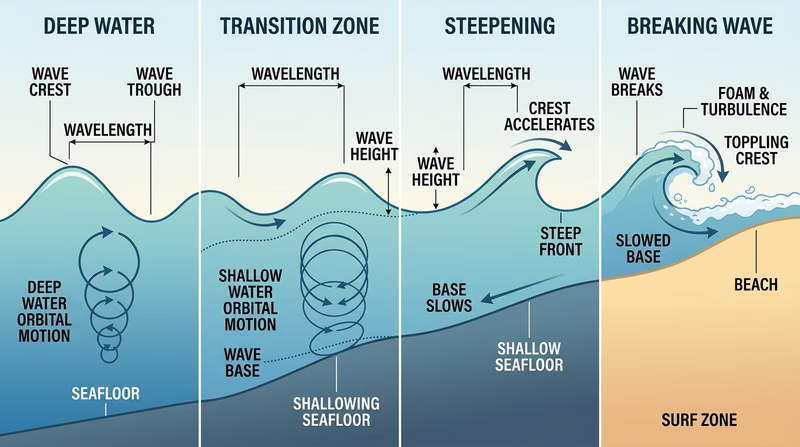
Out in deeper water, a wave can travel forward without breaking because the base of the wave is not dragging on the bottom. As the wave moves into shallow water, the lower part begins to slow down because of friction with the seafloor. The top keeps moving faster for a moment, the wave gets steeper, and eventually the crest spills or crashes forward. That is a breaker.
The slope of the beach matters too. Gentle slopes often produce spilling breakers. Steeper bottoms can create plunging breakers that curl and crash more dramatically.
🎬 Video: How Do Waves Break? (video) — https://www.youtube.com/watch?v=aXuQC1qRuEM
Requirement 3d: Rip Currents
A rip current is a narrow, fast-moving channel of water flowing away from shore. Waves pile water onto the beach, and that water has to return seaward somehow. Sometimes it escapes in a concentrated stream between sandbars or beside structures like piers.
How to avoid rip currents
- swim at beaches with lifeguards
- watch for posted warning flags
- avoid areas with a darker, calmer-looking gap between breaking waves
- stay away from piers, jetties, and sandbar cuts unless you understand local conditions
What to do if you are caught
Do not fight the current straight back to shore. That is how swimmers get exhausted.
Instead:
- Stay calm and float if needed.
- Swim parallel to shore until you leave the narrow current.
- Then angle back toward the beach.
- If you cannot swim out, wave and call for help while floating.
🎬 Video: New Guide to Spot and Escape a Rip Current (video) — https://youtu.be/lofVgAzut6w?si=At3-3C6bldcYJI5Q
Now that you understand moving water at the surface, the next step is to look below it at the landforms shaped by tectonics, sediment, and time.