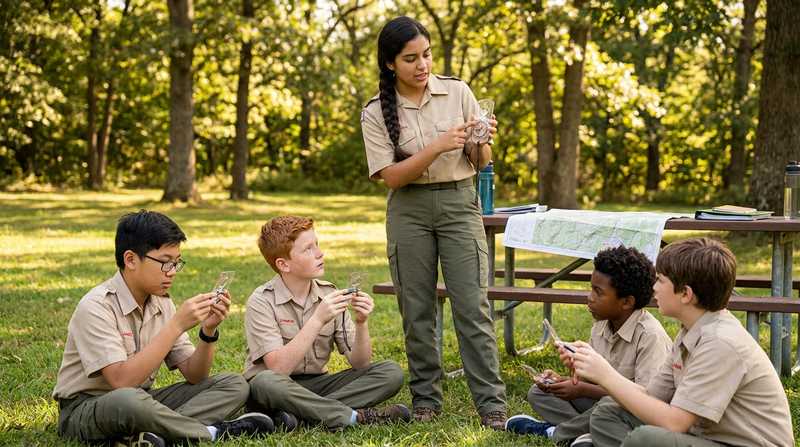
Req 10 — Teaching Orienteering
Teaching is the ultimate test of understanding. If you can explain magnetic declination to a Scout who has never held a compass, you truly know it. This final requirement asks you to pass your orienteering knowledge forward — and in the process, solidify your own mastery.
Planning Your Teaching Session
A good orienteering lesson has both classroom and field components. One without the other falls flat: pure lecture bores everyone, and jumping straight into the field without foundations leads to confusion.
Suggested Lesson Plan (60–90 minutes)
Part 1: Indoor or Shelter (20–30 minutes)
- What is orienteering? Give a quick overview using what you learned in Req 2. Show a sample orienteering map and a control description sheet.
- Compass basics. Pass out compasses and teach the parts (baseplate, bezel, needle, direction-of-travel arrow). Let everyone hold one and watch the needle settle. Reference your knowledge from Req 3a.
- Taking a bearing. Demonstrate how to set a bearing and follow it. Keep it simple — “set the number, red in the shed, walk.” This builds on Req 3b.
- Map reading. Show a topo map and explain contour lines using the five terrain features from Req 4a. Point out the common symbols from Req 4b.
Part 2: Outdoor Practice (40–60 minutes)
- Bearing exercise. Set up 3–4 stations in a field. Give each group a bearing and a distance (e.g., “Walk bearing 270° for 80 meters”). If they arrive at the correct station, they get the next bearing. This creates a simple course they can complete using only compass and pace count.
- Map orientation. Give everyone a map of the area and have them orient it using their compass. Then ask: “Point to the [building/parking lot/stream].” If they oriented correctly, they will point the right direction.
- Mini-course. If you have time and space, set up a short 3–5 control course using ribbons or cones as markers. Let them navigate it in pairs.
Teaching Techniques That Work
Show, then do
Demonstrate each technique yourself first, then have everyone try it. Walk through taking a bearing step-by-step, then pair up Scouts and let them practice on each other.
Use their language
When explaining declination, you might say: “Imagine the map says ’north is this way,’ but your compass needle says ’no, north is a little bit that way.’ Declination is the gap between those two directions.” Analogies beat technical definitions every time.
Celebrate mistakes
When someone follows a bearing and ends up 50 meters off target, celebrate it — that is exactly how they learn why pace counting and technique matter. Say: “You did the compass part right, but without pace counting, you did not know when to stop. Let’s add that.”
Adapt to your audience
For younger Scouts (11–12), keep it to compass basics and a short course. For older Scouts (15–17), you can cover declination, attack points, and the techniques from Req 6c.
What to Prepare
Teaching Session Prep
Gather these before your session
- Enough compasses for at least one per pair: Borrow from the troop if needed.
- A topographic map of the practice area: Or print one from USGS topoView.
- A sample orienteering map and control description sheet: Show what a real event looks like.
- Bearing exercise cards: Pre-written bearings and distances for the outdoor stations.
- Station markers: Cones, flags, or ribbons for marking controls.
- A whiteboard or poster: For drawing compass diagrams (optional but helpful).