Req 2 — What Is Orienteering?
Hand someone a map, a compass, and a list of checkpoints hidden in the woods. Tell them the clock is running. That, in its simplest form, is orienteering — the sport of navigating through unfamiliar terrain using only a detailed map and a compass to find a series of control points as quickly as possible.
But reducing orienteering to “running with a map” misses what makes it unique. Every other racing sport rewards pure speed. In orienteering, the fastest legs lose to the sharpest mind. A competitor who sprints the wrong direction finishes behind the one who walks the clever route. It is a sport where a 14-year-old who reads terrain well can beat a collegiate cross-country runner who cannot.
The Core Elements
Every orienteering event has the same basic components:
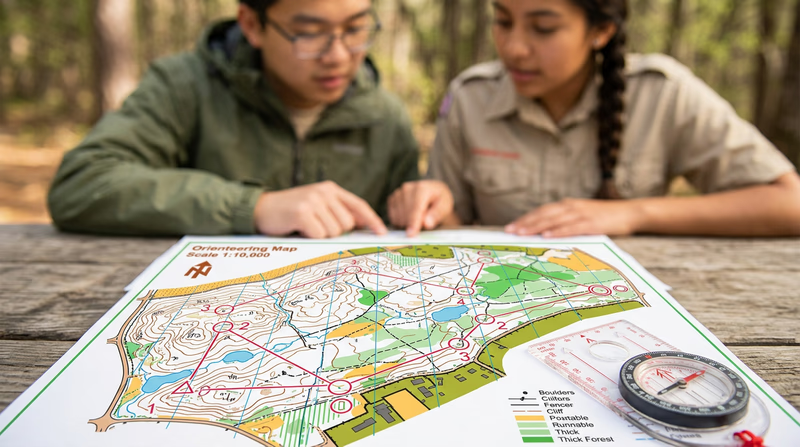
- A detailed map — Usually at 1:10,000 or 1:15,000 scale, printed in standardized colors. Unlike a hiking trail map, an orienteering map shows individual boulders, thickets, clearings, and even distinct ground surfaces. It is the most detailed map most people will ever use.
- A compass — For taking bearings and orienting the map to match the real world.
- Control points — Marked on the map as numbered circles, these correspond to physical markers (orange-and-white flags) hidden at specific features in the terrain.
- A control description sheet — A list using international symbols that tells you exactly what feature each control is placed on (e.g., “the northwest side of a large boulder”).
- A timing system — Your time starts at the start triangle and ends when you reach the finish. Some events use electronic punching (you carry a small chip that records each control visit); others use manual punch cards.
How an Event Works
- Start. You receive your map (sometimes only at the moment the clock starts) and a control description sheet.
- Navigate. You visit each control point in the order listed on your map (or, in score events, in any order you choose). At each control, you punch or tap to prove you were there.
- Route choice. Between any two controls, there are multiple possible routes. You might follow a trail that curves around a hill, or you might take a straight bearing through dense forest. The “right” route depends on your speed, the terrain, and your confidence in your navigation.
- Finish. Cross the finish line. Your time is your score.
Why Orienteering Matters Beyond the Sport
The skills you learn for this badge are the same ones used by:
- Search and rescue teams — When a lost hiker needs finding, SAR volunteers navigate with map and compass through trackless wilderness.
- Wildland firefighters — GPS signals often fail in steep canyons and heavy smoke. Map-and-compass is the reliable backup.
- Military land navigation — Every branch of the military teaches map and compass skills as a fundamental competency.
- Backcountry hikers and paddlers — Off-trail travel, route planning, and understanding terrain all build on orienteering fundamentals.
Even in everyday life, orienteering builds spatial reasoning, decision-making under pressure, and the ability to stay calm when you are temporarily “lost” — a skill that translates far beyond the woods.