Req 3a — How a Compass Works
Pick up a compass and the needle swings, wobbles, and settles — pointing roughly north every single time. It does this without batteries, without satellites, without any signal at all. Understanding why is the first step to trusting this tool with your navigation.
How a Compass Works
The Earth has a magnetic field generated by molten iron circulating in its outer core. This field extends from the South Magnetic Pole to the North Magnetic Pole, creating invisible lines of force that wrap around the planet. A compass needle is a small, lightweight magnet balanced on a nearly frictionless pivot. It aligns itself with the Earth’s magnetic field, so one end (usually painted red) points toward magnetic north.
That is the entire principle: a free-spinning magnet aligns with the Earth’s magnetism. No moving parts except the needle itself, no power source, no signal required. This is why a compass works in canyons where GPS fails, in storms where satellites are blocked, and in remote wilderness where there is no cell service.
Parts of an Orienteering Compass
An orienteering compass (also called a baseplate compass) is specifically designed for use with a map. It has features you will not find on a simple pocket compass.
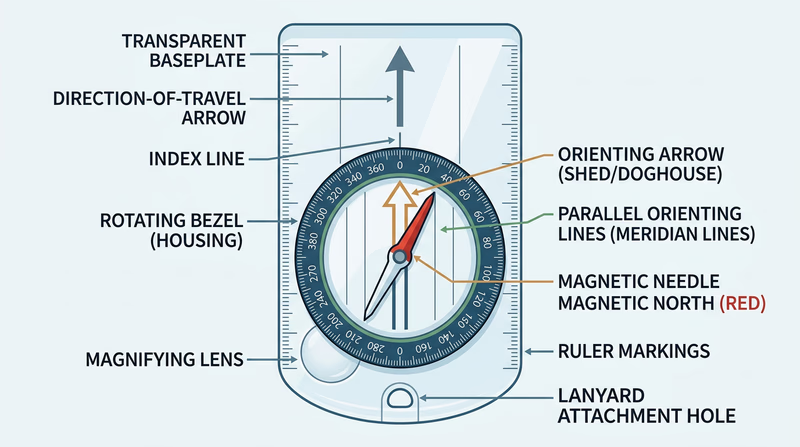
Baseplate
The flat, transparent plastic base that the compass housing sits on. Transparency matters — you need to see the map through it. The baseplate has a direction-of-travel arrow printed on it, a straight edge for drawing lines on maps, and ruler markings (usually in millimeters and map scales) along the edges.
Rotating Bezel (Housing)
The circular dial marked with degrees from 0° to 360°. You twist it to set your bearing. The index line (or read bearing mark) is where the bezel meets the direction-of-travel arrow — this is where you read your bearing number.
Magnetic Needle
Floating inside the bezel on a jeweled pivot, the needle spins freely and points to magnetic north. The north end is usually red. Some needles have luminous markings for use in low light.
Orienting Arrow and Lines
Inside the bezel (printed on the bottom of the housing), you will find the orienting arrow — sometimes called the “shed” or “doghouse” because of its shape. Surrounding it are orienting lines (also called meridian lines) that run parallel to the arrow. When you rotate the bezel, these move with it. Their job is to align with the north-south lines on your map.
Ruler and Scale Markings
The baseplate edges have rulers — typically in millimeters, plus one or two common map scales (1:25,000, 1:10,000). These let you measure distances directly on the map without a separate ruler.
Types of Compasses
While the baseplate orienteering compass is what you will use for this badge, it helps to know the other types exist:
- Thumb compass — Straps to your thumb. Preferred by competitive orienteers because it keeps the map and compass in one hand. Faster but takes practice.
- Lensatic (military) compass — Heavy, precise, and built for durability. Used by the military for detailed land navigation but slower to use with a map.
- Button (pocket) compass — Small and cheap. Fine for general direction but lacks the features needed for orienteering.