Req 7b — Event Reports
This requirement is where learning actually happens. Finishing an orienteering course feels great, but the real improvement comes from analyzing what you did afterward — control by control, leg by leg. The best orienteers in the world review every race. You should too.
The Four Parts of Your Report
1. Master Map and Control Description Sheet
After most events, you can keep your competition map or request a copy of the master map showing all control locations. Attach or include:
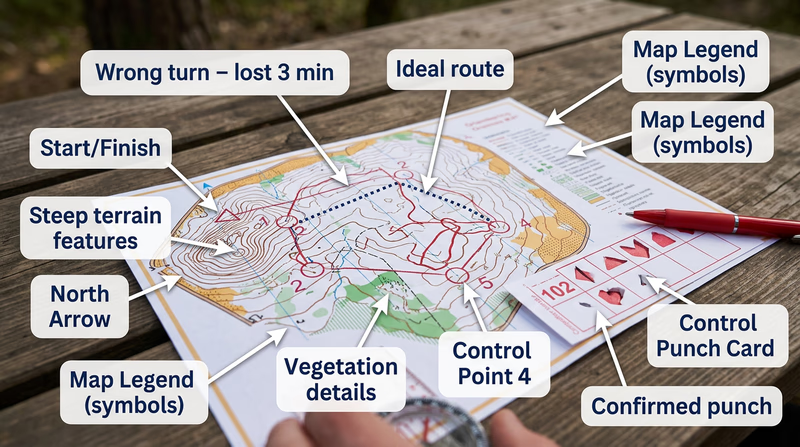
- A copy (or photo) of the master map with the course printed on it — start triangle, numbered control circles, and finish double circle
- The control description sheet you used during the event
If you took a photo of the map at the event or the organizer posts maps online afterward, use those.
2. Your Route
Using a red pen (standard in orienteering), draw the actual route you took on the map. Be honest — include the detours, the wrong turns, and the places where you wandered. Mark key decision points:
- Where did you leave each control?
- Where did you change direction?
- Where did you realize you were off course?
- What was your attack point for each control?
Comparing your route to the “ideal” route (which you can discuss with other competitors or your counselor) reveals where you lost the most time.
3. Improving Your Time
For each leg (the section between two consecutive controls), ask yourself:
- Route choice: Did you take the best route, or was there a faster option you did not see? Sometimes the straight-line bearing through thick brush is slower than a longer route following a trail.
- Attack point selection: Did you use a clear attack point, or did you try to navigate directly to the control? Would a different attack point have been faster?
- Navigation speed: Did you hesitate or stop to re-check your map too many times? Where were you confident and fast?
- Technique usage: Did you use handrails, collecting features, catching features, and aiming off effectively? Which techniques did you forget to apply?
4. Your Major Weaknesses
Be specific and honest. Generic statements like “I need to be faster” do not help. Focus on what actually went wrong:
| Weakness Example | What to Practice |
|---|---|
| “I overshot control 3 because I didn’t use a catching feature” | Pre-identify catching features during map study |
| “I lost 4 minutes relocating after control 5 because I misread the contour lines” | Practice contour reading on local topo maps |
| “My pace count was inaccurate on the uphill section” | Recalibrate pace count on hilly terrain |
| “I panicked when I couldn’t find control 2 and ran in circles” | Practice relocation drills |
| “I chose the trail route every time even when a bearing would have been faster” | Practice off-trail compass navigation |
Writing the Report
Keep it organized. A good format:
- Event header: Name, date, location, course level, total time, number of controls found.
- Attached documents: Map with route drawn, control description sheet.
- Leg-by-leg analysis: For each leg, note your time (if available), route choice, what went well, and what went wrong.
- Summary: Top 2–3 weaknesses, specific actions to improve for next time.
One to two pages per event is plenty. Quality analysis beats quantity.