Req 9 — Acting as an Official
9.
Act as an official during an orienteering event. This may be during the running of the course you set up for requirement 8.
Running a course tests your navigation skills. Officiating an event tests something different — organization, fairness, attention to detail, and the ability to keep an event running smoothly while handling the unexpected. This requirement puts you on the other side of the start line.
Official Roles at an Orienteering Event
Orienteering events need volunteers in several positions. You may serve in one or more of these roles:
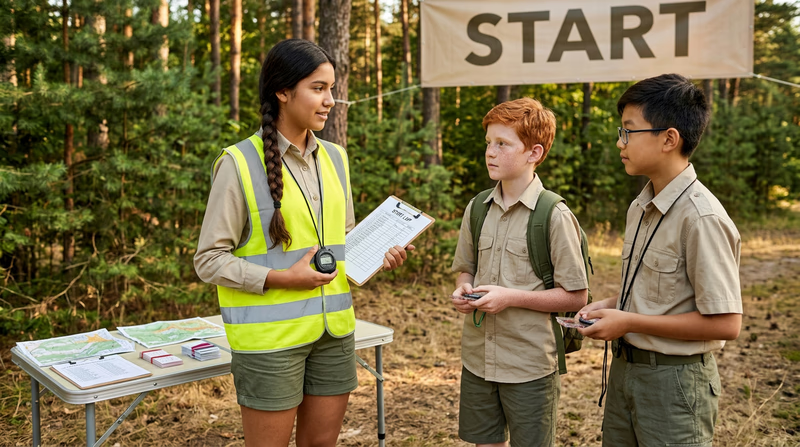
Starter
The starter manages the start area and sends competitors off at their assigned times:
- Pre-start briefing: Explain the rules, the course format, safety procedures, and the time limit (for score events). Make sure every competitor knows the distress signal (three whistle blasts) and what to do if they cannot find a control.
- Timed starts: In formal events, competitors start at intervals (usually 2–3 minutes apart) to avoid following each other. The starter calls each competitor, hands out the map (face-down until the start signal), and records the start time.
- Equipment check: Verify that every competitor has a compass, a whistle, and water.
Finish Timer
The finish timer records each competitor’s finish time and calculates results:
- Record the exact time each competitor crosses the finish line.
- Collect punch cards or download e-punch data.
- Verify that all controls were visited in the correct order (cross-country) or calculate point totals minus overtime penalties (score).
- Post preliminary results.
Control Monitor
At some events, an official is stationed at one or more controls to verify that competitors visit the correct location:
- Confirm the control flag is visible and correctly placed.
- Assist with any emergency situations.
- Report any problems (damaged flag, missing punch) to the event director.
Safety Officer
The safety officer ensures all competitors are accounted for:
- Maintain a list of all competitors and their start times.
- Track check-ins at the finish. If a competitor has not returned within a reasonable time after the course closes, initiate a search.
- Know the location of the nearest medical help and have a communication plan.
Tips for Being a Good Official
- Be fair and consistent. Apply the rules the same way for every competitor.
- Stay organized. Use a checklist for your role. Write down everything — start times, finish times, notes about problems.
- Anticipate problems. What if it starts raining? What if a control flag blows away? What if a competitor gets injured? Think through scenarios and have a plan.
- Be approachable. Competitors, especially beginners, will have questions. Answer patiently and clearly.
Official's Event Checklist
Complete before, during, and after the event
- All control flags placed and verified: Walk the course before competitors start.
- Competitor list complete: Name, start time, emergency contact for each participant.
- Rules briefed: Safety, format, time limits, distress signal explained.
- Timing system ready: Stopwatch charged, punch cards distributed, or e-punch working.
- Safety plan in place: Know the closest road, phone signal, and medical facility.
- All competitors accounted for at finish: No one left on the course.
- Course taken down: Retrieve all flags and markers after the event.