Req 4 — Fitness Assessments
Before you can improve, you need to know where you stand. This requirement asks you to choose the specific tests you will use to measure your fitness — and you will take these same tests three more times throughout your 12-week program to track your progress.
Think of these assessments as your fitness “scorecard.” They give you hard numbers that tell the truth about your current condition, and they will show you exactly how much you have improved when you are done.
Fitness Assessment Record4a — Cardiorespiratory (Aerobic) Fitness
The one-mile walk/run is a classic test of aerobic fitness. It is simple, requires no equipment, and produces a clear, measurable result — your time.
How to do it:
- Find a measured course. A standard 400-meter track (four laps = one mile) is ideal. You can also use a pre-measured route or a GPS device.
- Warm up with 5 minutes of easy walking or jogging.
- When ready, start your timer and go. Walk or run (or a combination) as fast as you safely can.
- Record your time when you finish.
Alternative assessments: If running or walking is not possible due to a disability, work with your counselor to choose an alternative that provides a similar aerobic challenge. Examples might include a timed swim, a wheelchair-based distance challenge, or a cycling test.
4b — Muscular Strength and Endurance
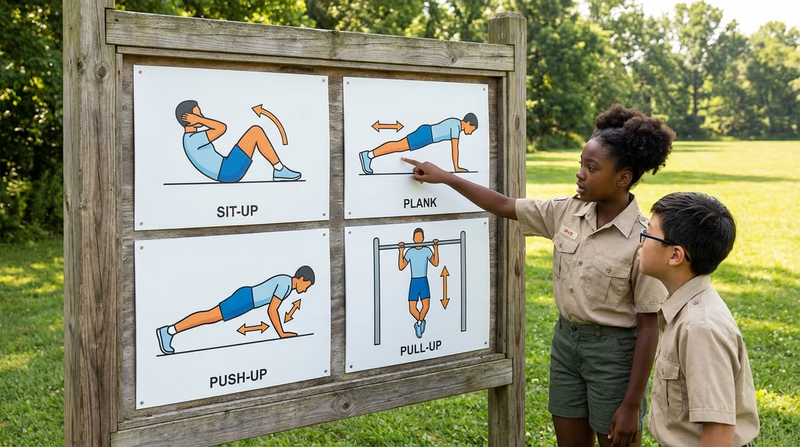
You need two tests here — one for your core and one for your upper body.
Core test — choose one:
- Sit-ups in 60 seconds: Lie on your back with knees bent, feet flat on the floor, and arms crossed over your chest. A partner holds your feet. Count how many full sit-ups you complete in one minute.
- Plank hold: Get into a push-up position but rest on your forearms instead of your hands. Keep your body in a straight line from head to heels. Time how long you can hold the position with good form.
Upper body test — choose one:
- Push-ups in 60 seconds: Start in a plank position with hands shoulder-width apart. Lower your chest to the floor and push back up. Count how many you complete with good form in one minute.
- Pull-ups in 60 seconds: Hang from a bar with palms facing away from you, arms fully extended. Pull yourself up until your chin is above the bar. Count how many you complete in one minute.
4c — Flexibility
Back-saver sit-and-reach: Sit on the floor with one leg extended and the other bent with the foot flat against the inner thigh of the straight leg. Reach forward along the extended leg as far as you can. Measure the distance. Repeat with the other leg.
Back scratch test (shoulder flexibility): Reach one hand over your shoulder and down your back. Reach the other hand behind your back and up. Try to touch or overlap your fingers. Measure the distance between your fingertips (or how much they overlap).
Choosing Your Nutrition Assessment
In addition to physical tests, you will track your diet. The specific nutrition assessment is straightforward: a 3-day food and drink log that you will complete at three points during your program (before, during week 8, and during week 12).
Measures of Physical Fitness (fillable PDF)