
Personal Management Merit Badge — Complete Digital Resource Guide
https://merit-badge.university/merit-badges/personal-management/guide/
Introduction & Overview
Personal Management is one of the most practical merit badges you can earn. It teaches you how to handle money wisely, manage your time, and plan projects — skills you will use every single day for the rest of your life. Whether you are saving up for a new bike, figuring out how to balance homework and sports, or dreaming about a future career, this badge gives you the tools to make it happen. As an Eagle-required badge, Personal Management is a key step on the trail to Eagle Scout.

Then and Now
Then
The idea of teaching young people about money management goes way back. Benjamin Franklin published Poor Richard’s Almanack in 1732, filling it with advice like “a penny saved is a penny earned.” When Scouting America introduced merit badges in 1911, Personal Management was among the earliest — recognizing that being “prepared” means more than knowing how to tie knots. In those days, most families tracked spending with handwritten ledgers, and young people learned about money by helping run the family store or farm.
Now
Today, money moves at the speed of a tap. You can buy something online in seconds, transfer money between accounts with an app, and even invest in the stock market from your phone. That speed makes personal management skills more important than ever. It is easy to spend without thinking when you never see physical cash leave your hands. This badge teaches you to be intentional — to pause, plan, and make smart decisions about your money, your time, and your future.
Kinds of Personal Management
Personal Management is not just one skill — it is a set of connected skills that work together to help you take charge of your life. Here are the four big areas you will explore in this badge.
Money Management
This is the core of the badge. You will learn how to create and follow a budget, compare prices like a smart shopper, and understand the difference between needs and wants. Money management is about making your dollars work for you instead of wondering where they all went.

Saving & Investing
Once you know how to manage day-to-day money, you will explore how to grow it over time. You will learn the difference between a savings account and stocks, understand how compound interest can turn small amounts into large ones, and discover why starting to save early gives you a huge advantage.
Time Management
Money is not the only resource you need to manage. Time is just as valuable — and you cannot earn more of it. You will build a weekly schedule, keep a journal of how you actually spend your time, and learn strategies for getting more done without feeling overwhelmed.
Project Planning
Every goal starts with a plan. Whether it is organizing a campout, launching a service project, or preparing for a big event, you will learn how to break a big idea into manageable steps, create a timeline, and build a budget that keeps the project on track.
Req 1a — Choosing a Major Purchase
What Counts as a “Major Expense”?
A major expense is any purchase that is too big to pay for out of a single paycheck or month’s budget. It is something your family would need to save up for over weeks or months. Think about things your family has talked about buying — or something that would genuinely improve your family’s life.
Here are some examples to get you thinking:
- Transportation: A used car, new tires, or a bicycle for commuting
- Home improvement: A new appliance (refrigerator, washer/dryer), furniture, or a home repair like fixing the roof
- Technology: A computer for schoolwork, a new phone, or a gaming console
- Recreation: A family vacation, camping gear, or sports equipment
- Education: Musical instrument, tutoring program, or college savings contribution
How to Choose the Right Item
This requirement asks you to pick one item, so be thoughtful about your choice. The item you select here will carry through Requirements 1b and 1c, where you will create a savings plan and a shopping strategy for it.
When choosing, consider these questions:
- Is it realistic? Pick something your family could genuinely save for, not a mansion or a private jet.
- Is it specific? “A laptop for schoolwork” is better than “electronics.” The more specific you are, the easier it will be to research prices in Requirement 1c.
- Does it have a clear price range? You will need to compare prices later, so choose something that is sold by multiple retailers.

Needs vs. Wants
Before finalizing your choice, think about whether this item is a need or a want. There is nothing wrong with wants — they make life more enjoyable — but understanding the difference helps you make better decisions about when and how to spend.
- Need: Something essential for daily life — reliable transportation to get to work, a working refrigerator, a winter coat
- Want: Something that improves quality of life but is not strictly necessary — a bigger TV, a vacation, a gaming console
Most major purchases fall somewhere in between. A car might be a need, but a brand-new car is partly a want. Being honest about this distinction will help you in the next steps when you build your savings plan.
Getting Ready for Your Counselor
When you meet with your counselor for this requirement, be prepared to explain:
- What the item is (be specific — brand, model, or type)
- Why your family would benefit from it
- Whether it is a need, a want, or somewhere in between
- Approximately how much it costs (a rough range is fine for now)
Req 1b — Creating a Savings Plan
Write a plan that tells how your family would save money for the purchase identified in requirement 1(a).
- Discuss the plan with your counselor.
- Discuss the plan with your family.
- Discuss how other family needs must be considered in this plan.
Building Your Savings Plan
A savings plan is a roadmap that tells you how to get from where you are now to where you want to be — with the money to buy that major purchase you identified in Requirement 1a. A good plan answers three questions: How much do you need? How long will it take? Where will the money come from?
Step 1: Set Your Target Amount
Start with the approximate cost of the item. If you are not sure of the exact price yet (you will research that more in Requirement 1c), use your best estimate. Do not forget to account for extras like sales tax, delivery fees, or accessories.
For example, if you are saving for a laptop that costs $800:
- Sales tax (about 7%): $56
- A protective case: $30
- Total target: $886
Step 2: Determine Your Timeline
How soon does your family need or want this item? A shorter timeline means saving more per week or month. A longer timeline gives you more flexibility but requires patience.
Step 3: Identify Where the Money Will Come From
This is the creative part. Where can your family find extra money each week or month? Here are common strategies:
- Reduce spending: Cut back on eating out, subscription services, or impulse buys
- Increase income: Extra chores, part-time work, selling items you no longer need
- Redirect savings: Temporarily pause saving for a less urgent goal
- Dedicated savings account: Set up an account specifically for this purchase so the money does not get mixed in with everyday spending

Step 4: Write It Down
Your written plan should include:
Savings Plan Components
Include each of these in your written plan- Target purchase: What you are saving for and why
- Total amount needed: Including tax and extras
- Timeline: Start date and target date
- Weekly or monthly savings amount: How much you need to set aside
- Sources of savings: Where the money will come from
- Tracking method: How you will keep track of progress
Considering Other Family Needs
This is the most important part of your plan — and the part many Scouts overlook. Your family does not exist to save for one item. There are bills, groceries, medical expenses, and other obligations that come first.
When you discuss your plan with your family, ask questions like:
- “Are there any upcoming expenses that might affect our ability to save?”
- “Is there a better time of year to make this purchase?”
- “Would it make sense to save a little less each month and take longer to reach our goal?”
Having the Conversations
This requirement asks you to discuss the plan with both your counselor and your family. These are not just check-the-box conversations — they are opportunities to get feedback and improve your plan.
With your counselor, focus on whether the plan is realistic and well-structured. Your counselor can point out things you might have missed.
With your family, focus on whether the plan works for everyone. Your family knows their budget better than anyone and can help you adjust the timeline or savings amount.
MyMoney.gov — Saving & Investing The U.S. government's resource on saving strategies, setting financial goals, and building a savings habit. Link: MyMoney.gov — Saving & Investing — https://www.mymoney.gov/saving-investingReq 1c — Shopping Strategy
Develop a written shopping strategy for the purchase identified in requirement 1(a).
- Determine the quality of the item or service (using consumer publications or rating systems.)
- Comparison shop for the item. Find out where you can buy the item for the best price. (Provide prices from at least two different price sources.) Call around; study ads. Look for a sale or discount coupon. Consider alternatives. Can you buy the item used? Should you wait for a sale?
Becoming a Smart Shopper
You have chosen your major purchase and created a savings plan. Now it is time to figure out exactly what to buy and where to buy it. A shopping strategy helps you get the best value — not just the lowest price, but the best combination of quality, price, and reliability.
Researching Quality
Before you compare prices, you need to know what “good” looks like. A cheaper version of a product that breaks in six months is not a bargain — it is a waste of money.
Here is how to research quality:
Consumer publications are organizations that independently test and rate products. They do not accept advertising money, so their reviews are unbiased.
Online rating systems like customer reviews on retail sites can be helpful, but use them carefully. Look for patterns across many reviews rather than trusting a single five-star or one-star rating.
Key quality factors to research:
- Durability: How long will this item last?
- Performance: Does it do what you need it to do well?
- Warranty: What does the manufacturer cover if something goes wrong?
- Brand reputation: Does this company stand behind its products?
- Safety ratings: Especially important for cars, appliances, and electronics

Comparison Shopping
Now that you know what quality looks like, it is time to find the best price. The requirement asks for at least two price sources, but checking three or four gives you a better picture.
Comparison Shopping Checklist
Places to check for prices- Retail stores: Visit or call local stores for in-store prices
- Online retailers: Check major websites and the manufacturer’s own site
- Classified ads and resale sites: Look for used or refurbished options
- Warehouse clubs: Membership stores sometimes offer significant discounts
- Sale flyers and circulars: Check weekly ads for upcoming sales
- Coupon sites and apps: Search for discount codes before buying
Should You Buy Used?
For many major purchases, buying used or refurbished can save you 30 to 70 percent of the retail price. But it is not always the right choice.
Buying used works well for:
- Cars (new cars lose significant value the moment you drive them off the lot)
- Furniture (especially solid wood pieces that hold up over time)
- Musical instruments (a well-maintained instrument can last decades)
- Sports equipment (items like bikes and camping gear that you may outgrow)
Buying new makes more sense for:
- Electronics with rapidly changing technology (the used version may be outdated)
- Items where warranty and support matter (appliances, for example)
- Safety equipment (helmets, car seats — you cannot verify their history)
Should You Wait for a Sale?
Timing can make a big difference. Many products go on sale at predictable times of the year:
- Electronics: Black Friday (late November), back-to-school season (August)
- Appliances: Holiday weekends (Memorial Day, Labor Day, Presidents’ Day)
- Cars: End of the model year (September–October), end of the month (dealers trying to hit quotas)
- Outdoor gear: End of season (winter gear on sale in spring, summer gear on sale in fall)
Writing Your Shopping Strategy
Your written strategy should be organized and easy to follow. Include:
- The item you chose and the specific model or type you recommend after researching quality
- Quality ratings from at least one consumer publication or rating system
- Price comparison chart showing at least two sources with prices, shipping costs, and any discounts
- Used/refurbished analysis — is buying used a good option for this item?
- Timing recommendation — should your family buy now or wait for a sale?
- Your recommendation — which source offers the best overall value and why
Req 2a — Building a Budget
What Is a Budget?
A budget is a plan for your money. It tells every dollar where to go before you spend it. Think of it like a trail map — without one, you might wander in circles. With one, you know exactly where you are headed and how to get there.
For this requirement, you will create a 13-week budget — that is about three months. This gives you enough time to see real patterns in how you earn and spend money.

Understanding the Three Parts of a Budget
Every budget has three components:
Income is money coming in. For a Scout, this might include:
- Allowance (weekly or monthly)
- Birthday or holiday gifts (if they fall within your 13 weeks)
- Wages from a job (babysitting, lawn mowing, part-time work)
- Money earned from selling things
Expenses are money going out. Think about everything you spend money on:
- Food and snacks (buying lunch at school, snacks with friends)
- Entertainment (movies, games, streaming subscriptions)
- Transportation (bus fare, gas money if you are driving)
- Clothing
- Gifts you buy for others
- Scout-related costs (campouts, equipment, dues)
- Personal items (hygiene products, phone case, school supplies)
Savings is money you set aside for the future instead of spending it now. This might go toward a specific goal (like the major purchase from Requirement 1) or into a general savings account.
Setting Up Your Budget
You can create your budget in several ways:
- On paper: Use a notebook with columns for each week
- Spreadsheet: Use Google Sheets, Excel, or another app
- Budget template: Use the forms in the Personal Management merit badge pamphlet
- Budgeting app: Some apps are designed for teens and young adults
No matter which format you use, your budget should have:
Budget Layout
What to include each week- Week number and dates: Label each of the 13 weeks
- Expected income: List each source and amount
- Expected expenses: List each category and amount
- Planned savings: How much you will set aside
- Totals: Sum of income, expenses, and savings for each week
How to Estimate When You Are Not Sure
Some weeks are easy to predict — your allowance is the same every week, for example. Others are trickier. Here are strategies for estimating:
- Regular expenses: If you buy lunch at school three times a week at $5 each, that is $15 per week — easy.
- Irregular expenses: A friend’s birthday party might only happen once during your 13 weeks. Put it in the week you expect it to happen.
- Surprise expenses: Set aside a small “miscellaneous” amount each week (even $2–3) for things you cannot predict.
A Word About the 13-Week Timeline
Thirteen weeks is a long commitment, and it is worth noting that you will also need to track your actual spending for these same 13 weeks in Requirement 2c. Start your budget and tracking at the same time — this way you can compare your plan to reality when you are done.
Practical Money Skills — Budget Basics Free budgeting tools, calculators, and guides designed for young people learning to manage money. Link: Practical Money Skills — Budget Basics — https://practicalmoneyskills.com/resources/budgetingReq 2b — Balancing Your Budget
Compare expected income with expected expenses.
- If expenses exceed budget income, determine steps to balance your budget.
- If income exceeds budget expenses, state how you would use the excess money (new goal, savings).
The Balancing Act
Now that you have built your 13-week budget in Requirement 2a, it is time to step back and look at the big picture. Add up your total expected income for all 13 weeks. Then add up your total expected expenses (including savings). How do the two numbers compare?
There are only three possible outcomes:
- Income > Expenses: You have money left over. Great problem to have.
- Income = Expenses: Perfectly balanced. Every dollar has a job.
- Income < Expenses: You are planning to spend more than you earn. This needs fixing.
When Expenses Exceed Income
If your expenses are higher than your income, your budget is “in the red.” This is not unusual — many people (and many governments) create budgets that spend more than they earn. The difference is that you are going to fix it.
Here are practical strategies to bring your budget into balance:
Cut expenses:
- Identify your biggest “want” expenses — can any be reduced or eliminated?
- Look for cheaper alternatives (pack lunch instead of buying it, borrow books instead of buying them)
- Postpone non-urgent purchases to after your 13-week period
Increase income:
- Can you take on a small job like dog walking, lawn care, or tutoring?
- Do you have items you could sell (old games, clothes you have outgrown)?
- Could you negotiate a small increase in your allowance in exchange for extra chores?

When Income Exceeds Expenses
If you have money left over after covering all your expenses and savings, congratulations — you are ahead of the game. But “extra” money without a plan tends to disappear. Decide now what you will do with the surplus.
Smart options for excess funds:
- Boost your savings goal: Add the extra to your savings from Requirement 1b
- Create an emergency fund: Set aside money for unexpected expenses
- Set a new goal: Is there something else you have been wanting to save for?
- Give: Consider donating a portion to a cause you care about (you will explore this idea more in Requirement 3)
Presenting Your Analysis
When you discuss this with your counselor, show your work clearly:
Budget Balance Summary
What your counselor will want to see- Total expected income: The sum across all 13 weeks
- Total expected expenses: Including planned savings
- The difference: Income minus expenses
- Your plan: Steps to balance (if negative) or how you will use excess (if positive)
- Specific changes: If you adjusted your budget, show what you changed and why
Req 2c — Tracking Your Money
The Real Test Begins
Building a budget was the plan. Tracking your money for 13 weeks is the test. This is where you find out what really happens when your plan meets real life — and that is the most valuable part of the entire merit badge.
Thirteen weeks is about three months. You will see patterns emerge that you never expected. Maybe you spend more in the first week of the month. Maybe your expenses spike around holidays. These are the kinds of insights that turn you into someone who truly understands money.
Choosing Your Tracking Method
The requirement gives you flexibility in how you track. Pick a method you will actually stick with for 13 weeks.
Paper tracker: A notebook or printed form where you write every transaction by hand. Simple, no technology needed, but easy to forget.
Spreadsheet: Google Sheets or Excel lets you create formulas that automatically total your income and expenses. Great if you are comfortable with computers.
App: Several free apps are designed for tracking income and expenses. Some connect to bank accounts, while others let you enter transactions manually.
The pamphlet forms: The Personal Management merit badge pamphlet includes tracking forms you can photocopy and use.

What to Track
Every time money comes in or goes out, record it. Every single time. Even small amounts.
For income, record:
- Date
- Source (allowance, birthday gift, lawn mowing job)
- Amount
For expenses, record:
- Date
- What you bought (be specific — “snack at 7-Eleven” not just “food”)
- Category (food, entertainment, transportation, etc.)
- Amount
For savings, record:
- Date
- Amount transferred to savings
- Running total in savings
Dealing with Common Challenges
Organizing Your Records
Keep your records organized by week so they match your budget from Requirement 2a. At the end of each week, total up your income, expenses, and savings for that week.
Weekly Tracking Summary
Complete this at the end of each week- Total income for the week: Sum of all money received
- Total expenses for the week: Sum of all money spent
- Total savings for the week: Amount set aside
- Running totals: Cumulative income, expenses, and savings since week 1
- Notes: Anything unusual that affected your spending this week
Staying Motivated Over 13 Weeks
Three months is a long time. Here are strategies to keep going:
- Check in weekly: Spend five minutes each Sunday reviewing the week. This keeps you engaged without being overwhelming.
- Celebrate milestones: At week 4, week 8, and week 12, look back at how far you have come.
- Share your progress: Tell a parent or friend what you are learning. Teaching others reinforces your own habits.
- Remember the goal: You are not just checking a box. You are building a skill that will benefit you for decades.
Presenting Your Records
At the end of 13 weeks, organize your records for your counselor. You do not need a fancy presentation — clear, accurate records are what matter. Make sure your counselor can see:
- Weekly breakdowns of income, expenses, and savings
- Grand totals for the entire 13-week period
- Categories of spending (so you can analyze patterns in Requirement 2d)
Req 2d — Budget Review
Budget vs. Reality
This is the payoff. After 13 weeks of tracking, you now have two sets of numbers: what you planned to happen and what actually happened. Comparing them is where the real learning takes place.
Almost nobody’s budget matches reality perfectly. That is not a failure — it is completely normal. The goal is to understand why they differed and what you would change next time.
How to Compare
Go through your records week by week and look at three things:
- Income: Did you earn what you expected? More? Less?
- Expenses: Did you spend what you planned in each category?
- Savings: Did you save as much as you intended?
For each area, calculate the difference:
Actual amount - Budgeted amount = Variance
A positive variance in income means you earned more than expected. A positive variance in expenses means you spent more than planned (not great). A positive variance in savings means you saved more than planned (awesome).

Common Patterns You Might Discover
You underestimated “small” expenses. That $3 snack three times a week? That is $117 over 13 weeks. Small, frequent expenses are the most commonly underestimated category.
Irregular expenses threw you off. A birthday party gift, a school field trip fee, or replacing something that broke — these one-time costs are hard to predict.
Your income was less consistent than expected. Maybe your babysitting gig dried up for a few weeks, or holiday gifts came in a different month than you expected.
Some categories were spot-on. Your fixed expenses (like a phone bill or Scout dues) probably matched your budget closely. Fixed costs are predictable — that is why they are called fixed.
Discussing What You Would Do Differently
When you meet with your counselor, be ready to reflect honestly. Here are questions to think about:
Budget Review Reflection
Questions to prepare for your counselor discussion- Which expense categories were most accurate? Why?
- Which categories were most off? What surprised you?
- Did any unexpected income or expenses arise? How did you handle them?
- Did you adjust your spending during the 13 weeks, or stick to the original plan?
- What would you change about your budget categories or estimates?
- Would you use a different tracking method next time?
- What did you learn about your own spending habits?
Lessons for Next Time
The whole point of this exercise is to get better at budgeting. Here are common improvements Scouts make:
- Add a “miscellaneous” category to absorb unpredictable small expenses
- Budget by category, not just total — knowing you spent $200 total is less useful than knowing you spent $80 on food and $60 on entertainment
- Review weekly, not just at the end — catching a spending spike in week 3 lets you adjust before week 13
- Be more realistic about income — budget based on what you consistently earn, not your best week
Req 3 — Psychology of Money
Discuss with your counselor FIVE of the following concepts:
a. The emotions you feel when you receive money.
b. Your understanding of how the amount of money you have with you affects your spending habits.
c. Your thoughts when you buy something new and your thoughts about the same item three months later. Explain the concept of buyer’s remorse.
d. How hunger affects you when shopping for food items (snacks, groceries).
e. Your experience of an item you have purchased after seeing or hearing advertisements for it. Did the item work as well as advertised?
f. Your understanding of what happens when you put money into a savings account.
g. Charitable giving. Explain its purpose and your thoughts about it.
h. What you can do to better manage your money.
Note: You need to discuss five of the eight options below with your counselor. Read through all of them, then choose the five that interest you most or that you have the strongest personal experiences with.
Understanding the Money-Emotion Connection
Money is not just numbers in an account. It is tied to how you feel, how you think, and how you make decisions — often in ways you do not even realize. This requirement helps you recognize those invisible forces so you can make smarter choices.

Option A: Emotions and Receiving Money
Think about the last time you received money — a birthday gift, payment for a job, or your allowance. How did it feel? Most people experience a rush of excitement, possibility, or even relief. That emotional response is powerful and can drive your next decision.
When you feel flush with cash, you are more likely to spend impulsively. The excitement of having money can make you want to do something with it right away. Recognizing this feeling is the first step to controlling it. Some people find it helpful to wait 24 hours before spending any “new” money — giving the initial excitement time to fade so they can think clearly.
Option B: Cash in Your Pocket
Here is something interesting: the amount of money you carry affects how much you spend. If you have $50 in your wallet, you are more likely to buy that $12 item than if you only have $15. This is true even if you were not planning to buy anything.
This effect is even stronger with digital money. When you cannot see your balance shrinking, it is easier to spend without thinking. One strategy is to carry only the cash you plan to spend — leave the rest at home or in a savings account.
Option C: Buyer’s Remorse
Buyer’s remorse is the feeling of regret after making a purchase. It usually hits a few days or weeks after buying something. That new video game that seemed amazing in the store? Three months later, it might be collecting dust on a shelf.
Buyer’s remorse happens because the excitement of buying something is temporary, but the cost is permanent. The rush of getting something new fades quickly — psychologists call this hedonic adaptation. You get used to the new thing, and it stops feeling special.
To fight buyer’s remorse, ask yourself before buying: “Will I still be excited about this in three months?” If the answer is not a clear yes, consider waiting.
Option D: Hungry Shopping
Never grocery shop on an empty stomach — you have probably heard this advice. But do you know why it works? When you are hungry, your brain is wired to seek out food aggressively. Everything looks appealing. Snack aisle items that you would normally walk past suddenly end up in your cart.
This is an example of how your physical state affects your financial decisions. You are not making a logical choice about nutrition or value — your body is making an emotional, survival-driven choice. The fix is simple: eat before you shop. Studies show that shoppers who eat a meal before grocery shopping spend 20 to 30 percent less.
Option E: Advertising and Reality
Companies spend billions of dollars on advertising because it works. Ads create desire for products by showing you idealized versions of what they can do. That new phone in the commercial looks life-changing. That energy drink promises peak performance.
Think about something you bought because of advertising. Did it live up to the hype? Often, the answer is no — or at least not completely. This does not mean all ads are lies, but they always show the best-case scenario. Being a smart consumer means recognizing when an ad is creating desire versus providing useful information.
Option F: How Savings Accounts Work
When you put money into a savings account, the bank does not just store it in a vault with your name on it. The bank uses your money — along with everyone else’s deposits — to make loans to other people. In return, the bank pays you interest, a small percentage of your balance, as a thank-you for letting them use your money.
Over time, you earn interest not just on your original deposit, but on the interest you have already earned. This is called compound interest, and you will dive deeper into it in Requirement 4c. For now, the key idea is that a savings account is not just a safe place to park money — it is a place where your money slowly grows.
Option G: Charitable Giving
Giving money to causes you care about — whether it is your place of worship, a food bank, or an environmental organization — is a powerful way to use your resources. Charitable giving helps communities, supports people in need, and funds important work.
But giving is not just about the recipient. Research consistently shows that people who give to others report greater happiness than those who spend the same amount on themselves. There is also a practical side: in many cases, charitable donations are tax-deductible, meaning they can reduce the amount of income tax you owe.
Think about what causes matter to you. Even small donations make a difference, and building a giving habit now creates a lifelong pattern of generosity.
Option H: Better Money Management
This option ties everything together. What specific steps can you take to manage your money more effectively? Based on what you have learned so far in this badge, consider strategies like:
- Track your spending (as you did in Requirement 2c)
- Set clear savings goals with timelines
- Wait before buying — the 24-hour rule for impulse purchases
- Learn the difference between needs and wants
- Talk about money with trusted adults
- Start saving early — even small amounts matter over time
Req 4 — Saving vs. Investing
Explain the following to your counselor:
a. The differences between saving and investing, including reasons for using one over the other.
b. The concepts of return on investment and risk and how they are related.
c. The concepts of simple interest and compound interest.
d. The concept of diversification in investing.
e. Why it is important to save and invest for retirement.
4a: Saving vs. Investing
Saving means putting money aside in a safe, easily accessible place — like a savings account or a piggy bank. Your money is protected, you can get to it whenever you need it, and it earns a small amount of interest. The trade-off is that it grows slowly.
Investing means putting money into something — like stocks, bonds, or real estate — with the expectation that it will grow in value over time. Investing offers the potential for much higher returns than saving, but it comes with risk. Your investment could lose value, and your money is usually not as easy to access quickly.
When to save:
- For short-term goals (less than 3–5 years away)
- For your emergency fund
- When you cannot afford to lose the money
When to invest:
- For long-term goals (5+ years away, like college or retirement)
- When you have already built an emergency fund
- When you can handle some ups and downs in value

4b: Return on Investment and Risk
Return on investment (ROI) measures how much money you earn (or lose) compared to how much you put in. If you invest $100 and it grows to $110, your return is $10, or 10%.
Risk is the chance that your investment could lose value. A savings account at an FDIC-insured bank has almost zero risk — your money is guaranteed. A stock in a single company has much higher risk — the company could do great, or it could go bankrupt.
Here is the key relationship: higher potential returns come with higher risk. This is one of the most fundamental rules of finance. No investment offers high returns with no risk — if someone promises that, it is a scam.
| Investment Type | Typical Risk | Typical Return |
|---|---|---|
| Savings account | Very low | 1–5% per year |
| Government bonds | Low | 3–5% per year |
| Mutual funds (diversified) | Medium | 7–10% per year (historically) |
| Individual stocks | High | Varies widely |
4c: Simple Interest vs. Compound Interest
Simple interest is calculated only on the original amount you deposited (called the principal). If you deposit $1,000 at 5% simple interest, you earn $50 every year — always $50, because it is always 5% of the original $1,000.
Compound interest is calculated on the principal plus any interest you have already earned. This is where the magic happens:
- Year 1: $1,000 × 5% = $50 in interest → Balance: $1,050
- Year 2: $1,050 × 5% = $52.50 in interest → Balance: $1,102.50
- Year 3: $1,102.50 × 5% = $55.13 in interest → Balance: $1,157.63
See how the interest grows each year? You are earning interest on your interest. Over long periods, this snowball effect becomes enormous.
After 10 years at 5%:
- Simple interest: $1,000 + $500 = $1,500
- Compound interest: $1,628.89
After 30 years at 5%:
- Simple interest: $1,000 + $1,500 = $2,500
- Compound interest: $4,321.94
4d: Diversification
Diversification means spreading your investments across different types of assets so that if one performs poorly, others may perform well and balance it out. It is the financial version of “don’t put all your eggs in one basket.”
Imagine you invest all your money in one company. If that company has a bad year, you lose a lot. But if you invest in 50 different companies across different industries, one bad performer barely dents your overall portfolio.
You can diversify across:
- Asset types: Stocks, bonds, real estate, savings accounts
- Industries: Technology, healthcare, energy, consumer goods
- Geography: U.S. companies, international companies
- Company size: Large established companies and small growing ones
Mutual funds, which you will learn about in Requirement 5, are one of the easiest ways to diversify because a single fund holds many different investments.
4e: Why Save and Invest for Retirement
Retirement might seem impossibly far away when you are a teenager, but that distance is actually your biggest advantage. Starting early gives compound interest decades to work.
Consider two people:
- Scout A starts investing $100 per month at age 18 and stops at age 28 (10 years, $12,000 total invested)
- Scout B starts investing $100 per month at age 28 and continues until age 65 (37 years, $44,400 total invested)
At a 7% average annual return, Scout A ends up with more money at age 65 than Scout B — even though Scout A invested for only 10 years and Scout B invested for 37 years. That is the power of starting early.
Investor.gov — Introduction to Investing The SEC's free educational site explaining investing basics, risk, and how different investments work. Designed for beginners. Link: Investor.gov — Introduction to Investing — https://www.investor.gov/introduction-investing Compound Interest Calculator Try different amounts, interest rates, and time periods to see how compound interest works with your own numbers. Link: Compound Interest Calculator — https://www.investor.gov/financial-tools-calculators/calculators/compound-interest-calculatorReq 5 — Types of Investments
Explain to your counselor what the following investments are and how each works:
a. Common stocks
b. Mutual funds
c. Life insurance
d. A certificate of deposit (CD)
e. A savings account
f. A U.S. savings bond.
The Investment Lineup
In Requirement 4, you learned the principles of investing — risk, return, diversification, and compound interest. Now it is time to meet the specific tools. Think of these six investment types as different tools in a toolbox. Each one has a purpose, and smart investors use a combination of them.

5a: Common Stocks
When you buy a stock, you are buying a tiny piece of ownership in a company. If the company does well and grows, your piece becomes more valuable. If the company struggles, your piece loses value.
How stocks make you money:
- Price appreciation: You buy a stock for $50, and it grows to $75. You can sell it for a $25 profit.
- Dividends: Some companies share profits with shareholders by paying dividends — regular payments (usually quarterly) for each share you own.
The risk: Stock prices go up and down daily, sometimes dramatically. A single company’s stock can lose most of its value if the company has serious problems. That is why diversification — owning many different stocks — is so important.
5b: Mutual Funds
A mutual fund pools money from many investors and uses it to buy a collection of stocks, bonds, or other investments. A professional fund manager decides what to buy and sell within the fund.
Why mutual funds are popular:
- Instant diversification: Instead of buying one stock, you own a piece of dozens or hundreds of investments
- Professional management: A fund manager does the research and makes decisions
- Accessibility: You can invest with relatively small amounts of money
The trade-off: Mutual funds charge fees (called an expense ratio) that reduce your returns. Index funds — a type of mutual fund that simply tracks a market index like the S&P 500 — tend to have much lower fees and often outperform professionally managed funds over long periods.
5c: Life Insurance
Life insurance is unusual on this list because it is primarily a protection product, not a pure investment. When someone buys a life insurance policy, they pay regular premiums. If they die while the policy is active, the insurance company pays a lump sum (called a death benefit) to the person’s beneficiaries — usually their family.
Why it is listed as an investment: Some types of life insurance (called whole life or universal life) include a savings component that builds cash value over time. You will learn more about the differences between whole life and term life in Requirement 6.
Who needs life insurance: Primarily people whose families depend on their income. If a parent earns the family’s main income and dies unexpectedly, life insurance helps the family pay bills, mortgages, and living expenses.
5d: Certificate of Deposit (CD)
A certificate of deposit (CD) is like a savings account with a lock on it. You deposit a fixed amount of money for a set period — called the term — and in return, the bank pays you a higher interest rate than a regular savings account.
How CDs work:
- You choose a term (common terms: 3 months, 6 months, 1 year, 2 years, 5 years)
- The bank pays a fixed interest rate for the entire term
- When the term ends (called maturity), you get your money back plus the interest earned
- If you withdraw early, you usually pay a penalty
When CDs make sense: When you have money you know you will not need for a specific period and you want a guaranteed, predictable return with virtually no risk.
5e: Savings Account
A savings account is the most basic and accessible place to keep money. You deposit money at a bank or credit union, earn a small amount of interest, and can withdraw your money whenever you need it.
Key features:
- FDIC insured (up to $250,000 per depositor, per bank) — your money is protected even if the bank fails
- Liquid — you can access your money at any time
- Low return — interest rates are typically lower than other investments
- No risk — your balance will never go down (the interest rate might change, but your principal is safe)
Types of savings accounts:
- Regular savings: Basic account, lowest interest rate
- High-yield savings: Online banks often offer significantly higher rates because they have lower overhead costs
- Money market accounts: Slightly higher rates, may require a higher minimum balance
5f: U.S. Savings Bond
A U.S. savings bond is a loan you make to the federal government. You buy the bond, and the government promises to pay you back with interest after a certain period.
Two main types:
- Series EE bonds: Guaranteed to double in value over 20 years. They earn a fixed interest rate.
- Series I bonds: Earn a combination of a fixed rate plus an inflation rate that adjusts every six months. These protect your money from losing purchasing power due to inflation.
How to buy them: U.S. savings bonds are purchased online through TreasuryDirect.gov. You can buy them for as little as $25.
Putting It All Together
Here is how these investments compare:
| Investment | Risk Level | Liquidity | Typical Return | Best For |
|---|---|---|---|---|
| Savings account | Very low | High | 1–5% | Emergency fund, short-term goals |
| CD | Very low | Low (locked in) | 2–5% | Money you will not need soon |
| U.S. savings bonds | Very low | Low (penalties if cashed early) | 2–5% | Long-term, safe growth |
| Mutual funds | Medium | Medium | 7–10% (historical average) | Long-term growth, diversification |
| Common stocks | High | High | Varies widely | Long-term growth (with research) |
| Life insurance | Low (cash value) | Low | Varies | Family protection + slow growth |
Req 6 — Understanding Insurance
Explain to your counselor why people might purchase the following types of insurance and how they work:
a. Automobile
b. Health
c. Homeowner’s/renter’s
d. Whole life and term life.
What Is Insurance?
Insurance is a way to protect yourself financially against unexpected bad events. You pay a relatively small, predictable amount (called a premium) on a regular basis. In return, the insurance company agrees to pay for large, unpredictable expenses if something bad happens.
Think of it like this: you probably will not get into a car accident this year. But if you do, it could cost tens of thousands of dollars. Insurance spreads that risk across thousands of people. Everyone pays a little so that the few who need help are covered.
Key insurance terms:
- Premium: The amount you pay for coverage (monthly, quarterly, or annually)
- Deductible: The amount you pay out of pocket before insurance kicks in
- Claim: A request to the insurance company to pay for a covered event
- Coverage/Policy: The contract that spells out what is and is not covered

6a: Automobile Insurance
Why people buy it: In almost every state, car insurance is required by law. But beyond the legal requirement, auto insurance protects you from enormous costs. A single car accident can result in tens of thousands of dollars in vehicle repairs, medical bills, and legal fees.
How it works: You pay monthly premiums, and if you are in an accident, the insurance company pays for covered damages (minus your deductible).
Types of auto coverage:
- Liability: Pays for damage or injuries you cause to other people and their property. This is the part that is legally required.
- Collision: Pays to repair or replace your car after an accident, regardless of who caused it.
- Comprehensive: Covers non-collision damage to your car — theft, vandalism, hail, falling trees, hitting a deer.
- Uninsured motorist: Protects you if you are hit by a driver who does not have insurance.
6b: Health Insurance
Why people buy it: Medical care in the United States is expensive. A single emergency room visit can cost thousands of dollars. A hospital stay or surgery can cost tens of thousands. Health insurance prevents a medical problem from becoming a financial disaster.
How it works: You (or your parents, or an employer) pay monthly premiums. When you visit a doctor or hospital, insurance covers most of the cost. You typically pay a copay (a small fixed fee per visit) or coinsurance (a percentage of the bill) until you reach your annual out-of-pocket maximum — after which insurance covers 100%.
Common types:
- Employer-sponsored: Most working adults get health insurance through their job, with the employer paying a portion of the premium
- Individual/Marketplace plans: Available through the Health Insurance Marketplace for people without employer coverage
- Medicaid: Government program for families with lower incomes
- CHIP: Children’s Health Insurance Program, covering kids in families that earn too much for Medicaid but cannot afford private insurance
6c: Homeowner’s and Renter’s Insurance
Homeowner’s insurance — why people buy it: A home is usually the most expensive thing a person will ever own. Homeowner’s insurance protects against damage from fires, storms, theft, and other disasters. Mortgage lenders require it — they will not lend you hundreds of thousands of dollars without knowing the property is protected.
How homeowner’s insurance works: You pay annual or monthly premiums. If your home is damaged by a covered event (fire, windstorm, certain water damage), the insurance company pays to repair or rebuild it. The policy also covers your personal belongings inside the home and provides liability protection if someone is injured on your property.
Renter’s insurance — why people buy it: If you rent an apartment or house, your landlord’s insurance covers the building but not your stuff. Renter’s insurance protects your personal belongings — electronics, furniture, clothes — if they are stolen or damaged. It is surprisingly affordable, typically costing $15 to $30 per month.
6d: Whole Life and Term Life Insurance
Life insurance was introduced briefly in Requirement 5. Now let’s dig into the two main types.
Term life insurance provides coverage for a specific period — the “term” — usually 10, 20, or 30 years. If the insured person dies during the term, the beneficiaries receive the death benefit. If the person outlives the term, the policy expires with no payout.
- Pros: Much cheaper than whole life. Simple and easy to understand.
- Cons: No cash value. No payout if you outlive the term.
- Best for: Most families. It covers the years when dependents (children) need financial protection.
Whole life insurance provides coverage for the person’s entire life, as long as premiums are paid. It also builds cash value — a savings component that grows over time. The policyholder can borrow against this cash value or surrender the policy for its cash value.
- Pros: Lifetime coverage. Builds cash value. Guaranteed death benefit.
- Cons: Much more expensive than term life (often 5 to 15 times more). The cash value grows slowly. Better investment returns are often available elsewhere.
- Best for: People with specific estate planning needs or who want guaranteed lifelong coverage.
Why Insurance Matters for You
You might not buy insurance yourself for several years, but understanding it now helps you in two ways. First, you can have informed conversations with your family about your coverage. Second, when the time comes to buy your own insurance — and it will come sooner than you think — you will make smarter, more confident choices.
Insurance Information Institute A comprehensive resource explaining how different types of insurance work, with consumer guides and FAQs for every major insurance category. Link: Insurance Information Institute — https://www.iii.org/Req 7a — Loans & Interest
What Is a Loan?
A loan is borrowed money that you agree to pay back over time, usually with interest. When you take out a loan, the lender (a bank, credit union, or other institution) gives you a lump sum of money. You then make regular payments — usually monthly — until the full amount plus interest is repaid.
Loans are a part of everyday life. Most people use loans to buy homes, cars, and pay for college because these things cost more than they can pay at once. The key is understanding how loans work so you borrow wisely.
Every loan has these components:
- Principal: The original amount you borrow
- Interest: The cost of borrowing — the extra money you pay the lender for the privilege of using their money
- Term: How long you have to pay it back
- Monthly payment: The amount you pay each month (includes both principal and interest)
What Is Interest?
In Requirement 4, you learned about interest as something you earn on savings. With loans, interest is something you pay. It is the price of using someone else’s money.
Think of it like renting. When you rent a bike for a day, you pay a fee for using it. When you borrow money, interest is the “rental fee” for using someone else’s cash.

Understanding APR
The annual percentage rate (APR) is the most important number to look at when comparing loans. It tells you the true cost of borrowing money, expressed as a yearly percentage.
Why not just look at the interest rate? Because some loans have hidden fees — origination fees, processing charges, closing costs — that make the actual cost higher than the interest rate alone. The APR rolls all of these costs together into one number, making it easier to compare different loan offers.
Example:
- Loan A: 5% interest rate, $500 in fees, APR = 5.8%
- Loan B: 5.5% interest rate, no fees, APR = 5.5%
Loan B looks more expensive at first glance (5.5% vs. 5%), but when you factor in fees, Loan A actually costs more. The APR reveals the true picture.
How Loan Interest Adds Up
The total cost of a loan depends on three factors: the amount borrowed, the interest rate, and the length of the loan. Here is a real-world example:
A $10,000 car loan at 6% APR:
- 3-year term: Monthly payment of $304, total interest paid = $950
- 5-year term: Monthly payment of $193, total interest paid = $1,600
- 7-year term: Monthly payment of $146, total interest paid = $2,260
Notice the trade-off: a longer term means lower monthly payments but much more interest paid overall. The 7-year loan costs you $1,310 more in interest than the 3-year loan — that is money you are paying just for the convenience of smaller monthly payments.
Consumer Financial Protection Bureau — Understanding Loan Costs The CFPB's guide to understanding loans, comparing offers, and avoiding costly mistakes when borrowing money. Link: Consumer Financial Protection Bureau — Understanding Loan Costs — https://www.consumerfinance.gov/consumer-tools/loans/Req 7b — Ways to Borrow
Borrowing Options
Not all borrowing is the same. Different situations call for different types of loans, and each comes with its own terms, interest rates, and rules. Understanding your options helps you choose the right tool for the right job — and avoid costly mistakes.
Secured vs. Unsecured Loans
The biggest distinction in borrowing is whether the loan is secured or unsecured.
Secured loans are backed by something valuable you own (called collateral). If you cannot repay the loan, the lender can take the collateral. Because the lender has this safety net, secured loans usually have lower interest rates.
Unsecured loans have no collateral. The lender is trusting you to repay based on your promise and your credit history. Because this is riskier for the lender, unsecured loans typically charge higher interest rates.
Common Ways to Borrow
Mortgage: A loan used to buy a home. The home itself is the collateral. Mortgages typically have terms of 15 or 30 years and relatively low interest rates because the home secures the loan. This is usually the largest loan a person will ever take out.
Auto loan: A loan to buy a car. The car is the collateral. Terms are usually 3 to 7 years. As you learned in Requirement 7a, shorter terms mean less total interest.
Student loans: Money borrowed to pay for college or trade school. These come in two forms:
- Federal student loans — funded by the government, with fixed interest rates and flexible repayment options
- Private student loans — from banks or other lenders, often with variable rates and fewer protections
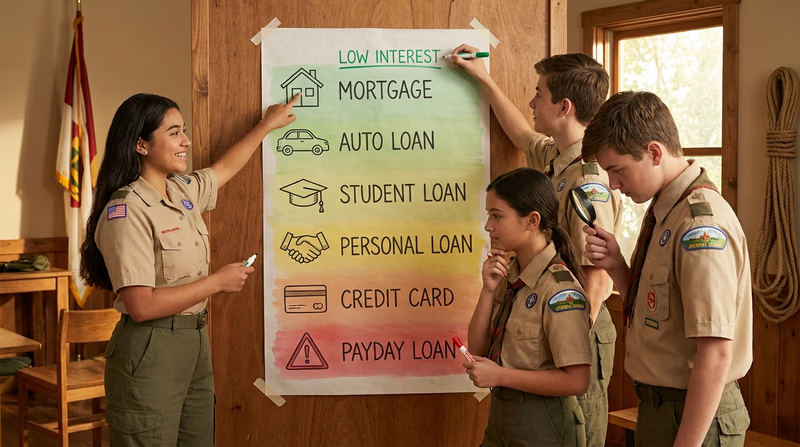
Personal loan: An unsecured loan from a bank or credit union for general purposes — home repairs, medical bills, or consolidating other debts. Interest rates are moderate (typically 6–15%), and terms range from 1 to 7 years.
Home equity loan / HELOC: If a homeowner has paid off part of their mortgage, they can borrow against the equity (the portion of the home they own outright). These are secured by the home and offer relatively low rates, but the borrower risks losing their home if they cannot repay.
Credit cards: Technically a form of borrowing, covered in detail in Requirement 7c. You borrow money every time you charge something and do not pay it off by the due date.
Sources You Should Avoid
Payday loans: Short-term, small-dollar loans that charge extremely high interest rates — often equivalent to 400% APR or more. They target people in financial emergencies and create cycles of debt that are very hard to escape.
Title loans: You hand over your car title as collateral for a short-term loan. If you cannot repay, you lose your car. Interest rates are extremely high.
Pawnshops: You leave a valuable item as collateral and receive a fraction of its worth in cash. If you do not repay within the deadline, the pawnshop keeps your item.
Borrowing from People You Know
Borrowing from family or friends might seem simpler than going to a bank, but it can be risky in a different way. Money disputes can damage relationships. If you ever borrow from someone you know, treat it like a formal loan: agree on the amount, timeline, and whether interest is involved — and put it in writing.
Consumer Financial Protection Bureau — Choosing a Loan Tools and guides from the CFPB to help you compare different types of loans and understand your rights as a borrower. Link: Consumer Financial Protection Bureau — Choosing a Loan — https://www.consumerfinance.gov/consumer-tools/Req 7c — Cards & Their Costs
Three Cards, Three Different Rules
They all look like small plastic rectangles (or digital versions on your phone), but charge cards, debit cards, and credit cards work very differently. Understanding these differences is one of the most practical financial skills you can have.
Debit Card
A debit card is connected directly to your bank account. When you swipe it, the money comes out of your account immediately — like paying with cash, but electronically.
Pros:
- You can only spend money you actually have
- No interest charges
- Easy to track spending (transactions show in your bank app)
- Widely accepted
Cons:
- No borrowing power — if your account is empty, the card will not work (or you will be hit with overdraft fees)
- Less fraud protection than credit cards in some cases
- Overdraft fees can be steep ($35 per transaction is common) if you accidentally spend more than your balance
Credit Card
A credit card lets you borrow money from the card issuer (usually a bank) every time you make a purchase. At the end of each billing cycle (usually monthly), you receive a statement showing what you owe. If you pay the full balance by the due date, you pay no interest. If you carry a balance, interest starts accumulating.
Pros:
- Builds credit history (important for Requirement 7d)
- Strong fraud protection — you are not liable for unauthorized charges
- Rewards programs (cash back, points, miles)
- Can handle emergencies when you do not have cash available
Cons:
- High interest rates (typically 18–28% APR)
- Easy to overspend because the money does not feel “real”
- Minimum payments are a trap (more on this below)
- Late payment fees and penalty rates
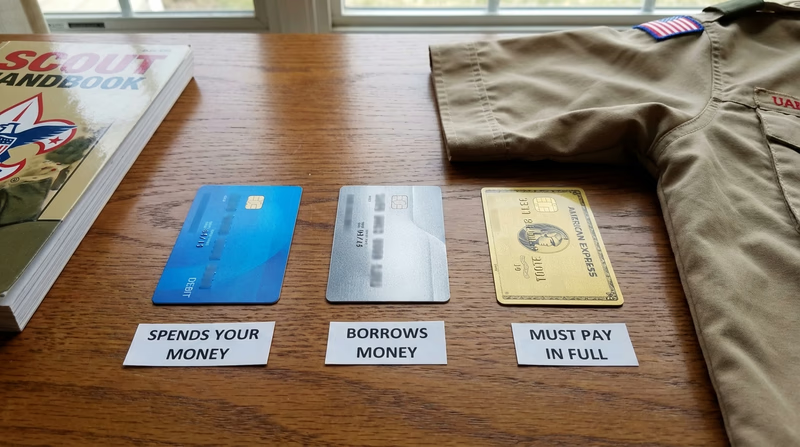
Charge Card
A charge card looks and works like a credit card, with one important difference: you must pay the full balance every month. There is no option to carry a balance and make minimum payments.
Pros:
- Forces responsible spending — you cannot accumulate debt
- No interest charges (because you pay in full each month)
- Often comes with premium rewards and benefits
Cons:
- Must pay the full balance monthly — no flexibility
- Hefty fees if you miss a payment
- Usually requires excellent credit to qualify
- Annual fees are common
The Minimum Payment Trap
This is one of the most important concepts in this entire badge. Credit card companies require only a small minimum payment each month — usually about 2% of your balance or $25, whichever is greater. This sounds convenient, but it is designed to keep you in debt for as long as possible.
Here is why making only the minimum payment is a terrible idea:
Example: $1,000 credit card balance at 20% APR
| Payment Strategy | Time to Pay Off | Total Interest Paid | Total Cost |
|---|---|---|---|
| Minimum payment only ($25/month) | 5 years, 2 months | $566 | $1,566 |
| $50/month | 2 years | $208 | $1,208 |
| $100/month | 11 months | $97 | $1,097 |
| Pay in full | 1 month | $0 | $1,000 |
By paying only the minimum, you pay $566 in interest — more than half the original purchase price. That $1,000 item actually costs you $1,566.
Costs and Pitfalls to Watch For
Hidden Costs of Cards
Fees and charges that catch people off guard- Annual fees: Some cards charge $50–$500 per year just to have the card
- Late payment fees: Typically $25–$40 if you miss the due date
- Over-limit fees: Charged when you exceed your credit limit
- Cash advance fees: Using a credit card to withdraw cash triggers immediate interest (no grace period) plus a fee
- Foreign transaction fees: Extra charges (usually 3%) for purchases made in other countries
- Balance transfer fees: Typically 3–5% of the amount transferred
- Penalty APR: Your interest rate can jump to 29.99% or higher after a late payment
Req 7d — Credit Reports
Your Financial Reputation
A credit report is a detailed record of your borrowing and repayment history. Think of it as a report card for how you handle money. Just as your school grades follow you from year to year, your credit report follows you throughout your adult life.
Three major companies — called credit bureaus — collect and maintain credit reports: Equifax, Experian, and TransUnion. Lenders, landlords, and even some employers check your credit report to decide whether they want to do business with you.
What Is on a Credit Report?
Your credit report includes:
- Personal information: Name, address, Social Security number, date of birth
- Credit accounts: Every credit card, loan, and mortgage you have ever had — when it was opened, the credit limit or loan amount, and your payment history
- Payment history: Whether you paid on time, were late, or missed payments entirely
- Public records: Bankruptcies, tax liens, or court judgments related to debt
- Inquiries: A record of who has looked at your credit report (lenders checking before approving a loan, for example)

Your Credit Score
Your credit report is used to calculate your credit score — a three-digit number (usually between 300 and 850) that summarizes your creditworthiness. The higher the score, the more trustworthy you appear to lenders.
Credit score ranges:
- 800–850: Exceptional
- 740–799: Very good
- 670–739: Good
- 580–669: Fair
- Below 580: Poor
What affects your credit score:
| Factor | Impact | What It Means |
|---|---|---|
| Payment history | 35% | Do you pay your bills on time? |
| Amounts owed | 30% | How much of your available credit are you using? |
| Length of credit history | 15% | How long have you had credit accounts? |
| New credit | 10% | Have you opened many new accounts recently? |
| Credit mix | 10% | Do you have different types of credit? |
How Personal Responsibility Affects Your Credit
Your daily financial decisions directly shape your credit report. Here is how responsible behavior helps — and irresponsible behavior hurts:
Builds good credit:
- Paying every bill on time, every month
- Keeping credit card balances low (under 30% of your limit)
- Only applying for credit when you truly need it
- Keeping old accounts open (length of history matters)
Damages your credit:
- Missing payments or paying late
- Maxing out credit cards
- Applying for many credit cards in a short period
- Defaulting on loans (failing to repay)
- Declaring bankruptcy
Why Your Credit Score Matters
Your credit score affects much more than just whether you can get a loan:
- Interest rates: A higher score means lower interest rates on mortgages, car loans, and credit cards. Over the life of a 30-year mortgage, the difference between a good score and a fair score can cost over $50,000.
- Renting an apartment: Most landlords check credit reports. A poor score can mean you are denied housing.
- Employment: Some employers check credit reports (with your permission) as part of the hiring process, especially for jobs involving money.
- Insurance premiums: In many states, your credit score affects your car and homeowner’s insurance rates.
- Cell phone plans: Carriers check credit to decide whether you qualify for a contract plan or need a prepaid plan.
Checking Your Own Credit Report
Federal law entitles everyone to one free credit report per year from each of the three bureaus. You can access them at AnnualCreditReport.com — the only truly free, government-authorized source.
AnnualCreditReport.com The only federally authorized source for free annual credit reports from all three major credit bureaus. Link: AnnualCreditReport.com — https://www.annualcreditreport.com Consumer Financial Protection Bureau — Credit Reports and Scores Comprehensive guide to understanding, checking, and disputing errors on your credit report. Link: Consumer Financial Protection Bureau — Credit Reports and Scores — https://www.consumerfinance.gov/consumer-tools/credit-reports-and-scores/Req 7e — Reducing Debt
Getting Out of Debt
Debt is a tool — like fire, it can be useful when controlled and destructive when it gets out of hand. This requirement teaches you practical strategies for reducing and eliminating debt. Even if you do not have debt right now, understanding these strategies prepares you for the future.
The First Step: Stop Adding New Debt
Before you can pay off existing debt, you need to stop creating new debt. This sounds obvious, but it is the step most people skip. If you are paying off a credit card while continuing to charge new purchases, you are running on a treadmill — working hard but going nowhere.
Two Popular Debt Payoff Strategies
The Debt Avalanche (Highest Interest First)
List all your debts from highest interest rate to lowest. Make minimum payments on everything, then put every extra dollar toward the debt with the highest interest rate. Once that is paid off, roll that payment into the next highest interest rate debt.
- Pros: Saves the most money in interest over time
- Cons: If your highest-rate debt is also your largest, it can take a long time to see progress
The Debt Snowball (Smallest Balance First)
List all your debts from smallest balance to largest. Make minimum payments on everything, then put every extra dollar toward the smallest debt. Once that is paid off, roll that payment into the next smallest debt.
- Pros: Quick wins build motivation — paying off a small debt feels great and keeps you going
- Cons: You may pay more in total interest because you are not prioritizing high-rate debts

Other Strategies for Reducing Debt
Increase payments: Even small increases make a difference. Paying $50 extra per month on a credit card can cut your payoff time in half.
Negotiate lower interest rates: Call your credit card company and ask for a lower rate. If you have been a good customer with on-time payments, they will often agree. A lower rate means more of your payment goes toward the principal.
Balance transfer: Some credit cards offer a 0% APR introductory period (usually 12–18 months) for balances transferred from other cards. This lets you pay down the principal without interest piling up. Be aware of transfer fees (usually 3–5%).
Debt consolidation: Combining multiple debts into a single loan with a lower interest rate. This simplifies your payments and can reduce the total interest you pay.
Sell things you do not need: Use the proceeds to make a lump-sum payment toward your debt. This is a one-time boost, but every dollar counts.
Increase your income: Take on extra work, sell a skill, or find other ways to earn more. Direct the extra income entirely toward debt payoff.
Strategies That Do Not Work
Prevention Is the Best Strategy
The easiest debt to pay off is the debt you never take on. The budgeting skills you learned in Requirement 2 and the understanding of credit from Requirement 7c give you the tools to avoid problematic debt in the first place.
Debt Prevention Habits
Build these habits now to avoid debt problems later- Build an emergency fund: 3–6 months of expenses so you do not need to borrow for surprises
- Pay credit cards in full every month: Never carry a balance
- Distinguish needs from wants: Only borrow for true needs
- Shop around for loans: Always compare APRs before borrowing
- Live below your means: Spend less than you earn, every month
Req 8 — Managing Your Time
Demonstrate to your counselor your understanding of time management by doing the following:
a. Write a “to do” list of tasks or activities, such as homework assignments, chores, and personal projects, that must be done in the coming week. List these in order of importance to you.
b. Make a seven-day calendar or schedule. Put in your set activities, such as school classes, sports practices or games, jobs or chores, and/or Scout or place of worship or club meetings, then plan when you will do all the tasks from your “to do” list between your set activities.
c. Follow the one-week schedule you planned. Keep a daily diary or journal during each of the seven days of this week’s activities, writing down when you completed each of the tasks on your “to do” list compared to when you scheduled them.
d. With your counselor, review your “to do” list, one-week schedule, and diary/journal to understand when your schedule worked and when it did not work. Discuss what you might do differently the next time.
Time: Your Most Valuable Resource
You have spent the first seven requirements learning to manage money. Now it is time to manage something even more valuable — your time. Here is the difference: you can always earn more money, but you can never get more time. Every person gets the same 24 hours each day. What separates people who get things done from people who feel overwhelmed is how they use those hours.

Step A: Your To-Do List
A to-do list is simply a written list of everything you need to accomplish in the coming week. The key word is written — tasks in your head are easy to forget or misjudge. Writing them down makes them real and manageable.
How to build your list:
- Brain dump: Write down everything you can think of — homework, chores, errands, projects, phone calls, anything.
- Be specific: “Study” is vague. “Study Chapter 7 for biology test on Thursday” is actionable.
- Prioritize: Rank your tasks from most important to least important.
Step B: Your Seven-Day Schedule
Now take your to-do list and fit it into your week. Start by blocking out your fixed commitments — the things that happen at set times and cannot be moved:
- School classes
- Sports practices and games
- Work shifts
- Scout meetings
- Religious services
- Family commitments
Once your fixed activities are in place, you will see the open blocks of time where your to-do list items can go. This is where the real planning happens.
Scheduling Tips
Strategies for fitting everything in- Schedule your “Must Do” items first: Put them in the earliest available time blocks
- Estimate how long each task will take: Be honest — most people underestimate
- Build in buffer time: Leave gaps between tasks for transitions and unexpected delays
- Protect your energy: Schedule difficult tasks when you are most alert (mornings for most people)
- Include breaks: Working nonstop leads to burnout, not productivity
- Do not over-schedule: Leave some open time — you will need it
Step C: Following Your Schedule and Keeping a Diary
This is the hands-on part — actually living your plan for a full week and recording what happens. Your diary or journal does not need to be long or fancy. For each day, note:
- What you planned to do and when
- What you actually did and when
- What changed and why
Common reasons schedules go off track:
- Tasks took longer than expected
- An unexpected event came up (surprise quiz, friend needed help)
- You procrastinated on a task you did not want to do
- You forgot to account for transition time (getting from one place to another)
- You were too tired to do a task you scheduled for late evening
Step D: Review and Reflect
At the end of the week, sit down with your counselor and compare your plan to your reality. This mirrors exactly what you did with your budget in Requirement 2d — and the lessons are similar.
Questions to explore with your counselor:
- Which tasks did you complete on time? Which ones slipped?
- Were your time estimates accurate?
- What was the biggest surprise of the week?
- Did prioritizing help you focus on what mattered most?
- What would you change about your scheduling approach?
- How did it feel to have a plan vs. winging it?
Time Management Tools
While pen and paper work perfectly for this requirement, here are tools you might explore for the future:
- Physical planners: A paper planner or bullet journal
- Digital calendars: Google Calendar, Apple Calendar, or Outlook
- Task apps: Todoist, Microsoft To Do, or Apple Reminders
- The Pomodoro Technique: Work in focused 25-minute blocks with 5-minute breaks
Req 9 — Project Planning
Prepare a written project plan demonstrating the steps below, including the desired outcome. This is a project on paper, not a real-life project. Examples could include planning a camping trip, developing a community service project or a school or religious event, or creating an annual patrol plan with additional activities not already included in the troop annual plan. Discuss your completed project plan with your counselor.
a. Define the project. What is your goal?
b. Develop a timeline for your project that shows the steps you must take from beginning to completion.
c. Describe your project.
d. Develop a list of resources. Identify how these resources will help you achieve your goal.
e. Develop a budget for your project.
From Idea to Plan
This requirement pulls together many of the skills you have been learning throughout this badge — budgeting, time management, and organized thinking — and applies them to a real-world scenario. You will create a complete project plan on paper. Even though you are not required to carry out the project, your plan should be detailed enough that someone could pick it up and actually do it.
Choosing Your Project
The requirement gives you several examples. Pick something you genuinely care about — passion makes planning easier and your discussion with your counselor more interesting.
Project ideas:
- A weekend camping trip for your patrol
- A community service project (park cleanup, food drive, volunteering event)
- A school event (fundraiser, dance, field day)
- A religious or club event
- An annual patrol activity plan
- A personal goal (training for a race, building something, learning a new skill)

Step A: Define Your Project and Goal
Every good project starts with a clear goal. Your goal should answer the question: “When this project is complete, what will we have accomplished?”
Write your goal using the SMART framework:
- Specific: What exactly will happen?
- Measurable: How will you know it is done?
- Achievable: Can it realistically be accomplished?
- Relevant: Why does this project matter?
- Time-bound: When will it be completed?
Example: “Organize a one-day community park cleanup on April 15 with at least 10 volunteers, removing litter and planting 20 native plants in the garden bed.”
Step B: Develop a Timeline
A timeline breaks your project into individual steps and assigns each step a deadline. This is the backbone of your plan.
Start from your completion date and work backward:
Sample Timeline (Park Cleanup)
Working backward from event date- 6 weeks before: Get permission from the park authority and set the date
- 5 weeks before: Create a volunteer sign-up sheet and start recruiting
- 4 weeks before: Order supplies (trash bags, gloves, plants)
- 3 weeks before: Confirm volunteers, assign roles and responsibilities
- 2 weeks before: Visit the site to finalize the plan and identify areas to focus on
- 1 week before: Send reminders to all volunteers, confirm supply delivery
- Day before: Prepare supply kits and review the schedule
- Event day: Execute the cleanup, take photos, thank volunteers
- 1 week after: Send thank-you notes and report results to the park authority
Step C: Describe Your Project
Write a clear description that someone who knows nothing about your project could read and understand. Include:
- What is happening (the activities)
- Who is involved (participants, leaders, helpers)
- Where it will take place
- When it will happen (date and time)
- Why it matters (the purpose and benefit)
- How it will be organized (logistics, transportation, communication)
Step D: List Your Resources
Resources are everything you need to make the project happen. Think broadly:
People:
- Who will help? What skills do they need?
- Do you need adult supervision?
- Who has expertise you can tap into?
Materials and equipment:
- What supplies do you need?
- What do you already have vs. what needs to be purchased or borrowed?
- Are there tools or equipment required?
Facilities:
- Where will the project take place?
- Do you need to reserve a space?
- Are there permits or permissions required?
Information:
- What do you need to research?
- Are there manuals, guides, or experts you should consult?
For each resource, explain how it contributes to achieving your goal. This shows your counselor that you have thought through not just what you need but why you need it.
Step E: Develop a Budget
Apply the budgeting skills you learned in Requirement 2 to your project. Your project budget should include:
Expected expenses:
- Materials and supplies (with specific prices from research)
- Transportation costs
- Food and beverages (if applicable)
- Printing or communication costs
- Permit or rental fees
- Contingency fund (10–15% of total for unexpected costs)
Expected income/funding:
- Personal or family contributions
- Troop or organization funds
- Fundraising
- Donations (in-kind or monetary)
- Sponsorships
Putting Your Plan Together
Your final written project plan should be organized and easy to follow. Consider using section headers that match the five parts of this requirement:
- Project Goal (Step A)
- Timeline (Step B)
- Project Description (Step C)
- Resource List (Step D)
- Budget (Step E)
Req 10 — Career Planning
Do the following:
a. Choose a career you might want to enter after high school or college graduation. Discuss with your counselor the needed qualifications, education, skills, and experience.
b. Explain to your counselor what the associated costs might be to pursue this career, such as tuition, school or training supplies, and room and board. Explain how you could prepare for these costs and how you might make up for any shortfall.
Your Future Starts Now
This final requirement brings everything together. You have learned to manage money, manage time, and plan projects. Now apply those skills to the biggest project of all: your career. You do not have to decide your whole life right now — but thinking seriously about a career path helps you make smart decisions today that pay off later.
Step A: Choosing and Researching a Career
How to choose a career to research:
Start with what interests you. Think about:
- What subjects do you enjoy in school?
- What activities or hobbies excite you?
- What problems do you want to solve?
- What skills do you already have or want to develop?
- Who do you admire, and what do they do for work?
You are not making a lifelong commitment — you are exploring. Pick a career that genuinely interests you, even if you are not 100% sure about it.

What to research about your chosen career:
Career Research Checklist
Information to gather for your counselor discussion- Job description: What does a typical day look like?
- Education required: High school diploma, associate degree, bachelor’s degree, graduate degree, or specialized training?
- Certifications or licenses: Are any required? (Medical license, teaching certificate, trade certification)
- Skills needed: Technical skills, soft skills, physical requirements
- Experience: Do you need internships, apprenticeships, or entry-level experience?
- Job outlook: Is this field growing or shrinking?
- Salary range: Entry-level, mid-career, and experienced
- Work environment: Office, outdoors, hospital, school, travel required?
Step B: Understanding and Preparing for Costs
Every career path has costs associated with getting there. Research the specific costs for your chosen career:
Education costs:
- Tuition: The biggest expense. Varies enormously — community college might be $3,000–$5,000 per year, while a four-year university can be $10,000–$60,000+ per year.
- Room and board: Living on campus or near school. Typically $10,000–$15,000 per year.
- Books and supplies: $1,000–$2,000 per year, depending on the field.
- Lab fees or special equipment: Some programs (nursing, engineering, culinary arts) have additional costs.
- Certification exams: Professional exams can cost hundreds or thousands of dollars.
How to prepare for these costs:
The budgeting and savings skills from Requirements 1 and 2 apply directly here:
- Start saving now: Even small amounts add up over years, thanks to compound interest from Requirement 4
- Research scholarships: Billions of dollars in scholarships go unclaimed every year. Start searching early.
- Consider financial aid: Complete the FAFSA (Free Application for Federal Student Aid) to see what federal aid you qualify for.
- Look at all school options: Community college for the first two years, then transferring to a four-year university, can save tens of thousands of dollars.
- Work-study and part-time jobs: Many students work during college to offset costs.
- Military service: The GI Bill and ROTC programs can pay for education in exchange for military service.
Making Up for Shortfalls
What if saving and financial aid are not enough to cover the full cost? Here are legitimate strategies:
- Federal student loans — lower interest rates and better repayment options than private loans (review Requirement 7)
- Employer tuition assistance — some employers pay for employees to go to school while working
- Cooperative education (co-op) programs — alternate between semesters of school and semesters of paid work in your field
- Trade and apprenticeship programs — many skilled trades (electrician, plumber, welder) offer paid training where you earn while you learn
- 529 savings plans — tax-advantaged accounts specifically designed for education expenses
Connecting It All
Look at how this requirement ties back to everything you have learned:
- Budgeting (Req 2) → Creating a plan to afford education
- Saving and investing (Req 4) → Starting to save for career costs now
- Understanding loans (Req 7) → Knowing how student loans work before you take them
- Project planning (Req 9) → Treating your career preparation like a structured project
- Time management (Req 8) → Balancing school, work, and preparation
Extended Learning
A. Congratulations!
You have earned one of the most practical merit badges in all of Scouting. The skills you developed — budgeting, saving, investing, managing time, and planning projects — are skills you will use every day for the rest of your life. Most adults wish they had learned these things as a teenager. You are ahead of the game, and the habits you build now will serve you well.
Ready to go even deeper? Here are some ways to continue your personal management journey beyond the badge.
B. Building Wealth: The Power of Starting Young
You learned about compound interest in Requirement 4, but let’s put that knowledge into a real-world context. The single biggest advantage you have as a young person is time. Money invested at age 15 has 50 years to grow before retirement — and in that time, compound interest does extraordinary things.
Consider this scenario: if you invest just $25 per month starting at age 15, earning an average return of 8% per year, by age 65 you would have approximately $175,000 — from total contributions of only $15,000. The remaining $160,000 is pure growth from compound interest.
Now imagine you wait until age 25 to start. The same $25 per month at 8% yields about $78,000 by age 65. Starting just 10 years earlier more than doubles your result.
This is why financial literacy at your age is so powerful. You do not need a lot of money — you need time and consistency. Even tiny amounts, invested regularly, grow into significant sums. The key habits to build right now are:
- Save a portion of every dollar you earn. Even 10% is a strong start.
- Open a custodial investment account. With a parent or guardian, you can open a brokerage account and start investing in index funds with as little as $1.
- Automate your savings. Set up automatic transfers so saving happens without you having to think about it.
- Reinvest all returns. Do not pull out dividends or interest — let them compound.
The difference between someone who starts at 15 and someone who starts at 35 is not talent, income, or luck — it is simply time.

C. Financial Literacy in the Digital Age
Money is increasingly digital, and the financial world looks different today than it did even five years ago. Understanding these modern financial tools and risks will help you navigate the landscape ahead.
Digital banking and mobile payments have made managing money more convenient but also more abstract. When you tap your phone to pay, you do not physically feel the money leaving. This can lead to spending more than you realize. One strategy is to check your account balance every evening — a quick habit that keeps you aware of where you stand.
Online scams and identity theft are growing threats. Phishing emails that look like they are from your bank, fake shopping websites that steal credit card numbers, and social engineering attacks that trick people into giving away personal information are increasingly sophisticated. Protect yourself by never clicking links in unexpected emails, using strong and unique passwords for financial accounts, and enabling two-factor authentication everywhere it is available.
Peer-to-peer payment apps like Venmo, Zelle, and Cash App make it easy to send money to friends. But these transfers are often instant and irreversible — sending money to the wrong person or falling for a scam means the money is gone. Always verify the recipient before sending, and never send money to someone you do not know.
Cryptocurrency has generated enormous attention. While blockchain technology is genuinely innovative, cryptocurrency markets are highly volatile and largely unregulated. Many people have lost significant money investing in crypto without understanding the risks. If you are curious about it, treat it as a learning opportunity rather than an investment strategy — and never invest money you cannot afford to lose.
The core principles of personal management — spending less than you earn, saving consistently, understanding risk, and protecting yourself from fraud — apply regardless of whether money is physical or digital.
D. The Psychology of Financial Success
In Requirement 3, you explored how emotions affect spending. Let’s go deeper into the psychological habits that separate people who build wealth from those who struggle financially.
Delayed gratification is the ability to resist the temptation of an immediate reward in favor of a later, larger reward. In the famous “marshmallow experiment,” researchers gave children a choice: eat one marshmallow now, or wait 15 minutes and get two marshmallows. Children who waited tended to have better life outcomes decades later — better grades, higher incomes, and healthier relationships. Every time you choose to save instead of spend, you are exercising this same muscle.
Lifestyle inflation is the tendency to increase your spending as your income grows. When someone gets a raise, they often immediately upgrade their car, apartment, or wardrobe. The result? They earn more but save no more. The antidote is to save a fixed percentage of every raise before adjusting your lifestyle. If you get a $200/month raise, save $100 of it and enjoy $100.
The comparison trap is the habit of measuring your financial success against others. Social media makes this worse — people post their vacations, new cars, and purchases, but never their credit card bills. Comparing your financial situation to someone else’s highlight reel leads to poor decisions. Focus on your own goals and progress instead.
Financial automation is the most underrated wealth-building strategy. When saving and investing happen automatically — without requiring a conscious decision each time — you remove willpower from the equation. Set up automatic transfers to savings and investment accounts on the day you get paid, and you will build wealth without thinking about it.

E. Real-World Experiences
Explore these opportunities to put your personal management skills into practice beyond the badge.
Stock Market Game
Junior Achievement Programs
Open a Bank Account
Start a Small Business
Attend a Financial Literacy Workshop
F. Organizations
These organizations offer resources, programs, and opportunities to continue developing your personal management skills.
The nation’s largest organization dedicated to preparing young people for financial success. Offers programs in financial literacy, entrepreneurship, and career readiness in schools and communities across the country.
Organization: Junior Achievement USA — https://jausa.ja.org/
A nonprofit foundation focused on inspiring empowered financial decision-making. Their High School Financial Planning Program provides free financial education resources for teens.
Organization: National Endowment for Financial Education (NEFE) — https://www.nefe.org/
A U.S. government agency that protects consumers in the financial marketplace. Their website offers tools, guides, and educational resources on every financial topic covered in this badge.
Organization: Consumer Financial Protection Bureau (CFPB) — https://www.consumerfinance.gov/
The FDIC’s free financial education program with resources designed specifically for young people. Covers banking, saving, credit, and more through interactive activities and guides.
Organization: Federal Deposit Insurance Corporation (FDIC) — Money Smart — https://www.fdic.gov/resources/consumers/money-smart/
The U.S. government’s central website for financial education. Organized around five key areas — earn, save and invest, protect, spend, and borrow — with resources for all ages.
Organization: MyMoney.gov — https://www.mymoney.gov/
As you continue your Scouting journey toward Eagle, the skills from Personal Management will help you plan and execute your Eagle Scout service project. Connect with your council for mentorship and resources.
Organization: Scouting America — Eagle Scout Service — https://www.scouting.org/programs/scouts-bsa/advancement-and-awards/eagle-scout-resources/