Req 3 — Psychology of Money
Discuss with your counselor FIVE of the following concepts:
a. The emotions you feel when you receive money.
b. Your understanding of how the amount of money you have with you affects your spending habits.
c. Your thoughts when you buy something new and your thoughts about the same item three months later. Explain the concept of buyer’s remorse.
d. How hunger affects you when shopping for food items (snacks, groceries).
e. Your experience of an item you have purchased after seeing or hearing advertisements for it. Did the item work as well as advertised?
f. Your understanding of what happens when you put money into a savings account.
g. Charitable giving. Explain its purpose and your thoughts about it.
h. What you can do to better manage your money.
Note: You need to discuss five of the eight options below with your counselor. Read through all of them, then choose the five that interest you most or that you have the strongest personal experiences with.
Understanding the Money-Emotion Connection
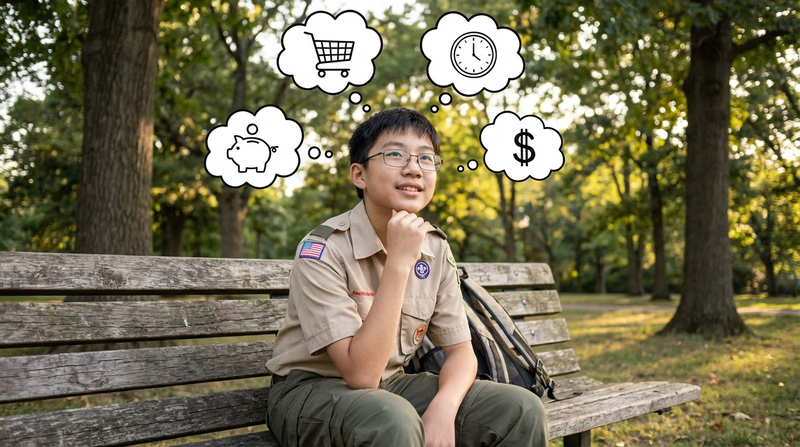
Money is not just numbers in an account. It is tied to how you feel, how you think, and how you make decisions — often in ways you do not even realize. This requirement helps you recognize those invisible forces so you can make smarter choices.
Option A: Emotions and Receiving Money
Think about the last time you received money — a birthday gift, payment for a job, or your allowance. How did it feel? Most people experience a rush of excitement, possibility, or even relief. That emotional response is powerful and can drive your next decision.
When you feel flush with cash, you are more likely to spend impulsively. The excitement of having money can make you want to do something with it right away. Recognizing this feeling is the first step to controlling it. Some people find it helpful to wait 24 hours before spending any “new” money — giving the initial excitement time to fade so they can think clearly.
Option B: Cash in Your Pocket
Here is something interesting: the amount of money you carry affects how much you spend. If you have $50 in your wallet, you are more likely to buy that $12 item than if you only have $15. This is true even if you were not planning to buy anything.
This effect is even stronger with digital money. When you cannot see your balance shrinking, it is easier to spend without thinking. One strategy is to carry only the cash you plan to spend — leave the rest at home or in a savings account.
Option C: Buyer’s Remorse
Buyer’s remorse is the feeling of regret after making a purchase. It usually hits a few days or weeks after buying something. That new video game that seemed amazing in the store? Three months later, it might be collecting dust on a shelf.
Buyer’s remorse happens because the excitement of buying something is temporary, but the cost is permanent. The rush of getting something new fades quickly — psychologists call this hedonic adaptation. You get used to the new thing, and it stops feeling special.
To fight buyer’s remorse, ask yourself before buying: “Will I still be excited about this in three months?” If the answer is not a clear yes, consider waiting.
Option D: Hungry Shopping
Never grocery shop on an empty stomach — you have probably heard this advice. But do you know why it works? When you are hungry, your brain is wired to seek out food aggressively. Everything looks appealing. Snack aisle items that you would normally walk past suddenly end up in your cart.
This is an example of how your physical state affects your financial decisions. You are not making a logical choice about nutrition or value — your body is making an emotional, survival-driven choice. The fix is simple: eat before you shop. Studies show that shoppers who eat a meal before grocery shopping spend 20 to 30 percent less.
Option E: Advertising and Reality
Companies spend billions of dollars on advertising because it works. Ads create desire for products by showing you idealized versions of what they can do. That new phone in the commercial looks life-changing. That energy drink promises peak performance.
Think about something you bought because of advertising. Did it live up to the hype? Often, the answer is no — or at least not completely. This does not mean all ads are lies, but they always show the best-case scenario. Being a smart consumer means recognizing when an ad is creating desire versus providing useful information.
Option F: How Savings Accounts Work
When you put money into a savings account, the bank does not just store it in a vault with your name on it. The bank uses your money — along with everyone else’s deposits — to make loans to other people. In return, the bank pays you interest, a small percentage of your balance, as a thank-you for letting them use your money.
Over time, you earn interest not just on your original deposit, but on the interest you have already earned. This is called compound interest, and you will dive deeper into it in Requirement 4c. For now, the key idea is that a savings account is not just a safe place to park money — it is a place where your money slowly grows.
Option G: Charitable Giving
Giving money to causes you care about — whether it is your place of worship, a food bank, or an environmental organization — is a powerful way to use your resources. Charitable giving helps communities, supports people in need, and funds important work.
But giving is not just about the recipient. Research consistently shows that people who give to others report greater happiness than those who spend the same amount on themselves. There is also a practical side: in many cases, charitable donations are tax-deductible, meaning they can reduce the amount of income tax you owe.
Think about what causes matter to you. Even small donations make a difference, and building a giving habit now creates a lifelong pattern of generosity.
Option H: Better Money Management
This option ties everything together. What specific steps can you take to manage your money more effectively? Based on what you have learned so far in this badge, consider strategies like:
- Track your spending (as you did in Requirement 2c)
- Set clear savings goals with timelines
- Wait before buying — the 24-hour rule for impulse purchases
- Learn the difference between needs and wants
- Talk about money with trusted adults
- Start saving early — even small amounts matter over time