Req 2 — Know Your Pet Well
If a friend had to care for your pet for one week, could you hand them clear instructions that would keep the animal healthy and safe? That is the real test behind this requirement. Your writing should show that you understand not only what you do, but why your pet needs it.
Organize Your 200+ Words Around Five Questions
A strong response is easier to write when you break it into clear parts.
What Your Write-Up Should Cover
Use these five buckets to organize your ideas
- Care: What daily, weekly, and monthly tasks keep your pet healthy?
- Feeding: What does your pet eat, how much, how often, and what foods should be avoided?
- Housing: What kind of space, temperature, bedding, lighting, or equipment does your pet need?
- Interesting facts: What makes this species unique in behavior, body design, senses, or habits?
- Local laws: Are there leash laws, licensing rules, exotic-pet restrictions, vaccination requirements, or housing rules that apply where you live?
You do not need fancy language. You need accurate details. A counselor would rather hear a plain, specific explanation than a vague paragraph full of general statements.
Care Means Daily Needs Plus Observation
Describe the tasks that keep your pet safe and comfortable. That might include feeding, watering, cleaning a habitat, exercise, grooming, handling, social interaction, or health checks. Try to explain both the routine and the reason behind it.
For example, saying “I clean the tank” is only half the job. Saying “I change part of the water and check the filter so waste does not build up and stress the fish” shows understanding. The same idea applies to litter boxes, bedding, cages, hutches, terrariums, and outdoor enclosures.
Feeding Is More Than “My Pet Eats This”
Good feeding information answers several questions:
- what food is appropriate for the species
- how often the pet should eat
- how much is reasonable
- whether treats are limited
- what foods are dangerous
- how fresh water is provided
A cat, a snake, a guinea pig, and a goldfish all eat differently for different biological reasons. This is a good place to prove that you know your pet as an animal, not just as a companion.
🎬 Video: Understanding Hamsters: Care, Feeding, Housing, and More (video) — https://www.youtube.com/watch?v=Pi_slxuGJUg
Even if your pet is not a hamster, notice how the video connects feeding, housing, and behavior. That same kind of connected thinking will strengthen your own write-up.
Housing Should Match the Species
Your pet’s home should support normal behavior, not just contain the animal. Birds need room to perch and move. Rabbits need space to stretch and safe materials to chew. Reptiles may need heat gradients and UV lighting. Dogs need secure fencing or leash control, shelter, and safe places to rest.
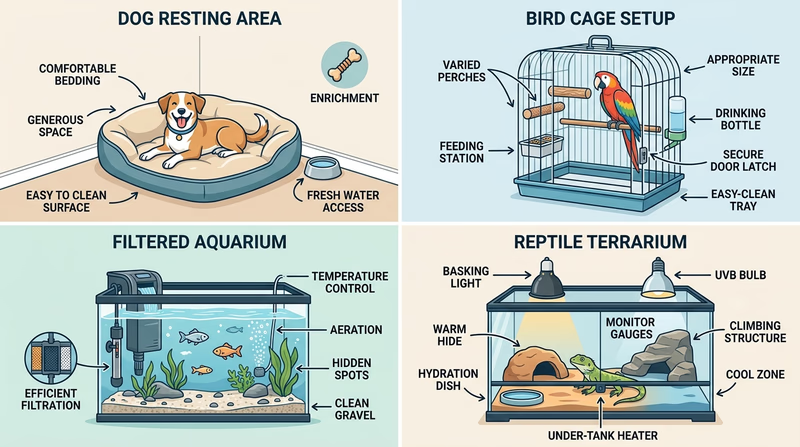
When you write about housing, mention the details that matter most for your kind of pet:
- space size
- bedding or substrate
- hiding places or enrichment
- light and temperature
- cleaning routine
- safety hazards to avoid
Interesting Facts Should Show Real Curiosity
This section should be fun, but it still needs substance. Choose facts that help explain your pet’s behavior or needs.
Examples of useful facts:
- Rabbits have teeth that keep growing, which is why chewing materials matter.
- Many reptiles rely on outside heat sources because they do not regulate body temperature like mammals do.
- Cats use scent, body posture, and tail position to communicate.
- Guinea pigs are social animals and often do better with companionship when housed appropriately.
Useful facts make your counselor think, “Yes, this Scout has really studied this animal.”
Local Laws Matter Because Responsibility Extends Beyond Your House
This part is easy to overlook, but it is important. Your area may have rules about:
- dog licenses
- rabies vaccinations
- leash laws
- number of animals allowed at a home
- exotic or restricted species
- noise or nuisance rules
- landlord or housing restrictions
If you are not sure where to look, check your city or county animal services department, local humane society, or veterinary office. Ask an adult to help if needed.
ASPCA A strong starting point for practical pet-care topics such as feeding, safety, behavior, enrichment, and responsible ownership. Link: ASPCA — https://www.aspca.orgWhy You Chose This Pet
Do not skip the personal part. This is where your writing becomes yours. Maybe your pet fits your family’s space. Maybe you love training and interaction. Maybe you enjoy quiet observation. Maybe the animal was adopted and became part of your story.
Being honest makes your discussion better. You are not trying to prove your pet is the “best” kind. You are showing that you understand what kind of care this animal needs and why you chose to meet that challenge.
Once you can explain your pet clearly in writing, the next step is learning from an approved expert source and discussing what you discovered.