Req 8 — Build a Strong Frame
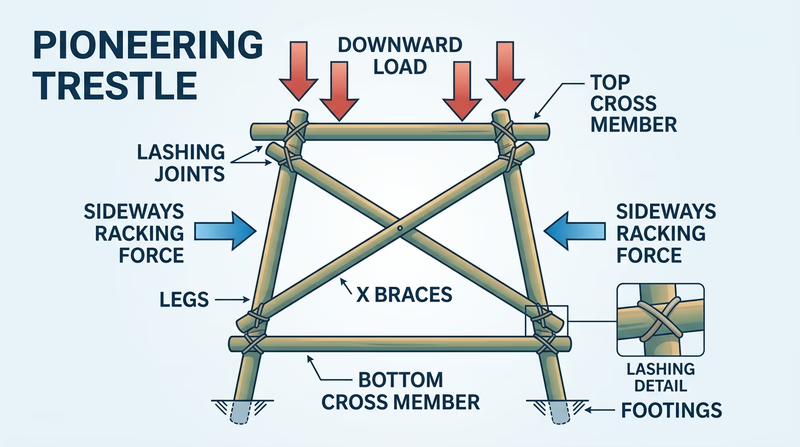
A trestle is one of the most important building blocks in large pioneering projects. Bridges, towers, and platforms often depend on trestles because they create a stable support frame that can carry load downward while resisting sideways movement.
Lashings used in a trestle
A trestle often uses more than one kind of lashing because different joints do different jobs.
- Shear lashings can join legs that spread into a support shape.
- Square lashings secure crosspieces where poles meet at right angles.
- Diagonal lashings may appear where braces need to stop racking or shifting.
The exact combination depends on the design, but your explanation should connect each lashing to the force it resists.
How the poles are positioned
Pole position is not random. A good trestle spreads load clearly.
- Leg poles carry weight toward the ground.
- Cross members hold spacing and shape.
- Braces keep the frame from folding sideways.
If the poles are uneven, misaligned, or set on weak ground, even good lashings will struggle to keep the structure true.
Why X braces matter
X braces are a big deal because they fight racking. Racking is the sideways distortion that turns a rectangle into a leaning parallelogram. Without bracing, a frame may feel solid when empty but shift dangerously once someone climbs or crosses it.
This official trestle video helps you visualize how the support frame is assembled.
🎬 Video: Making a Trestle (video) — https://youtu.be/YATmim1eIrQ?si=XFpV4wfQRaEE5l_6
The anchoring video connects directly to this requirement because a strong trestle and a strong anchor system must work together.
🎬 Video: Anchoring Pioneering Projects (video) — https://youtu.be/_z-GzDAjVZM?si=qyEvV1jFW0nCHHT8
Next comes the biggest decision in the badge: choosing and planning your full-size project for Req 9.