 Getting Started
Introduction & Overview
Overview
Plants are the foundation of almost every ecosystem on Earth. They produce the oxygen you breathe, the food on your table, the lumber in your house, and the cotton in your shirt. The Plant Science merit badge takes you from the basic anatomy of a flower all the way to hands-on fieldwork — growing crops, designing landscapes, or conducting botanical surveys in your own community.
Whether you live in a city apartment or on a thousand-acre farm, this badge will change the way you look at the green world around you.
Then and Now
Then
For most of human history, understanding plants was a matter of survival. Early peoples learned through trial and error which plants were safe to eat, which could heal wounds, and which would kill. When agriculture emerged roughly 10,000 years ago in the Fertile Crescent, it transformed human civilization — permanent settlements, stored food, and growing populations all depended on people who understood seeds, soil, and seasons.
By the 1700s, Carl Linnaeus developed the binomial naming system that botanists still use today. In the 1800s, Gregor Mendel’s experiments with pea plants unlocked the science of genetics. Luther Burbank bred hundreds of new plant varieties, proving that careful selection could feed more people with less land.
Now
Modern plant science blends ancient knowledge with cutting-edge technology. Agronomists use satellite imagery and GPS-guided equipment to manage fields with precision. Horticulturists develop disease-resistant cultivars that thrive in changing climates. Field botanists use DNA barcoding alongside traditional identification keys to catalog biodiversity. And backyard gardeners can track soil moisture with smartphone sensors.
The challenges have evolved too. Invasive species threaten native ecosystems across North America. Pollinators face habitat loss and pesticide exposure. Climate change is shifting hardiness zones northward. The skills you build in this badge — observation, identification, propagation, and stewardship — are exactly what the world needs right now.
Get Ready!
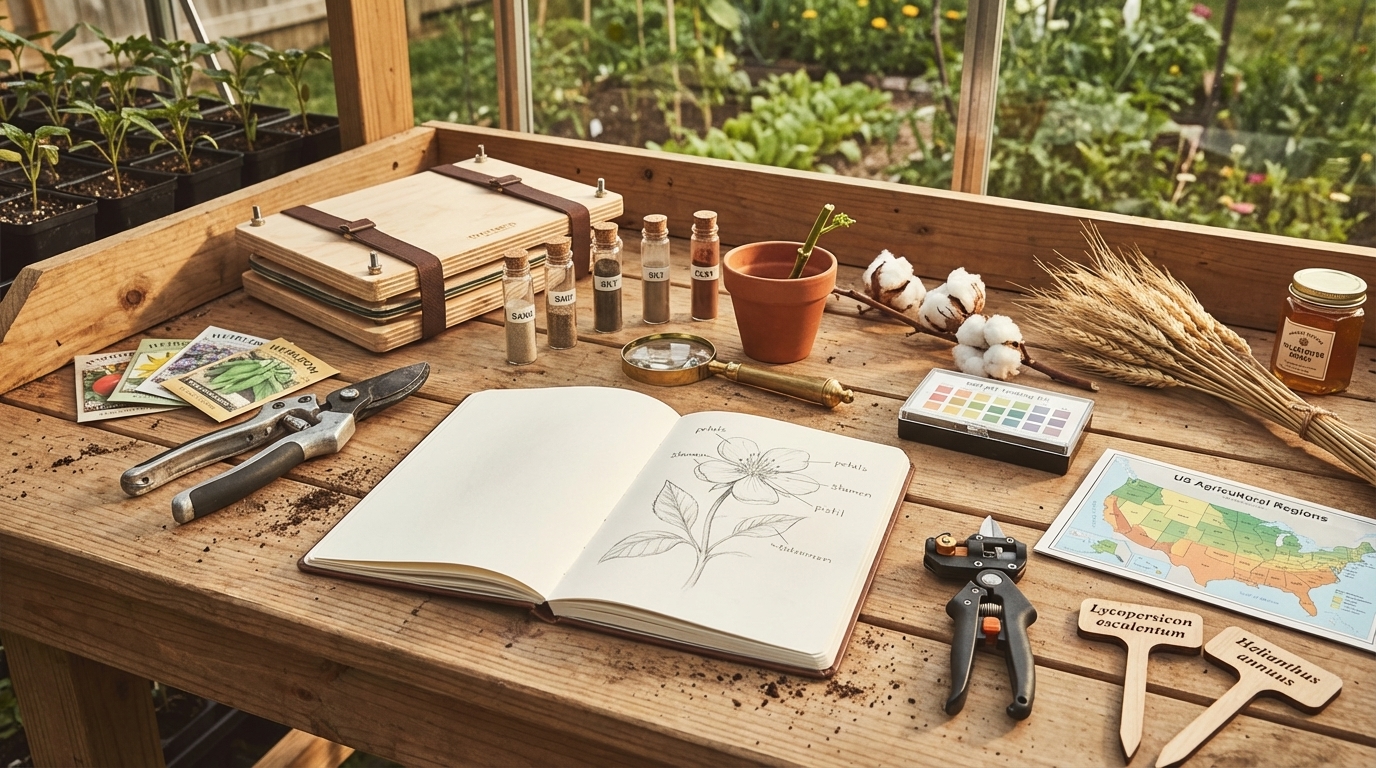
Plant Science is one of the most hands-on merit badges you can earn. You will draw plant anatomy, grow living plants, identify species in your neighborhood, and complete a major project in agronomy, horticulture, or field botany. Some requirements take weeks of growing time, so start early and plan ahead. A notebook, a pencil, and a willingness to get dirt under your fingernails are all you need to begin.
Before your first meeting with your counselor, look around your yard or neighborhood and ask yourself: Can I name five plants I see? Do I know if any are native? Could I grow one of them from seed? By the end of this badge, those questions will be easy.
Kinds of Plant Science
Agronomy
Agronomy focuses on field crops — the corn, wheat, soybeans, and cotton that feed and clothe the world. If you choose Option A in Requirement 8, you will learn about seedbed preparation, germination testing, crop pests, and the geography of American agriculture.
Horticulture
Horticulture is the science and art of growing ornamental plants, fruits, vegetables, and landscape trees. Option B takes you into nurseries and gardens, teaching you about hardiness zones, propagation, pruning, and landscape design.
Field Botany
Field botany is the study of plants in their natural habitats. Option C sends you into parks, forests, and wild areas to identify species, press specimens, learn about rare plants, and conduct real scientific surveys.
Ready to discover what makes a plant tick? Your first stop is the anatomy of a flowering plant — the parts that make growth, reproduction, and survival possible.