Req 1 — Flower Parts and Jobs
This requirement asks you to draw a flowering plant and label at least five parts. Your drawing does not need to be artistic — it needs to be accurate and clearly labeled. Use a real flower if possible; dissecting one will help you see structures that are hard to spot from the outside.
Key Parts of a Flowering Plant
Here are the major parts you should know. You need at least five, but learning all of them will strengthen your understanding for later requirements.
Roots
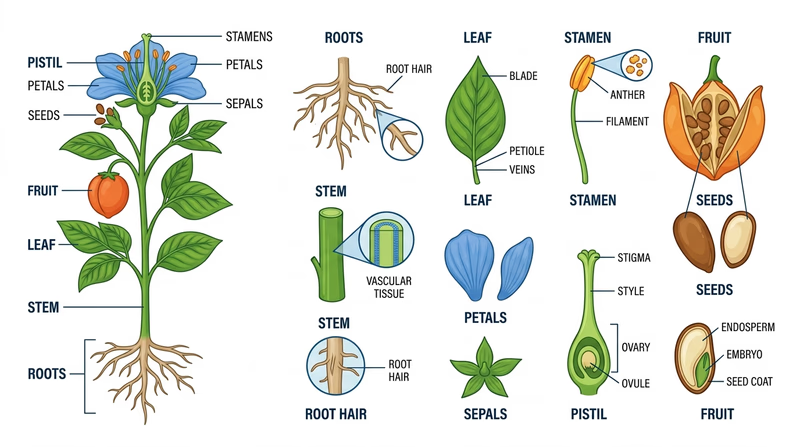
Roots anchor the plant in the soil and absorb water and dissolved minerals. They also store food for the plant. Some plants have a single thick taproot (like a carrot), while others have a network of thin fibrous roots (like grass).
Stem
The stem supports the plant and carries water, minerals, and sugars between the roots and leaves. Inside the stem, xylem tissue moves water upward from the roots, while phloem tissue carries sugars made in the leaves to the rest of the plant.
Leaves
Leaves are the primary site of photosynthesis — the process that converts sunlight, water, and carbon dioxide into sugar and oxygen. Leaves have tiny pores called stomata on their surfaces that allow gas exchange with the air.
Flower
The flower is the reproductive structure. It contains:
- Petals — Often colorful, petals attract pollinators like bees and butterflies.
- Sepals — The small, usually green leaf-like structures at the base of the flower that protect the bud before it opens.
- Stamen (male part) — Made up of the anther (which produces pollen) and the filament (which holds the anther up).
- Pistil (female part) — Made up of the stigma (sticky tip that catches pollen), the style (tube connecting stigma to ovary), and the ovary (which contains ovules that develop into seeds after fertilization).
Fruit and Seeds
After pollination, the ovary develops into a fruit that contains seeds. The fruit protects the seeds and helps with dispersal — by wind, water, or animals.
Drawing Tips
Drawing Checklist
Make sure your drawing includes
- The whole plant from roots to flower.
- At least five labeled parts with lines pointing to each structure.
- A brief note next to each label explaining the function (e.g., “Roots — absorb water and minerals”).
- Your name and date.
🎬 Video: Flower Dissection - Reproduction in Flowering Plants — https://youtu.be/493WeySyf-8?si=u7d6_2RKO2h03wNo
🎬 Video: Flower Structures and Functions — https://youtu.be/GkzFimUJdD8
With a solid understanding of plant anatomy, you are ready to learn the chemical process that makes all plant life possible.