Req 4 — Plumbing Parts and Terms
Plumbing has its own vocabulary, and many terms sound simple until you see the parts in real life. The easiest way to learn them is to group them by what they do: sealing, joining, changing direction, draining, or measuring water use.
Sealing and Repair Parts
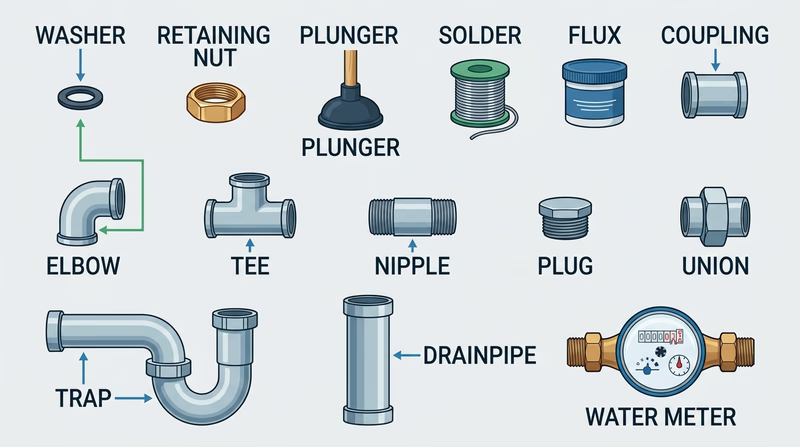
Washer — A washer is a small part, often rubber or another flexible material, that helps create a watertight seal. In some faucets, replacing a worn washer stops a drip.
Retaining nut — A retaining nut holds another part in place. You may see it securing faucet parts, drains, or cartridge assemblies.
Plunger (rubber force cup) — A plunger uses water pressure and suction to help clear simple clogs. The rubber cup seals against the drain opening so you can push and pull water through the blockage.
Materials Used in Joining Pipe
Solder — Solder is a metal filler used to join copper pipe and fittings. It melts at a lower temperature than the copper and flows into the cleaned joint.
Flux — Flux is a paste or liquid used before soldering. It helps clean the metal and allows solder to flow properly into the joint.
Fittings That Shape and Join Pipe
Elbow — An elbow changes the direction of a pipe, often by 45 or 90 degrees.
Tee — A tee fitting forms a branch, allowing one pipe to split into two directions.
Nipple — A nipple is a short piece of threaded pipe used to connect fittings.
Coupling — A coupling joins two pipes in a straight line.
Plug — A plug closes off an opening, usually by threading into a fitting.
Union — A union is a fitting designed to let a connection come apart more easily for service or replacement.
Drainage Parts
Trap — A trap is the curved section of pipe that holds water and blocks sewer gases from entering the room.
Drainpipe — A drainpipe carries wastewater away from a fixture toward the larger drainage system.
Measuring and Service Parts
Water meter — A water meter measures how much water a building uses. It is often near where the water service enters the home.
A Good Way to Study These Terms
Move from words to real objects
- Look under a sink to find a trap, retaining nuts, and drain connections.
- Visit a hardware store to compare elbows, tees, couplings, plugs, and unions side by side.
- Inspect a faucet repair kit to see washers and other small sealing parts.
- Find the home water meter with an adult so you know where the service enters the building.
Now that the parts have names, you are ready to compare the pipe materials those parts connect to in real plumbing systems.