Req 2 — From Punch Cards to Python
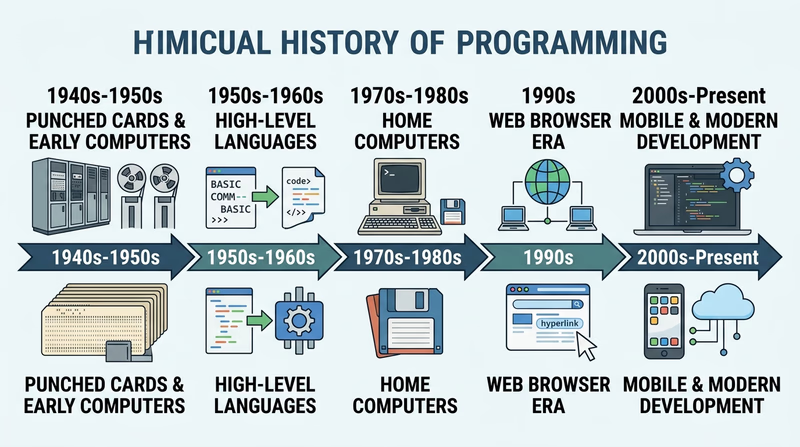
Programming history is really the story of people trying to make machines do more useful things with less effort. At first, programming meant giving extremely detailed instructions to giant machines. Over time, languages became easier for humans to read, computers became faster and smaller, and programming spread from research labs into homes, schools, businesses, and pockets.
A good discussion with your counselor should do more than list dates. Show how each milestone changed what programmers could build, who could build it, or how fast they could work.
A simple timeline to know
1. Early ideas — Ada Lovelace and machine instructions
In the 1840s, Ada Lovelace wrote about how Charles Babbage’s proposed Analytical Engine might follow instructions to manipulate symbols, not just numbers. The machine was never fully built, but the idea mattered: a machine could follow a sequence of operations designed by a person.
2. Early electronic computers — hardwired and low-level programming
In the 1940s, computers like ENIAC used switches, cables, and later machine code. Programming was difficult because the instructions were close to the hardware itself. A small mistake could keep the whole system from working.
3. High-level languages — FORTRAN and COBOL
In the 1950s, programmers developed languages that looked more like human reasoning. FORTRAN helped scientists and engineers write mathematical programs more efficiently. COBOL made business data processing easier to manage. This was a major shift because programmers no longer had to write every instruction in raw machine language.
4. Structured programming — clearer logic
Languages and methods in the 1960s and 1970s pushed programmers toward clearer structure with loops, conditionals, and reusable blocks. This helped large projects become easier to read, test, and maintain.
5. Personal computers — programming reaches individuals
In the late 1970s and 1980s, personal computers put programming in homes and schools. BASIC became a common first language for many learners. Suddenly, programming was not only for governments, universities, and big companies.
6. The web era — software becomes connected
In the 1990s, the growth of the internet changed programming again. Languages like JavaScript helped make websites interactive. Programmers were no longer only building stand-alone software. They were building connected systems used by millions of people.
7. Modern languages and open-source collaboration
Today, languages like Python, JavaScript, Java, C#, Swift, Kotlin, and many others help programmers build tools for data science, web apps, games, robotics, artificial intelligence, and mobile devices. Open-source platforms also make it easier for people to learn from real projects and contribute from anywhere.
Three milestones you could discuss
If you need help choosing milestones, these are strong examples:
Milestones worth bringing to your counselor
Pick at least three and explain why they mattered
- High-level languages: They made programming more readable and less tied to machine hardware.
- Personal computers: They gave everyday people access to programming tools.
- The internet and web programming: They turned software into a connected experience instead of a single-machine activity.
- Open-source collaboration: It made shared learning and large volunteer projects possible.
- Modern beginner-friendly languages: They lowered the barrier to entry for new programmers.
How language evolution changed programming
Programming languages evolved because programmers kept running into the same problem: computers need precise instructions, but humans need tools that are easier to understand. Newer languages often improved one or more of these areas:
- readability — code became easier to follow
- speed of development — programmers could build more in less time
- safety — some languages help catch mistakes earlier
- portability — code could run on different systems
- specialization — some languages became better for web, science, mobile, or embedded systems
🎬 Video: 5 Minute Video of Programming Language History (video) — https://youtu.be/K5yv7dY17EA?si=yYdqNCZwa0w0SzJs
Before you leave this page, make sure you can explain not only what changed, but why those changes mattered to real programmers.