Req 3 — Languages and Everyday Code
This requirement helps you see programming from two angles. First, you will compare languages and the jobs they are good at. Then you will look around your own day and notice how many ordinary devices depend on code.
Requirement 3a
A programming language is a tool, not a trophy. No language is best at everything. Different industries choose languages based on speed, reliability, available libraries, hardware limits, team experience, and the kinds of problems they solve most often.
Here is a useful way to think about five common languages.
| Language | Often used in | Why industries choose it |
|---|---|---|
| Python | data science, automation, education, AI, web back ends | Easy to read, huge library ecosystem, quick to prototype |
| JavaScript | web front ends, web back ends, interactive sites | Runs in browsers and powers much of the modern web |
| Java | enterprise software, Android, large business systems | Mature tools, strong performance, portable across systems |
| C# | game development, business apps, desktop tools | Strong Microsoft ecosystem and popular for Unity game projects |
| C/C++ | operating systems, game engines, robotics, embedded systems | Fast and close to hardware when performance matters |
You do not have to use these exact five, but your list should show range. Try to include languages used in different settings instead of five that all do almost the same job.
Eight Popular Programming Languages, Their Industries and Coding Examples (PDF) This official overview gives examples of common languages, sample code, and the kinds of industries that rely on each one. Link: Eight Popular Programming Languages, Their Industries and Coding Examples (PDF) — https://filestore.scouting.org/filestore/Merit_Badge_ReqandRes/Requirement%20Resources/Programming/Req3-General.docxRequirement 3b
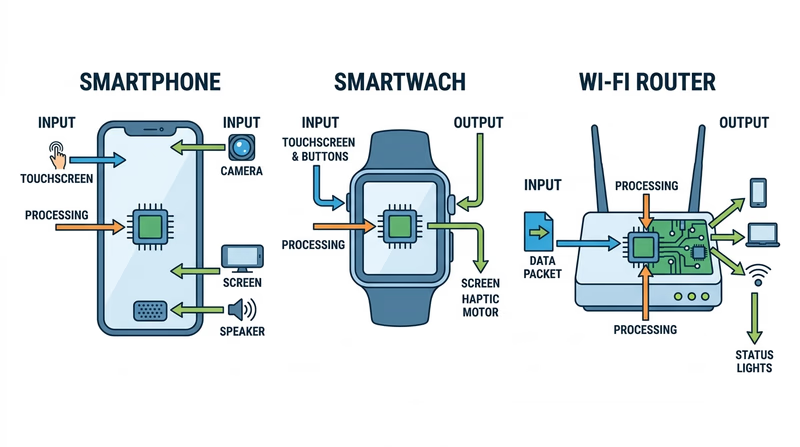
This part is about noticing the invisible software around you. Many devices do not look like computers, but they still run programs that take input, make decisions, and produce output.
Three strong examples might include:
Smartphone
A smartphone takes input from touches, cameras, microphones, GPS, and sensors. Its programs decide how to respond, display maps, send messages, play media, and manage battery use. You probably rely on it for communication, directions, weather, calendars, or school information.
Car or family vehicle systems
Modern vehicles contain many small computers. Programs help control braking, engine timing, dashboard warnings, navigation, backup cameras, and even climate control. Even if you are not the driver, you still rely on those systems for safety and transportation.
Home router or Wi-Fi equipment
Your internet connection depends on programmed devices that direct traffic, manage security, and connect many devices at once. Most people never see that code, but it is one reason their laptops, tablets, and game systems work.
Other good examples could be a smartwatch, microwave, game console, traffic signal, thermostat, alarm clock, or school Chromebook.
Choosing your three devices
Pick examples you actually use and can describe clearly
- Choose devices from different parts of life: communication, transportation, home, health, or entertainment.
- Explain what input the device receives.
- Explain at least one decision the program makes.
- Explain what output the device gives you.
In Req 2, you looked backward at programming history. Here, you can see the result: programming is now woven into the tools people depend on every day.