Req 5c — Third Language Project
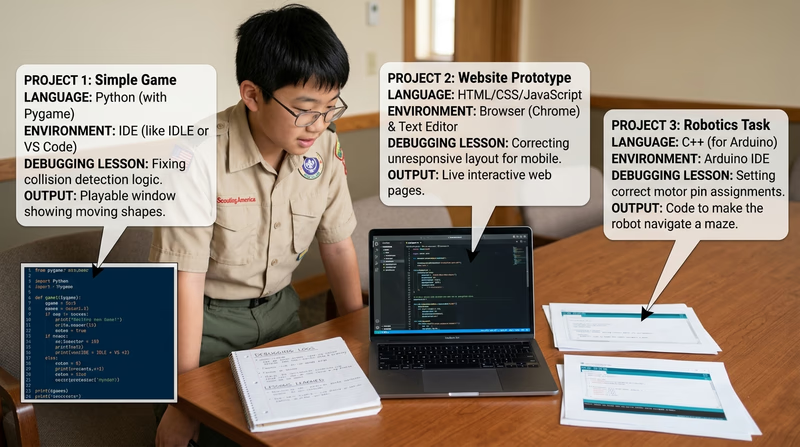
By the time you reach this third project, you are no longer just trying to prove that you can get a program to run. You are showing that the big ideas of programming transfer across tools. Input, decisions, computations, output, and debugging are still the core — even when the language or environment changes.
Stretch a little farther
A good third project often adds a new twist. Maybe your first project was text-based and your second was web-based. Your third could involve block coding, a simple game engine, physical computing, or a different style of interface. The point is not to make the most difficult project possible. The point is to show range.
Good third-project directions might include:
- a small game with score tracking and win/lose logic
- a sensor or button program in a physical-computing environment
- a web page that reacts to user input
- a useful tool that sorts, counts, or transforms data
Show what transfers between languages
This is a great place to notice that languages may look different, but the thinking often stays the same.
- variables still store information
- conditionals still guide decisions
- loops still repeat tasks
- debugging still depends on careful testing
If your counselor asks what you learned from using three languages, a strong answer might be: the syntax changed, but the problem-solving process stayed familiar.
What to compare across all three projects
Use this when you discuss the full set with your counselor
- Which language felt most readable?
- Which development environment made debugging easiest?
- Which project gave the clearest output?
- Which language would you choose for another similar task?
- What programming ideas stayed the same across all three?
After three projects, you have done something real: you have written code in multiple contexts and learned how to talk about it clearly. The next requirement asks what you might do with that knowledge beyond the badge.