Req 1 — How Disease Spreads
This requirement gives you the language of public health. You will define the field, trace how infections and other hazards reach people, and organize diseases by type, transmission, prevention, and treatment. Instead of memorizing facts one by one, look for patterns.
- Start with the source: Where does the disease or hazard come from?
- Look at transmission: How does it move from place to place or person to person?
- Think about prevention: What breaks that chain?
- Notice the difference: Some diseases come from germs, some from toxins, and some from environmental exposure.
Requirement 1a
Public health is the work of protecting and improving the health of groups of people rather than treating one patient at a time. A doctor may treat one person with food poisoning. Public health asks why several people got sick, whether the source was a restaurant, and how to stop more cases.
Public health uses prevention as its main tool. That includes safe water, vaccination, sanitation, health education, food inspections, mosquito control, emergency planning, and data tracking. The goal is not only to cure illness after it happens. The goal is to make illness less likely in the first place.
A helpful way to remember it is this: medicine treats the person in front of you; public health protects the people around them too. That is why public health workers pay attention to patterns, environments, and shared risks.
American Public Health Association — What Is Public Health? A leading professional organization for the field. Use it to see how public health connects prevention, policy, education, and community action. Link: American Public Health Association — What Is Public Health? — https://www.apha.org/Requirement 1b
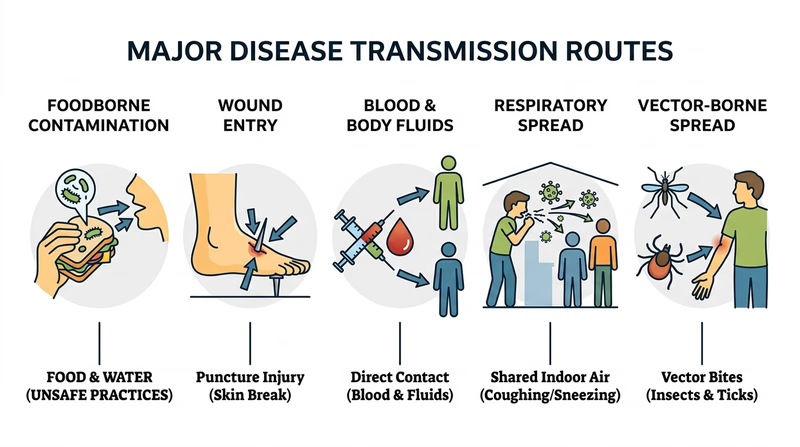
These seven examples show several different transmission routes.
| Disease or condition | Usually contracted by |
|---|---|
| E. coli | Eating or drinking something contaminated with certain strains of the bacteria, or through poor hand hygiene after contact with feces or contaminated surfaces |
| Tetanus | Bacteria entering the body through a wound, especially dirty punctures or injuries involving contaminated soil or dust |
| AIDS | AIDS is the late stage of HIV infection. HIV spreads through specific body fluids such as blood, semen, vaginal fluids, rectal fluids, or breast milk |
| Encephalitis | This is brain inflammation with several possible causes; some forms follow viral infections and some are spread by mosquito or tick bites |
| Salmonellosis | Eating contaminated food, especially undercooked poultry or eggs, unwashed produce, or through contact with infected animals or their droppings |
| Lyme disease | Being bitten by an infected blacklegged tick |
| COVID-19 | Breathing in virus-containing droplets or aerosols, especially in close indoor contact with an infected person |
When you explain these to your counselor, do not stop at the disease name. Be precise about the route: foodborne, bloodborne, wound-related, vector-borne, or respiratory. That is what makes prevention strategies make sense.
Requirement 1c
For this part, the key verbs are contracted and possibly prevented. The strongest way to prepare is to treat each disease as a two-part question:
- How does it reach the body?
- What action lowers that risk?
You only need to choose four, but studying the full list helps you pick a balanced set instead of four diseases that all spread the same way.
| Disease or condition | Usually contracted by | Possible prevention to explain |
|---|---|---|
| Gonorrhea | Sexual contact with an infected person | Safer sexual-health practices, testing, early treatment |
| West Nile virus | Bite from an infected mosquito | Repellent, long sleeves, draining standing water, screens |
| Botulism | Eating food containing botulinum toxin, especially improperly canned or preserved food | Safe canning, proper food storage, avoiding bulging or spoiled containers |
| Influenza | Respiratory droplets or aerosols from an infected person | Annual vaccination, handwashing, staying home when sick, covering coughs |
| Syphilis | Sexual contact with an infected person; sometimes passed from pregnant parent to baby | Safer sexual-health practices, testing, prompt treatment |
| Hepatitis | Varies by type: some spread through contaminated food or water, others through blood or body fluids | Vaccination for some types, handwashing, safe food and water, avoiding blood exposure |
| Emphysema | Usually develops after long-term exposure to tobacco smoke or other lung irritants | Do not smoke or vape, avoid secondhand smoke and harmful dusts or fumes |
| Meningitis | Varies by type: some spread through respiratory droplets or close contact | Vaccination for some types, handwashing, avoiding close exposure when someone is ill |
| Herpes | Direct contact with infected skin, saliva, or sexual contact depending on type | Avoid direct contact during active outbreaks, safer sexual-health practices |
| Lead poisoning | Swallowing or breathing in lead from paint dust, contaminated soil, water, or certain products | Test older homes, control dust, wash hands, avoid known lead sources |
A strong way to choose your four
Pick diseases that let you show different routes of transmission and prevention
- Pick one vector-borne example: West Nile virus is the clearest one.
- Pick one food or toxin example: Botulism works well.
- Pick one respiratory or close-contact example: Influenza or meningitis.
- Pick one environmental or chronic exposure example: Lead poisoning or emphysema.
Requirement 1d
This part is broader than 1c. Now you are not picking four. You are comparing all 10 using the same four lenses:
- type or form
- possible vectors
- prevention or reduced spread
- available treatments
A chart works especially well here because the requirement is asking for side-by-side analysis.
| Disease or condition | Type or form | Possible vectors | Prevention or reduced spread | Available treatments |
|---|---|---|---|---|
| Gonorrhea | Bacterial | None in the insect sense | Safer sexual-health practices, testing, prompt care of partners | Antibiotics |
| West Nile virus | Viral | Mosquitoes | Repellent, drain standing water, protective clothing, screens | Supportive care; severe cases need medical treatment |
| Botulism | Toxin produced by bacteria | None | Safe food preservation, safe canning, refrigeration when needed | Urgent medical care, antitoxin, breathing support in severe cases |
| Influenza | Viral | None | Annual vaccination, handwashing, respiratory hygiene, staying home when sick | Rest, fluids, supportive care, antiviral medicine for some cases |
| Syphilis | Bacterial | None | Safer sexual-health practices, testing, prompt treatment | Antibiotics |
| Hepatitis | Viral in the most common forms discussed here | None | Vaccination for some types, safe food and water, avoiding blood or body-fluid exposure | Depends on type; supportive care or antiviral treatment for some forms |
| Emphysema | Chronic lung disease; environmental or exposure-related | None | Avoid smoking, vaping, secondhand smoke, and chronic lung irritants | Inhaled medicines, oxygen for some patients, pulmonary rehab, stopping exposure |
| Meningitis | Often viral or bacterial | None | Vaccination for some forms, handwashing, limiting close exposure, rapid medical evaluation | Depends on cause; bacterial meningitis needs urgent antibiotics, viral cases often need supportive care |
| Herpes | Viral | None | Avoid direct contact during outbreaks, safer sexual-health practices | Antiviral medicines can help control symptoms and reduce spread |
| Lead poisoning | Environmental toxic exposure | None | Remove lead sources, wet-clean dust, test older homes or water, wash hands | Remove exposure; medical follow-up and sometimes chelation therapy |
What the word “vector” means here
The requirement asks for possible vectors for transmission, but only a few items on this list truly use vectors. West Nile virus is the clearest example because mosquitoes carry it from host to host. Most of the others spread by contact, air, food, blood, or environmental exposure instead.
What makes this comparison useful
This chart helps you explain why prevention changes from one disease to the next. Vaccination helps with influenza and some hepatitis or meningitis risks, but it does nothing for lead poisoning. Mosquito control matters for West Nile virus, but not for gonorrhea. Antibiotics help bacterial diseases, but not viral ones.
CDC — Clean Hands A useful reminder that many infectious-disease prevention strategies begin with handwashing and other basic hygiene habits. Link: CDC — Clean Hands — https://www.cdc.gov/clean-hands/about/index.html CDC — Tick Bite Prevention Helpful for comparing true vector-borne transmission with diseases that spread by other routes. Link: CDC — Tick Bite Prevention — https://www.cdc.gov/ticks/prevention/index.htmlYou now have the core idea behind the badge: diseases and health hazards follow patterns. In the next requirement, you will look at one of public health’s strongest prevention tools.