Req 2 — Immunization Basics
This requirement covers three linked ideas: what immunization is, which diseases vaccines help prevent, and where vaccines are not currently available. Public health is strongest when people understand both the power and the limits of immunization.
Requirement 2a
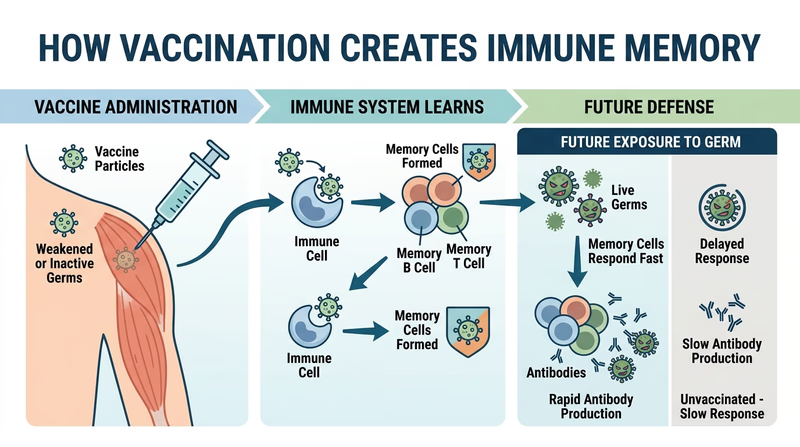
Immunization is the process of helping the body build protection against a disease, usually through vaccination. A vaccine trains your immune system to recognize a germ or part of a germ so your body can respond faster and more effectively later.
The important idea is preparation. Your immune system has “memory.” After immunization, it may recognize the threat before the real infection can do major damage. That does not always mean a person will never get sick. It often means they are less likely to get seriously sick, be hospitalized, or spread the disease widely.
Immunization also protects communities. When many people are protected, a germ has fewer easy paths to move through a school, troop, neighborhood, or family.
Requirement 2b
For this discussion, focus on the pattern rather than trying to sound perfect from memory. Your counselor wants to know that you understand how vaccine schedules work.
Young children are commonly immunized against several serious diseases early in life. Examples often discussed in childhood vaccine schedules include measles, mumps, rubella, polio, diphtheria, tetanus, pertussis, chickenpox, hepatitis B, and certain bacterial infections such as Hib or pneumococcal disease. Your counselor may want current local recommendations, so use an up-to-date source.
Two examples of diseases for which people may need periodic reimmunization or booster protection include tetanus and COVID-19, depending on current guidance and age or risk group. The classic annual immunization is influenza.
Requirement 2c
This part matters because vaccines are powerful, but they do not exist for everything. Some conditions in Requirement 1 are not prevented by routine vaccination at all. Lead poisoning is an exposure problem, not an infectious disease. Emphysema is usually prevented by avoiding tobacco smoke and harmful inhaled irritants. Lyme disease prevention mainly depends on avoiding tick bites. Salmonellosis prevention depends heavily on safe food handling.
Even when no vaccine is available, public health still has tools. Those tools include sanitation, better food safety, pest control, protective equipment, safer behaviors, testing, early treatment, and education.
When there is no vaccine
Ask what public health uses instead
- Environmental controls: remove lead, improve ventilation, improve sanitation
- Behavior changes: safer handling of food, safer sex practices, handwashing
- Vector control: reduce mosquitoes and ticks
- Early detection: testing, reporting, and contact tracing when needed
- Treatment and follow-up: reduce complications and further spread
🎬 Video: How do vaccines help babies fight infections? | How Vaccines Work — Centers for Disease Control and Prevention (CDC) — https://www.youtube.com/watch?v=k7DGeWlKu0Q
Public health cannot vaccinate away every problem, so the next requirement moves to another major defense: safe water and sanitation.