Extended Learning
A. Introduction
You have completed every requirement for the Public Speaking merit badge — congratulations! You have introduced yourself, delivered a prepared talk with visuals, spoken on the spot without preparation, written and delivered a full-length speech, and navigated the world of parliamentary procedure. These are skills that many adults wish they had, and you have built them before you even graduated high school. What comes next is entirely up to you.
B. Deep Dive: The Art of Storytelling in Speeches
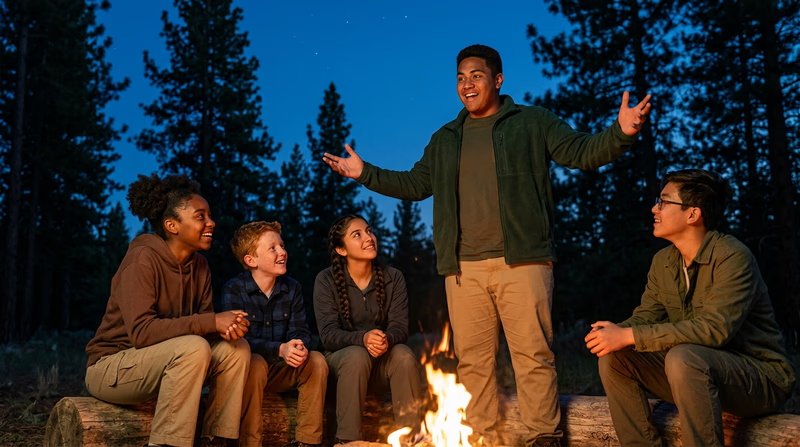
Every great speaker is, at heart, a great storyteller. Stories are the oldest form of communication, and they remain the most effective. When you share a fact, your audience processes it with the analytical part of their brain. When you tell a story, their brain lights up as if they are experiencing the events themselves. That difference is what makes stories unforgettable.
The best speech stories follow a simple arc: character, conflict, resolution. You introduce someone (often yourself), describe a challenge they faced, and explain how they overcame it. The key is specificity — do not say “I went camping and it was hard.” Say “At 2 a.m. on my first night at Philmont, my tent collapsed in a thunderstorm, and I had to rebuild it in the dark while my tentmate held a flashlight with shaking hands.”
Here are four types of stories that work in almost any speech:
- Personal experience stories — The most powerful because they are uniquely yours. Share a moment that changed your perspective, taught you a lesson, or made you laugh.
- “I was there” stories — Describe an event you witnessed or participated in. These put the audience in the moment with vivid sensory details.
- Historical stories — Connect your topic to a real event from history. These add authority and context to your message.
- Hypothetical stories — “Imagine you are standing at the edge of the Grand Canyon…” These invite the audience to picture themselves in a scenario, creating instant engagement.
To practice, try the “60-second story challenge.” Pick a random moment from your life — a camping trip, a school event, a family dinner — and tell the story in exactly 60 seconds. Focus on one moment, one emotion, and one lesson. Do this daily, and within a month you will have a library of stories ready to drop into any speech.
C. Deep Dive: Overcoming the Fear for Good
You have already spoken in front of people multiple times for this merit badge, so you know the fear is survivable. But how do you move beyond surviving to actually enjoying public speaking? The answer lies in understanding what your brain is doing — and retraining it.
When you stand in front of a group, your brain detects a potential threat (all those eyes!) and triggers the fight-or-flight response. Your heart races, your palms sweat, and your mouth goes dry. This is the exact same response your ancestors had when they spotted a predator. The good news is that this response is manageable, and with repeated exposure, it fades dramatically.
Professional speakers use a technique called cognitive reframing — deliberately changing how you interpret the situation. Instead of thinking “everyone is judging me,” think “everyone chose to be here and wants to hear what I have to say.” Instead of “I might mess up,” think “even if I stumble, the audience will not care as much as I think.” These are not tricks — they are accurate descriptions of reality that your anxious brain tends to ignore.
Another powerful technique is pre-performance routines. Athletes use them before every game, and speakers can do the same. Develop a consistent routine you follow before every speech: listen to a favorite song, do ten jumping jacks, review your first three lines, take five deep breaths, and walk to the stage. The routine signals your brain that what follows is familiar and safe, which reduces anxiety significantly.
Finally, seek more opportunities to speak, not fewer. Join your school’s speech or debate team. Volunteer to give announcements at troop meetings. Offer to present at church, at a community event, or in class. Every time you speak and survive (which you will, every time), your brain recalibrates. The fear shrinks. Eventually, the butterflies do not go away — but they start flying in formation.
D. Deep Dive: Speaking in the Digital Age
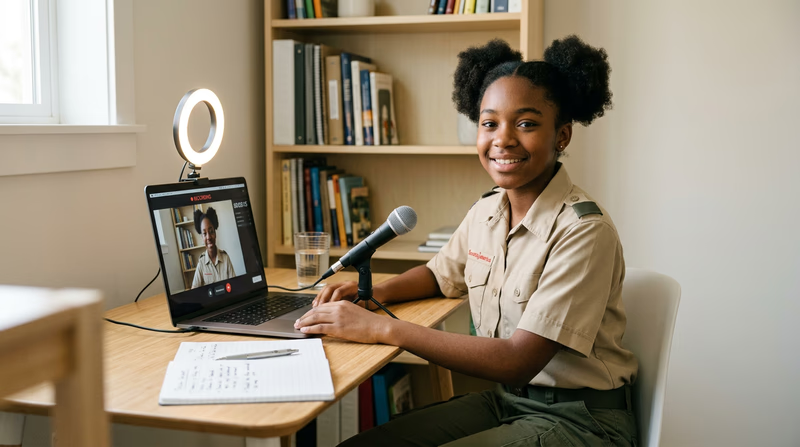
Public speaking no longer means standing behind a podium in a room full of chairs. Today, millions of people speak to audiences through screens — on YouTube, in podcasts, on live streams, and in virtual meetings. If you want to be an effective communicator in the modern world, you need to understand how digital speaking works.
Video presentations require you to look at the camera lens, not at the screen. This feels unnatural at first, but it creates the illusion of eye contact with every viewer. Keep your background clean and well-lit. Speak slightly slower than normal because audio compression can make fast speech harder to understand.
Podcasting removes the visual element entirely. Your voice does all the work. Vary your tone, pace, and volume even more than you would in person. Avoid long pauses (they feel much longer without visuals) and use vivid descriptions so listeners can “see” what you are talking about.
Virtual meetings (Zoom, Teams, Google Meet) blend elements of both. You need to look at the camera, but you also need to manage chat questions, mute/unmute dynamics, and screen sharing. The best virtual speakers keep their energy high because screens naturally flatten your presence — what feels like normal energy in person looks flat and bored on camera.
The fundamental skills — clear thinking, strong structure, audience awareness, and confident delivery — are exactly the same whether you are in a conference hall or a bedroom recording studio. The medium changes, but the principles you learned in this merit badge apply everywhere.
E. Real-World Speaking Experiences
Ready to put your skills to work? These opportunities will challenge you and help you grow as a speaker.
Toastmasters Youth Leadership Program
National Speech and Debate Tournaments
Scout Sunday / Scout Sabbath Talks
Eagle Scout Project Presentations
Community Service Presentations
F. Organizations
These organizations can help you continue developing your speaking and communication skills long after you earn this badge.
The world’s largest organization dedicated to helping people become better public speakers and leaders. Many clubs welcome youth participants.
The largest interscholastic speech and debate organization in the United States, serving middle and high school students with competitions, resources, and community.
The honor society of the National Speech and Debate Association, recognizing outstanding achievement in speech, debate, and congressional debate.
Dedicated to teaching and promoting parliamentary procedure. Offers educational materials, certification programs, and youth resources.
A program that helps students discover, develop, and share their ideas in the form of short TED-style talks, with support from teachers and mentors.