Req 1 — Paper Through History
If paper disappeared for one week, you would notice fast. Shipping would slow down, food packaging would change, labels would go missing, schools and offices would scramble, and stores would run short of cartons, tissues, receipts, and paper towels. That is why this requirement is about more than old mills and ancient history. It is about how one material became part of almost every daily system people rely on.
A Short History of Papermaking
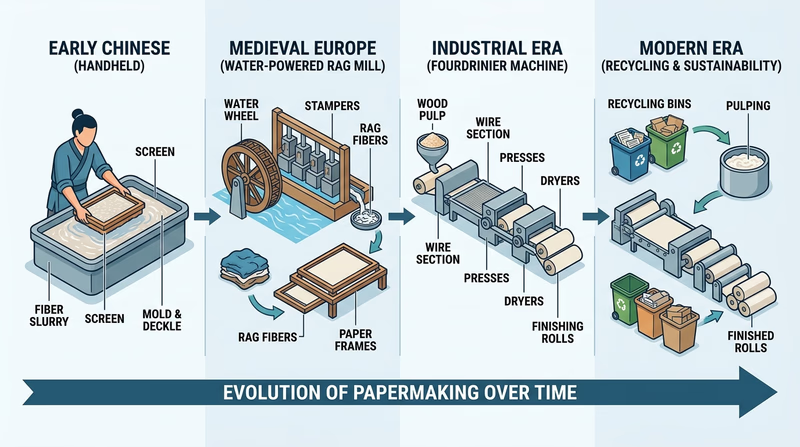
The story usually begins in China, where early papermakers discovered that plant fibers could be soaked, beaten into pulp, suspended in water, and lifted out on a screen. When the water drained away, the fibers dried into a thin sheet. That basic idea still describes paper today.
From China, papermaking spread to other regions over centuries. Craftspeople in the Islamic world improved techniques and built mills. Later, paper production reached Europe, where rag paper made from linen and cotton became important for books, maps, legal records, and trade. Water-powered mills let workers process more fiber than hand labor alone.
For a long time, old cloth rags were the main raw material. That became a problem as demand for newspapers, books, and business records exploded. By the 1800s, inventors developed ways to get usable fibers from wood. That change transformed paper from a valuable material into a mass-market product.
Why Wood Changed Everything
Trees contain cellulose fibers that can be separated, cleaned, and turned into pulp. Once mills learned how to do that at scale, paper became cheaper and more available. Newspapers could be printed in huge numbers. Packaging expanded with industrial trade. Schools, governments, and businesses could all use more paper without depending on limited rag supplies.
Wood also made it possible to tailor pulp to different products. Longer fibers from many softwoods help create strength. Shorter fibers from many hardwoods can improve smoothness and printing quality. Recycled fiber adds another important source for new paper and paperboard.
Paper’s Role in Society
Paper helps people communicate, organize, protect, and clean.
Communication and Learning
Books, notebooks, worksheets, maps, signs, and packaging labels all depend on paper or paperboard. Even in a digital world, paper is still useful because it is easy to carry, mark up, stack, print, archive, and recycle.
Packaging and Shipping
E-commerce has made corrugated boxes, protective inserts, and paper mailers even more important. A product may be made in one place, packed in another, shipped through several warehouses, and delivered to a home — with paper packaging helping at every step.
Hygiene and Food Service
Tissues, napkins, toilet paper, paper towels, cups, cartons, and wraps support sanitation and convenience. These are products people use quickly and replace often, which is why recycling, fiber sourcing, and responsible use matter.
Ways Paper Shows Up in Daily Life
Look for these roles around you today
- Information: books, receipts, labels, mail, instructions.
- Protection: boxes, cartons, dividers, sleeves, and wraps.
- Absorption: tissues, paper towels, coffee filters, and napkins.
- Presentation: gift wrap, greeting cards, magazines, and display packaging.
Paper’s Role in the Economy
The pulp and paper sector supports a chain of jobs, not just mill workers. It includes foresters, loggers, truck drivers, machine operators, mechanics, chemists, lab technicians, designers, recycling workers, warehouse staff, and packaging engineers. When you buy cereal in a carton, receive a box in the mail, or use a paper napkin in a restaurant, you are touching part of that economic network.
Paper products also connect rural and urban economies. Forestland and fiber production often begin in rural areas. Converting, printing, packaging, retail, and recycling may happen closer to towns and cities. That makes paper an example of a material that moves through many communities before and after you use it.
🎬 Video: The History of Paper From Ancient China to Modern Times (video) — https://youtu.be/gvdeiWWOG8w
In the next requirement, you will move from history to the modern industry itself — starting in the forest, where the raw material for most paper begins.