Req 3 — Fibers, Pulp, and Bleaching
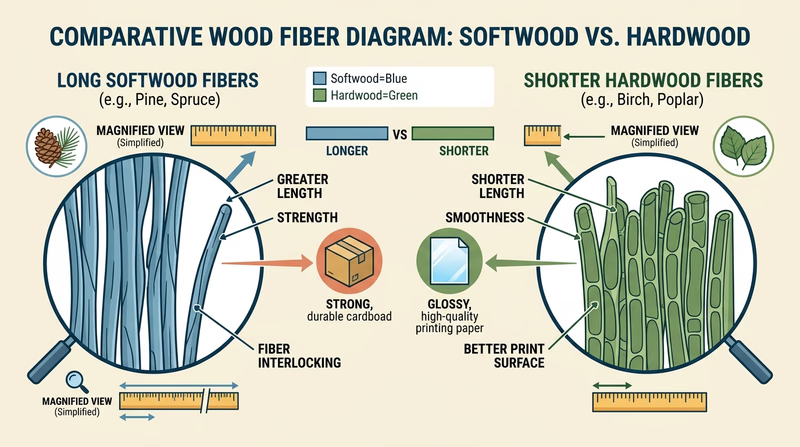
This requirement moves from the forest into the fiber itself. Before you start the subrequirements, be ready to name at least four important papermaking trees. Common examples include pine, spruce, fir, and hemlock from the softwood group, plus eucalyptus, birch, aspen, and poplar from the hardwood group.
Softwoods often provide longer fibers that help with strength. Hardwoods often provide shorter fibers that can improve smoothness, opacity, and print quality. Mills mix fibers because different products need different performance.
🎬 Video: What Kind of Tree Does Paper Come From (video) — https://youtube.com/shorts/oRgPQdX0CLI
Requirement 3a: Other Uses for Trees and Forestland
A tree grown on industrial forestland is not useful only for paper. Different parts of the same tree may end up in different industries. Straight, high-quality sections may become lumber or plywood. Smaller logs, chipped residues, or lower-grade wood may be used for pulp. Bark and other byproducts may be used as fuel or soil products in some operations.
The land itself often has more than one purpose too. Managed forestland can support wildlife habitat, watershed protection, hunting leases, recreation, erosion control, and carbon storage. In some places, roads built for forestry also provide access for firefighting, research, or maintenance crews.
That is why foresters think in terms of multiple use. A working forest can produce fiber while still supporting streams, habitat, and recreation if it is managed carefully.
Purposes and Techniques of Forest Management (website) Explains how forestland can support more than one use at the same time, including timber, water, wildlife, and grazing. Link: Purposes and Techniques of Forest Management (website) — https://www.britannica.com/science/forestry/Range-and-forageRequirement 3b: Two Ways of Getting Fibers From Wood
The two big approaches are mechanical pulping and chemical pulping.
Mechanical pulping
In mechanical pulping, wood is ground or refined until the fibers separate. This keeps most of the wood substance, including lignin, which is the material that helps hold the tree together. Mechanical pulping usually gets more pulp from each log because less material is dissolved away.
Chemical pulping
In chemical pulping, wood chips are cooked with chemicals that dissolve much of the lignin and free the cellulose fibers. This process usually gives a lower yield than mechanical pulping, but the resulting fibers are often stronger and better suited to many durable paper products.
Major differences
| Method | Main idea | Strengths | Trade-offs |
|---|---|---|---|
| Mechanical | Physically grind or refine wood apart | High fiber yield, good for some printing uses | More lignin stays in the pulp, which can affect brightness and aging |
| Chemical | Use chemicals to dissolve lignin and release fibers | Stronger pulp, cleaner cellulose fiber | Lower yield from the original wood, more process complexity |
A simple way to remember it: mechanical pulping tears wood apart; chemical pulping cooks it apart.
🎬 Video: From Tree to Paper (video) — https://youtube.com/shorts/c-87Bw_lXso
Requirement 3c: Why Some Pulps Are Bleached
Not every paper product needs bright white pulp. Shipping boxes and some packaging grades can work well with brown or unbleached pulp. But products such as office paper, some tissues, high-brightness printing paper, and certain packaging grades may need lighter color and cleaner-looking fiber.
Bleaching helps remove or alter leftover color-causing compounds, especially those linked to lignin. The goal is usually one or more of these:
- increase brightness
- improve appearance for printing
- create a cleaner-looking sheet
- meet the product expectations of customers
Bleaching is not just “pour in bleach.” In industrial papermaking, it happens in controlled stages. After chemical pulping and washing, the pulp may go through one or more treatment steps using specific chemicals. Between stages, it is washed and tested so the mill can reach the desired brightness without damaging fiber strength more than necessary.
🎬 Video: Bleaching (video) — https://youtu.be/d43q0j831f8
Req 2 focused on growing and managing trees. This requirement showed what mills want from those trees once they arrive: usable fiber with the right properties. Next, you will follow that pulp all the way into finished paper and recycling.