 Getting Started
Introduction & Overview
Overview
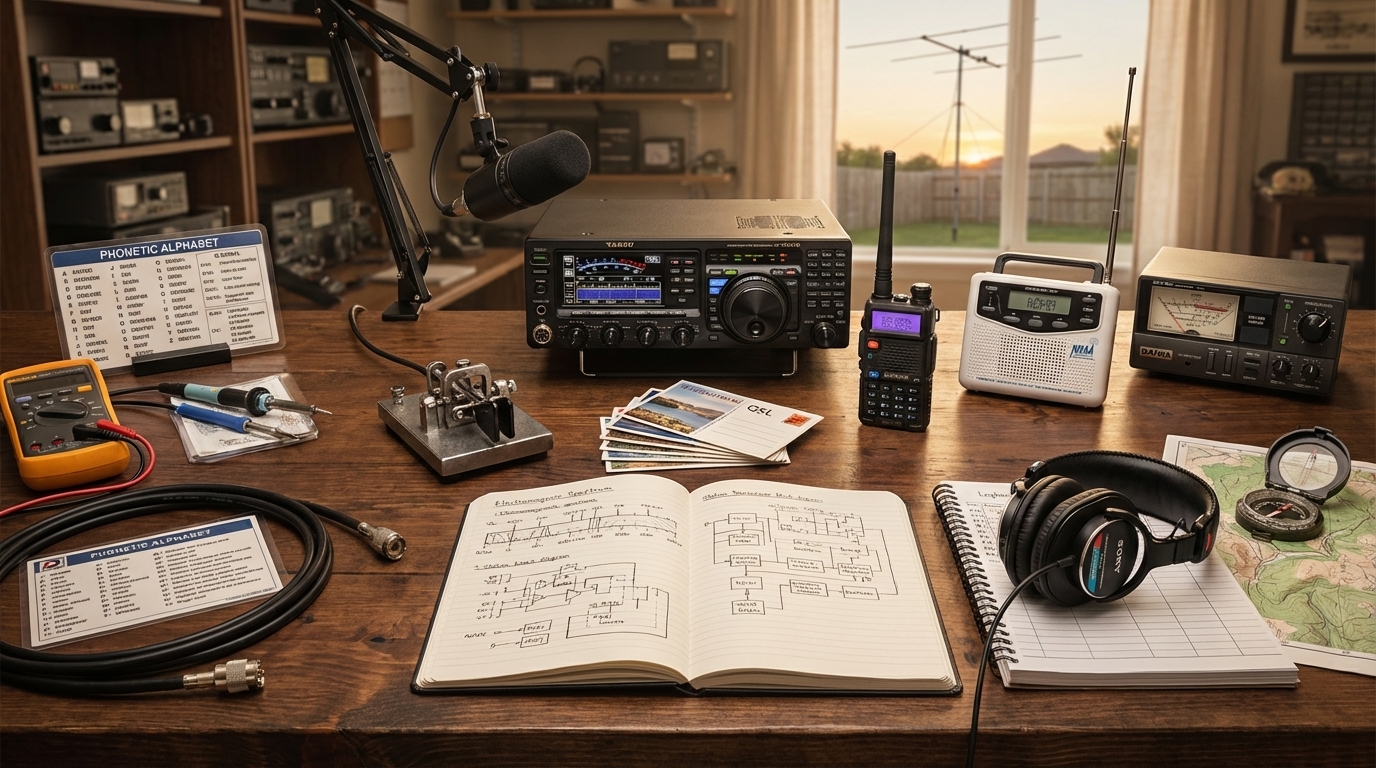
Radio is everywhere — and most people never notice. Every time you stream a song, send a text, connect to Wi-Fi, or hear a weather alert, you are using radio waves. The Radio merit badge pulls back the curtain on the invisible signals that connect the modern world, from the AM broadcast tower in your town to the satellite links that reach the International Space Station.
This badge is unusual because it combines hands-on science (you’ll draw spectrum charts and build diagrams) with practical communication skills (you’ll log stations, learn the phonetic alphabet, and potentially operate real radio equipment). Whether you end up pursuing an amateur radio license or simply understanding how your phone actually works, Radio gives you knowledge that most adults don’t have.
Then and Now
Then
In 1895, Guglielmo Marconi sent the first radio signals across a field in Italy. By 1901 he had transmitted the letter “S” in Morse code across the Atlantic Ocean — 2,100 miles through empty air. People called it “wireless telegraphy,” and it felt like magic.
Radio transformed the 20th century. Ships at sea could call for help (the Titanic’s distress calls in 1912 led directly to modern maritime radio laws). Families gathered around living room radios to hear news, music, and fireside chats from the president. During World War II, radio was the backbone of military communication — and after the war, thousands of returning servicemembers brought their radio skills home and launched the amateur radio hobby that thrives today.
Scouting embraced radio early. The Radio merit badge was first offered in 1923, making it over a century old — one of the longest-running merit badges in BSA history.
Now
Today’s radio technology is almost unrecognizable from Marconi’s spark-gap transmitter. Your smartphone alone contains radios for cellular voice and data, Wi-Fi, Bluetooth, GPS, and NFC (near-field communication). A single modern car may have a dozen radio systems operating simultaneously.
Amateur radio operators (“hams”) still provide critical emergency communication when cell towers fail — as they did during hurricanes Katrina, Maria, and Ian. Software-defined radios let hobbyists experiment with signals using a $25 USB dongle and a laptop. And the radio spectrum itself has become one of the most valuable resources on Earth: wireless spectrum auctions regularly raise tens of billions of dollars.
Get Ready!
Radio is a badge that rewards curiosity. You’ll draw diagrams, sketch charts, listen to stations you’ve never heard before, and learn a vocabulary that lets you talk like an operator. Several requirements ask you to “explain” or “discuss” — these are counselor conversations where depth of understanding matters more than memorization. Come ready to think about why radio works the way it does, not just what the rules are.
For Requirement 8, you’ll choose one of five hands-on options — from amateur radio operation to broadcasting to fox hunting with a directional antenna. Read through all five options before committing so you pick the one that fits your interests and available resources.
Kinds of Radio
Broadcast Radio
One transmitter sends to many receivers. AM and FM stations, television broadcasts, and satellite radio all follow this model. The audience listens but cannot reply.
Two-Way Radio
Both sides can transmit and receive. Amateur (ham) radio, FRS/GMRS walkie-talkies, CB radio, and public safety (police, fire, EMS) radios all allow two-way communication. This is the world where Scouts can directly participate.
Digital & Data Radio
Wi-Fi, Bluetooth, 5G, GPS, and RFID are all radio systems that carry data rather than voice. You use them constantly without thinking of them as “radio” — but they follow the same physics as a 1920s broadcast tower.
Emergency & Navigation Radio
NOAA Weather Radio, the Emergency Alert System, satellite messengers, and GPS all exist specifically to keep people safe. Understanding these systems is directly relevant to Scouting’s outdoor mission.
Ready to start? Your first stop is safety — because working with antennas, power supplies, and batteries carries real risks that every radio operator must understand.