Radio Merit Badge — Complete Digital Resource Guide
https://merit-badge.university/merit-badges/radio/guide/
Introduction & Overview
Overview
Radio is everywhere — and most people never notice. Every time you stream a song, send a text, connect to Wi-Fi, or hear a weather alert, you are using radio waves. The Radio merit badge pulls back the curtain on the invisible signals that connect the modern world, from the AM broadcast tower in your town to the satellite links that reach the International Space Station.
This badge is unusual because it combines hands-on science (you’ll draw spectrum charts and build diagrams) with practical communication skills (you’ll log stations, learn the phonetic alphabet, and potentially operate real radio equipment). Whether you end up pursuing an amateur radio license or simply understanding how your phone actually works, Radio gives you knowledge that most adults don’t have.
Then and Now
Then
In 1895, Guglielmo Marconi sent the first radio signals across a field in Italy. By 1901 he had transmitted the letter “S” in Morse code across the Atlantic Ocean — 2,100 miles through empty air. People called it “wireless telegraphy,” and it felt like magic.
Radio transformed the 20th century. Ships at sea could call for help (the Titanic’s distress calls in 1912 led directly to modern maritime radio laws). Families gathered around living room radios to hear news, music, and fireside chats from the president. During World War II, radio was the backbone of military communication — and after the war, thousands of returning servicemembers brought their radio skills home and launched the amateur radio hobby that thrives today.
Scouting embraced radio early. The Radio merit badge was first offered in 1923, making it over a century old — one of the longest-running merit badges in BSA history.
Now
Today’s radio technology is almost unrecognizable from Marconi’s spark-gap transmitter. Your smartphone alone contains radios for cellular voice and data, Wi-Fi, Bluetooth, GPS, and NFC (near-field communication). A single modern car may have a dozen radio systems operating simultaneously.
Amateur radio operators (“hams”) still provide critical emergency communication when cell towers fail — as they did during hurricanes Katrina, Maria, and Ian. Software-defined radios let hobbyists experiment with signals using a $25 USB dongle and a laptop. And the radio spectrum itself has become one of the most valuable resources on Earth: wireless spectrum auctions regularly raise tens of billions of dollars.
Get Ready!
Radio is a badge that rewards curiosity. You’ll draw diagrams, sketch charts, listen to stations you’ve never heard before, and learn a vocabulary that lets you talk like an operator. Several requirements ask you to “explain” or “discuss” — these are counselor conversations where depth of understanding matters more than memorization. Come ready to think about why radio works the way it does, not just what the rules are.
For Requirement 8, you’ll choose one of five hands-on options — from amateur radio operation to broadcasting to fox hunting with a directional antenna. Read through all five options before committing so you pick the one that fits your interests and available resources.
Kinds of Radio
Broadcast Radio
One transmitter sends to many receivers. AM and FM stations, television broadcasts, and satellite radio all follow this model. The audience listens but cannot reply.
Two-Way Radio
Both sides can transmit and receive. Amateur (ham) radio, FRS/GMRS walkie-talkies, CB radio, and public safety (police, fire, EMS) radios all allow two-way communication. This is the world where Scouts can directly participate.
Digital & Data Radio
Wi-Fi, Bluetooth, 5G, GPS, and RFID are all radio systems that carry data rather than voice. You use them constantly without thinking of them as “radio” — but they follow the same physics as a 1920s broadcast tower.
Emergency & Navigation Radio
NOAA Weather Radio, the Emergency Alert System, satellite messengers, and GPS all exist specifically to keep people safe. Understanding these systems is directly relevant to Scouting’s outdoor mission.
Ready to start? Your first stop is safety — because working with antennas, power supplies, and batteries carries real risks that every radio operator must understand.
Req 1 — Radio Safety
Radio equipment runs on electricity, connects to outdoor antennas, and increasingly uses lithium-ion batteries — three things that can hurt you if handled carelessly. Before you build your first circuit or raise your first antenna, you need to understand the hazards and how to manage them. This requirement covers grounding, electrical burns, and battery safety.
Requirement 1a: Grounding
Grounding means providing a safe path for unwanted electrical current to flow harmlessly into the earth instead of through equipment — or through you.
Why Grounding Matters
Every electrical circuit needs a return path. In a properly grounded system, stray current follows a low-resistance wire to the earth rather than looking for an alternative path (like your body). Without grounding, a fault in your power supply or a lightning strike on your antenna could send lethal voltage through your radio equipment and anyone touching it.
Types of Grounding
| Type | Purpose | How It Works |
|---|---|---|
| AC safety ground | Protects against faults in household wiring | The third prong on a plug connects the metal chassis to earth ground via your home’s grounding system |
| DC circuit ground | Provides a common reference point in low-voltage circuits | One terminal of the power supply connects to the chassis and to earth |
| Antenna/RF ground | Reduces interference and improves antenna performance | A wire or ground rod connects the antenna system to the earth |
| Lightning ground | Diverts lightning energy away from equipment and people | A heavy conductor runs from the antenna mast to a ground rod driven into the soil |
Key Rules
- Never defeat the ground. Don’t remove the third prong from a power cord or use an adapter that bypasses it.
- Use a dedicated ground rod for your antenna system, bonded to your home’s electrical ground system. Two separate, unbonded ground systems can create dangerous voltage differences.
- Disconnect antennas during thunderstorms. Even with proper grounding, a direct lightning strike can overwhelm any protection system. The safest move is to physically disconnect the antenna feedline and ground it before the storm arrives.
- Inspect ground connections regularly. Corrosion increases resistance and defeats the purpose of the ground.
Requirement 1b: Electrical Burns
Electrical burns happen when current passes through body tissue. They can occur from household AC power, high-voltage DC supplies, or even relatively low voltages if the skin is wet or broken.
Prevention
- Power down and unplug before working on any circuit. Don’t just flip the switch — disconnect the power source.
- Use one hand when possible when working near energized equipment. This reduces the risk of current flowing across your chest (hand to hand through the heart).
- Keep your workspace dry. Water dramatically reduces skin resistance, making even low voltages dangerous.
- Respect capacitors. Large capacitors in power supplies and transmitters can store lethal charges even after the equipment is unplugged. Discharge them properly before servicing.
- Wear insulated shoes and work on a dry, non-conductive surface.
Treatment
If someone receives an electrical burn:
- Ensure the scene is safe. Do not touch the victim if they are still in contact with the electrical source. Disconnect power first, or use a dry, non-conductive object (like a wooden broom handle) to separate them from the source.
- Call 911 for any electrical burn. Current can cause internal injuries that aren’t visible on the surface.
- Check breathing and pulse. Electrical shock can cause cardiac arrest. Be prepared to perform CPR.
- Cover visible burns with a sterile, non-adhesive dressing. Do not apply ice, butter, or ointments.
- Watch for shock. Lay the victim flat, keep them warm, and monitor their condition until help arrives.
Requirement 1c: Lithium-Ion Battery Safety
Lithium-ion (Li-ion) batteries power nearly every portable electronic device: phones, tablets, laptops, handheld radios, and portable power banks. They store a tremendous amount of energy in a small package — and that’s both their greatest strength and their biggest hazard.
How Battery Fires Start
Li-ion batteries can enter thermal runaway — a self-sustaining chain reaction where the battery overheats, vents flammable gases, and ignites. Common causes include:
- Physical damage — dropping, puncturing, or crushing a device can breach the thin separator inside the battery, causing an internal short circuit.
- Overcharging — using a damaged or non-certified charger can push voltage beyond safe limits.
- Overheating — leaving a device in direct sunlight, on a car dashboard, or next to a heat source.
- Manufacturing defects — rare, but occasionally a batch of batteries has internal flaws.
Prevention Rules
- Use only manufacturer-approved chargers and cables. Cheap knockoff chargers may lack proper voltage regulation.
- Don’t charge devices on soft surfaces (beds, couches, pillows) that trap heat.
- Stop using a battery that is swelling, hot, or smells unusual. Move it to a non-flammable surface away from anything combustible.
- Don’t leave devices charging unattended overnight in confined spaces.
- Store spare batteries in a cool, dry place and never carry them loose in a pocket where metal objects (keys, coins) could short the terminals.
- Recycle damaged batteries properly. Never throw a Li-ion battery in regular trash — take it to a battery recycling drop-off.
If a Battery Catches Fire
- Get away from the device. Do not try to smother it with your hands.
- Move the device away from flammable materials if you can do so safely (use a metal tool, not your bare hands).
- Let it burn out in a safe location or douse it with water (water is acceptable for Li-ion fires — it cools the cells and slows the reaction).
- Ventilate the area. Li-ion fires produce toxic fumes.
- Call the fire department if the fire spreads or if you’re indoors.
Now that you understand the safety fundamentals, you’re ready to dive into the science of radio itself — starting with the electromagnetic spectrum.
Req 2a — The Electromagnetic Spectrum
This requirement asks you to create a visual map of the radio spectrum — the range of frequencies that carry everything from AM broadcast to Wi-Fi. You’ll draw a chart, label the major frequency bands, and place at least eight real radio services on it. By the end, you’ll be able to look at any frequency and know roughly what lives there.
Requirement 2a1: Draw the Spectrum Chart
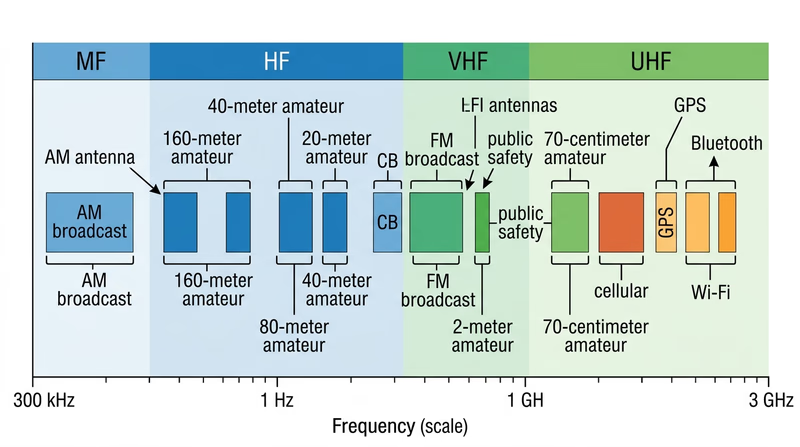
Your chart should show frequencies from 300 kHz (the low end of the medium-frequency band) to 3,000 MHz (the upper edge of the UHF band, which is also the start of microwaves). That’s a factor of 10,000 in frequency — so you’ll want to use a logarithmic scale rather than a linear one.
How to Set Up Your Chart
- Draw a horizontal axis along the bottom of a sheet of paper (landscape orientation works best).
- Mark the following frequency points spaced roughly equally along the axis: 300 kHz, 1 MHz, 3 MHz, 10 MHz, 30 MHz, 100 MHz, 300 MHz, 1,000 MHz (1 GHz), 3,000 MHz (3 GHz).
- Each step is roughly a factor of 3, which keeps the spacing even on a log scale.
- Label the axis “Frequency” and include units (kHz / MHz / GHz).
Requirement 2a2: Label the Frequency Bands
The International Telecommunication Union (ITU) divides the radio spectrum into named bands. Here are the five you need to label on your chart:
| Band | Abbreviation | Frequency Range | Key Characteristic |
|---|---|---|---|
| Medium Frequency | MF | 300 kHz – 3 MHz | AM broadcast, ground-wave propagation |
| High Frequency | HF | 3 MHz – 30 MHz | Shortwave, long-distance skywave propagation |
| Very High Frequency | VHF | 30 MHz – 300 MHz | FM broadcast, TV channels 2–13, public safety |
| Ultra High Frequency | UHF | 300 MHz – 3,000 MHz | TV channels 14+, cellular, Wi-Fi, GPS |
| Microwave | — | 3,000 MHz and above | Satellite links, radar, 5G mmWave |
Color-code or shade each band on your chart so the boundaries are visually clear.
Requirement 2a3: Locate Eight Radio Services
Place at least eight of these services on your chart at their correct frequency ranges. You must include at least four amateur radio bands. Here’s a reference table:
| Service | Approximate Frequency | Band |
|---|---|---|
| AM broadcast | 535 kHz – 1,705 kHz | MF |
| 160-meter amateur | 1.8 – 2.0 MHz | MF |
| 80-meter amateur | 3.5 – 4.0 MHz | HF |
| 40-meter amateur | 7.0 – 7.3 MHz | HF |
| 20-meter amateur | 14.0 – 14.35 MHz | HF |
| Citizens Band (CB) | 26.965 – 27.405 MHz | HF |
| 10-meter amateur | 28.0 – 29.7 MHz | HF |
| TV channels 2–6 | 54 – 88 MHz | VHF |
| FM broadcast | 88 – 108 MHz | VHF |
| 2-meter amateur | 144 – 148 MHz | VHF |
| Public safety | 150 – 174 MHz / 450 – 470 MHz | VHF/UHF |
| TV channels 7–13 | 174 – 216 MHz | VHF |
| 70-cm amateur | 420 – 450 MHz | UHF |
| Cellular (4G/5G) | 700 – 2,600 MHz | UHF |
| GPS | 1,227 – 1,575 MHz | UHF |
| Wi-Fi | 2,400 – 2,483 MHz | UHF |
| Bluetooth | 2,400 – 2,483 MHz | UHF |
Tips for a Good Chart
- Use arrows or brackets to show that a service spans a range, not just a single point.
- Label clearly — small text next to each service mark, with a line pointing to its position on the frequency axis.
- Four amateur bands is the minimum. If you have room, adding all six listed above shows real depth.
- Your counselor will want to see that you understand where things live in the spectrum and why — lower frequencies travel farther but carry less data; higher frequencies carry more data but need line-of-sight.
With your spectrum chart complete, you have a visual map of the radio world. Next, you’ll define what “radio” actually means and learn the difference between broadcast and two-way communication.
Req 2b — Radio Basics
Before you can understand how different radio systems work, you need a clear definition of radio itself and the ability to distinguish the major categories. This is a counselor discussion — prepare to explain these concepts in your own words, not just recite definitions.
Requirement 2b1: The Definition of Radio
Radio is the transmission and reception of information using electromagnetic waves at frequencies below visible light — typically between about 3 kHz and 300 GHz. These waves travel at the speed of light, need no wires or physical medium, and can carry voice, music, data, images, and control signals.
A radio system always has the same basic components:
- A transmitter that generates a radio-frequency (RF) signal and feeds it to an antenna.
- An antenna that radiates the signal into space as electromagnetic waves.
- A receiving antenna that captures a tiny portion of those waves.
- A receiver that extracts the information from the captured signal.
Everything from a billion-dollar satellite link to a $5 walkie-talkie follows this pattern.
Requirement 2b2: Broadcast Radio vs. Two-Way Radio
| Feature | Broadcast Radio | Two-Way Radio |
|---|---|---|
| Direction | One-way: transmitter → many receivers | Two-way: both sides transmit and receive |
| Who transmits | Only the station (licensed broadcaster) | All participants |
| Examples | AM/FM stations, TV, satellite radio | Ham radio, FRS/GMRS, CB, public safety |
| Purpose | Entertainment, news, information | Conversation, coordination, emergency |
| Licensing | Station holds the license; listeners need none | Operators may need individual licenses (varies by service) |
Key point for your counselor discussion: Broadcast radio is designed for one-to-many communication — the station talks, and thousands or millions of people listen. Two-way radio is designed for person-to-person or group communication — anyone with the right equipment can both talk and listen.
Requirement 2b3: Commercial Broadcast vs. Hobby Radio
| Feature | Commercial Broadcast | Hobby Radio |
|---|---|---|
| Motivation | Profit (advertising revenue) | Personal enjoyment, experimentation, public service |
| Content | Music, news, talk shows, advertising | Conversations, contests, emergency comms, digital experiments |
| Power | High (thousands of watts for AM/FM stations) | Low to moderate (varies; ham operators range from milliwatts to 1,500 watts) |
| Regulation | Heavy FCC oversight of content, advertising, and technical standards | Technical rules but almost no content restrictions (hams can discuss anything except commerce and obscenity) |
| Revenue | Advertising, subscriptions | None — hobby radio operators are prohibited from using the air for commercial purposes |
| Who can participate | Companies with broadcast licenses | Individuals with amateur licenses (or no license for FRS) |
The fundamental difference: commercial broadcast exists to reach an audience and generate revenue. Hobby radio exists because people are fascinated by the technology itself — the thrill of making contact with someone across the country (or across the world) using equipment you built or configured yourself.
You’ve now built the conceptual foundation: you know what the spectrum looks like, what radio means, and how the major types of radio differ. Next, you’ll learn how radio waves actually travel from one place to another — and why some signals can cross the ocean while others can barely reach the next hill.
Req 3 — Wave Propagation
Understanding propagation — how radio waves get from point A to point B — is the key to knowing why you can hear a station in Japan on a shortwave radio at midnight but not at noon. This requirement covers the three main propagation modes, the role of time-signal stations WWV and WWVH, and the difference between local and distant (DX) stations.
Requirement 3a: Propagation Diagram
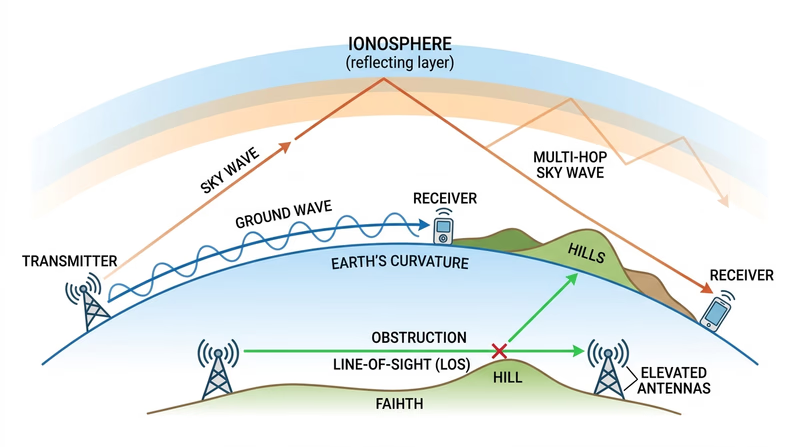
Your diagram should show three distinct propagation modes:
Ground Wave
- How it works: The radio wave follows the curve of the Earth’s surface, bending along the ground.
- Frequencies: Primarily MF (AM broadcast band, 300 kHz – 3 MHz).
- Range: Up to several hundred miles, depending on power and terrain. Range is greater over saltwater (which conducts well) than over dry land.
- On your diagram: Draw a curved line hugging the Earth’s surface from a transmitter tower to a receiver.
Sky Wave (Ionospheric Propagation)
- How it works: HF radio waves travel upward, hit the ionosphere (a layer of electrically charged particles 50–250 miles above the Earth), and are refracted (bent) back down to Earth. They can bounce between the ionosphere and the ground multiple times, crossing thousands of miles.
- Frequencies: Primarily HF (3 – 30 MHz). The exact frequencies that propagate depend on solar activity, time of day, and season.
- Range: Regional to worldwide — a low-power HF transmitter can reach the other side of the planet under the right conditions.
- On your diagram: Draw a wave going up from the transmitter, bouncing off a labeled “ionosphere” layer, and coming back down to a distant receiver. Show at least one “hop.”
Line of Sight
- How it works: VHF and UHF waves travel in straight lines. They pass through the atmosphere without bending significantly, so they can only reach receivers that have a clear, unobstructed path to the transmitter.
- Frequencies: VHF (30 – 300 MHz), UHF (300 MHz – 3 GHz), and microwave.
- Range: Typically limited by the horizon — about 30–50 miles for a tower-mounted antenna, much less for a handheld radio on flat ground. Tall buildings, mountains, and the curvature of the Earth itself block these signals.
- On your diagram: Draw a straight dashed line from a transmitter on a hill or tower to a receiver, with the Earth’s curve shown below. Optionally show a blocked path where terrain interrupts the signal.
Requirement 3b: WWV and WWVH
WWV (Fort Collins, Colorado) and WWVH (Kauai, Hawaii) are time-and-frequency stations operated by the National Institute of Standards and Technology (NIST). They broadcast continuously on 2.5, 5, 10, 15, and 20 MHz.
What They Broadcast
- Precise time announcements (voice and tones) synchronized to the U.S. atomic clock.
- Solar and geophysical alerts — reports on solar activity, geomagnetic conditions, and radio propagation forecasts, updated every few hours.
How They Help Shortwave Listeners
- Propagation check: If you can hear WWV clearly on 10 MHz but not on 20 MHz, you know the ionosphere is supporting propagation at 10 MHz but not at the higher frequency right now. This tells you which shortwave bands are likely to be active.
- Solar reports: The solar flux index and geomagnetic activity numbers broadcast by WWV directly predict HF propagation conditions. High solar flux generally means better long-distance HF conditions; disturbed geomagnetic conditions mean poor propagation.
- Baseline reference: Because WWV’s power and frequency are precisely known, the strength and quality of its signal give you a quick read on current band conditions without needing to search for other stations.
🎬 Video: Radio Propagation 101 — Dan Vanevenhoven — https://www.youtube.com/watch?v=yShlAl2kMZw
Requirement 3c: DX vs. Local
Local station: A station close enough that its signal reaches you via ground wave or direct line of sight. You can usually hear it reliably any time of day with a strong, clear signal. Your local AM and FM stations are local.
DX (distant) station: A station far enough away that its signal reaches you via sky wave propagation — bouncing off the ionosphere. “DX” comes from the telegraphic shorthand for “distance.” DX signals are often weaker, subject to fading, and may only be receivable under certain conditions (typically at night for MF, and depending on solar conditions for HF).
Why the Distinction Matters
Hearing a local FM station isn’t remarkable — the signal is designed to reach you. Hearing a shortwave broadcast from Australia or a medium-wave AM station from 1,000 miles away is an achievement that depends on understanding propagation, timing, and band conditions. Much of the excitement in radio hobbying comes from “working DX” — making contact with or receiving signals from distant, unexpected sources.
Now you understand how waves travel and how to predict what you’ll hear. Next, you’ll learn how those waves actually carry information — from Morse code to 5G.
Req 4 — Modulation & Data
A raw radio wave by itself carries no information — it’s just a steady oscillation. To send a voice, a song, or a data file, you have to modify (“modulate”) the wave in a way that encodes the information. This requirement covers the classic analog methods, modern digital standards, the relationship between encoding and range, and how wireless compares to wired connections.
Requirement 4a: Modulation Methods
Continuous Wave (CW) — Morse Code
The simplest method: the transmitter is turned on and off in patterns of short and long bursts (dots and dashes) to spell out characters in Morse code. No voice, no music — just the presence or absence of a signal. CW is extremely efficient and can be decoded even when signals are very weak, which is why it remains popular with amateur radio operators for long-distance contacts.
Amplitude Modulation (AM)
The amplitude (strength) of the carrier wave is varied to match the shape of the audio signal. When the announcer’s voice gets louder, the carrier wave gets taller; when the voice gets quieter, the carrier shrinks. AM is simple and requires relatively narrow bandwidth, but it’s vulnerable to electrical noise (lightning, motors, power lines) because noise also changes signal amplitude.
Frequency Modulation (FM)
The frequency of the carrier wave is varied to match the audio signal. The amplitude stays constant. Because most electrical noise affects amplitude rather than frequency, FM is much more resistant to static and interference than AM. This is why FM radio sounds cleaner than AM. The trade-off: FM requires more bandwidth per channel.
Single Sideband (SSB)
AM actually generates three parts: a carrier wave and two mirror-image “sidebands” that contain the actual information. SSB strips away the carrier and one sideband, transmitting only the remaining sideband. This saves power and bandwidth — roughly half the bandwidth and less than one-sixth the power of full AM for the same voice quality. SSB is the workhorse mode for long-distance voice communication on HF amateur and marine radio.
Frequency Hopping
Instead of staying on one frequency, the transmitter rapidly jumps between many frequencies in a pattern known to both the transmitter and receiver. This makes the signal extremely difficult to intercept or jam and reduces interference. Modern Bluetooth and some military systems use frequency hopping. The concept was co-invented by actress Hedy Lamarr and composer George Antheil during World War II.
🎬 Video: All Modulation Types Explained in 3 Minutes — Wireless Explained — https://www.youtube.com/watch?v=c3eMoHuPRy0
Requirement 4b: Digital vs. Analog
Analog systems (AM, FM) transmit a continuous signal that degrades gradually with distance and interference — the farther you are, the noisier the signal gets. Digital systems convert information into binary data (1s and 0s) before transmission and add error correction — extra data bits that let the receiver detect and fix errors caused by noise and interference.
Why Digital Is More Reliable
- Error correction: If a few bits are corrupted in transit, the receiver can reconstruct the original data perfectly. Analog signals have no equivalent — noise is permanent.
- Compression: Digital signals can be compressed, allowing more information to fit in the same bandwidth.
- Encryption: Digital signals can be encrypted for privacy — far harder to achieve with analog.
- Graceful vs. harsh degradation: An analog signal gets progressively noisier. A digital signal stays perfect until the error rate exceeds what correction can handle — then it drops out entirely (“cliff effect”). For most practical purposes, this means digital is either clear or silent, with no middle ground of static.
Bluetooth uses frequency hopping spread spectrum in the 2.4 GHz band for short-range connections (headphones, speakers, keyboards). Wi-Fi uses sophisticated modulation schemes (OFDM) in the 2.4 GHz and 5 GHz bands for high-speed data. 5G uses advanced encoding across multiple frequency bands (including millimeter wave) for extremely high data rates over cellular networks.
Requirement 4c: Encoding and Range
There’s a fundamental trade-off in radio: data rate vs. range. The more information you try to push through a signal, the shorter the effective range — because higher data rates require wider bandwidth and are more sensitive to noise.
| Method | Typical Range | Data Rate | Why |
|---|---|---|---|
| CW (Morse) | Worldwide (HF) | ~50 bits/sec | Extremely narrow bandwidth; can be decoded in heavy noise |
| SSB voice | Worldwide (HF) | ~2,400 bits/sec equivalent | Narrow bandwidth, efficient power use |
| FM voice | 30–50 miles (VHF) | ~64 kbits/sec equivalent | Wider bandwidth, line-of-sight required |
| Bluetooth | 30–300 feet | 1–3 Mbits/sec | Very low power, designed for short range |
| Wi-Fi | 100–300 feet indoors | 50–1,000+ Mbits/sec | High bandwidth, but signals attenuate quickly through walls |
| 5G mmWave | 500–1,500 feet | 1–10+ Gbits/sec | Extremely high frequency; blocked by buildings, trees, even rain |
The pattern: simpler, narrower signals travel farther; faster, wider signals are limited to shorter ranges.
Requirement 4d: Wi-Fi vs. Wired/Fiber
| Connection Type | Typical Max Data Rate | Latency | Reliability |
|---|---|---|---|
| Wi-Fi 6 (802.11ax) | ~1–2 Gbps (shared among devices) | 5–20 ms | Subject to interference, walls, distance |
| Ethernet (Cat 6a) | 10 Gbps (dedicated) | <1 ms | Very reliable; physical connection required |
| Fiber optic | 10–100+ Gbps | <1 ms | Extremely reliable; immune to RF interference |
Key points for your counselor discussion:
- Wi-Fi is convenient but shares bandwidth among all connected devices and is affected by interference from other Wi-Fi networks, Bluetooth, and microwave ovens.
- Ethernet and fiber provide dedicated, consistent bandwidth with almost no latency.
- Fiber optic is the fastest because light travels through glass with virtually no loss — and light can be modulated at frequencies trillions of times higher than radio waves, allowing enormous data rates.
- For most home and office use, Wi-Fi is “good enough.” For applications demanding maximum speed and minimum latency (gaming, video editing, data centers), wired connections are superior.
You now understand how information rides on radio waves. Next, you’ll look at the actual hardware — the physical equipment that makes a radio station work.
Req 5 — Equipment & Devices
This requirement moves from theory to hardware. You’ll learn the difference between block diagrams and schematics, draw a station block diagram, catalog the radio devices you use every day, and understand two important applications: NOAA Weather Radio and RFID.
Requirement 5a: Block Diagrams vs. Schematics
| Feature | Block Diagram | Schematic Diagram |
|---|---|---|
| Purpose | Shows the overall flow and organization of a system | Shows the exact electrical connections between individual components |
| Level of detail | High-level; each block represents a major functional stage | Component-level; shows every resistor, capacitor, transistor, and wire |
| Symbols | Simple labeled boxes connected by arrows | Standardized electronic symbols (zigzag for resistor, parallel lines for capacitor, etc.) |
| Who uses it | Anyone trying to understand how a system fits together | Engineers and technicians who need to build or repair the circuit |
| Analogy | A road map showing cities and highways | A street-by-street navigation guide showing every turn |
For your counselor: A block diagram is like describing a recipe by listing the steps (“chop vegetables, heat oil, stir-fry, plate”). A schematic is like listing every ingredient, measurement, temperature, and timing detail.
🎬 Video: How to Read a Schematic — RimstarOrg — https://www.youtube.com/watch?v=_HZ-EQ8Hc8E
Requirement 5b: Radio Station Block Diagram
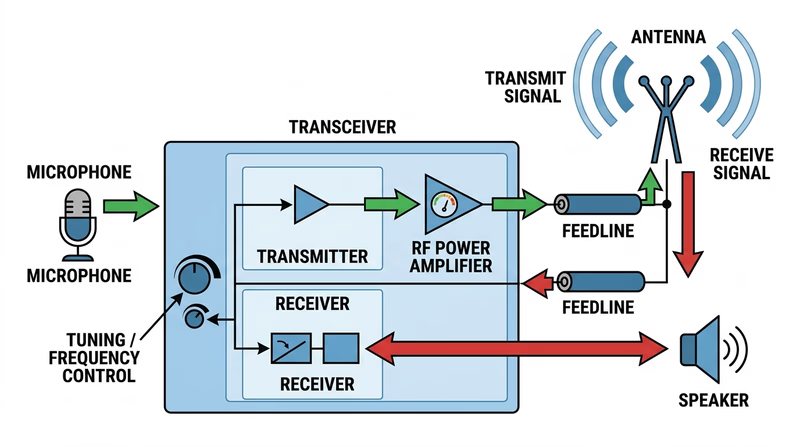
Here’s what each component does:
| Component | Function |
|---|---|
| Microphone | Converts sound waves (your voice) into an electrical audio signal |
| Transmitter | Takes the audio signal and modulates it onto a radio-frequency carrier wave |
| Amplifier | Boosts the modulated RF signal to a power level sufficient to reach distant receivers |
| Feedline | A cable (typically coaxial cable) that carries the amplified RF signal from the transmitter to the antenna with minimal loss |
| Antenna | Converts the electrical RF signal into electromagnetic waves that radiate into space |
| Receiver | Captures incoming radio waves via the antenna and demodulates them back into an audio signal |
| Speaker | Converts the electrical audio signal back into sound waves you can hear |
| Transceiver | A combined transmitter and receiver in one unit — most modern ham radios are transceivers |
Drawing Your Diagram
- Start with the microphone on the left.
- Draw an arrow into the transceiver box (which contains both the transmitter and receiver).
- From the transceiver, draw an arrow through an amplifier box.
- From the amplifier, draw an arrow through the feedline to the antenna.
- Show the return path: antenna → feedline → transceiver (receiver section) → speaker.
- Label every box and every arrow showing signal flow direction.
Requirement 5c: Consumer Radio Devices
You interact with radio-based devices far more often than you probably realize. Here’s a starter list — aim for at least 10 items in your counselor discussion:
Analog or mixed:
- AM/FM car radio
- Garage door opener
- Baby monitor (some models)
- Walkie-talkies (FRS/GMRS)
Digital:
- Smartphone (cellular, Wi-Fi, Bluetooth, GPS, NFC)
- Laptop (Wi-Fi, Bluetooth)
- Smart TV (Wi-Fi)
- Wireless earbuds/headphones (Bluetooth)
- Smartwatch/fitness tracker (Bluetooth, sometimes cellular)
- Wi-Fi router
- Video game controller (Bluetooth or proprietary wireless)
- Keyless car entry / push-button start (RFID/low-power radio)
- Contactless payment (NFC)
- Drone controller (2.4 GHz or 5.8 GHz radio)
- Home security system (wireless sensors)
- Smart home devices (Wi-Fi, Zigbee, Z-Wave)
- GPS navigation unit
- Satellite radio receiver (SiriusXM)
- NOAA Weather Radio
Requirement 5d: NOAA Weather Radio
NOAA Weather Radio (NWR) is a nationwide network of radio stations broadcasting continuous weather information directly from the National Weather Service. It operates on seven VHF frequencies between 162.400 MHz and 162.550 MHz.
How It Alerts You
- Continuous broadcast: NWR stations transmit 24/7, providing current conditions, forecasts, and hazard information for your area.
- SAME technology: Specific Area Message Encoding (SAME) allows weather radios with SAME capability to remain silent until a warning is issued for your specific county or region. When a tornado warning, severe thunderstorm warning, flash flood, or other hazard is issued, the radio automatically activates and broadcasts the alert — even at 3 a.m.
- All-hazards alerting: NWR also broadcasts non-weather emergencies like AMBER alerts, chemical spills, and national security events through the Emergency Alert System (EAS).
Why It Matters for Scouts
Cell phone alerts depend on cell towers — which can fail during the very storms that create emergencies. A dedicated NOAA Weather Radio works on batteries, receives signals from high-power transmitters, and is designed to wake you up when danger is approaching. Many Scout leaders carry one in their camp kit.
Requirement 5e: RFID
RFID (Radio-Frequency Identification) uses radio waves to read information from a small electronic tag attached to an object or embedded in a card.
How It Works
- An RFID reader emits a radio signal.
- An RFID tag (a tiny chip plus an antenna) receives the signal.
- Passive tags (no battery) use the energy from the reader’s signal to power up and transmit their stored data back. Active tags (with a battery) can transmit over longer ranges.
- The reader captures the tag’s response and processes the data.
Everyday Uses
- Contactless payment (tap-to-pay credit cards, Apple Pay, Google Pay — these use NFC, a form of RFID)
- Building access cards (keycard entry to offices, hotels, dorm rooms)
- Retail inventory tracking (tags on clothing and merchandise)
- Library book checkout (self-checkout stations read RFID tags embedded in books)
- Pet microchips (a passive RFID tag injected under the skin, readable by a vet’s scanner)
- Toll collection (E-ZPass and similar systems in your car’s windshield)
- Luggage tracking (airlines increasingly use RFID tags on checked bags)
- Passport chips (the small gold symbol on the cover of modern U.S. passports indicates an embedded RFID chip)
You’ve now covered the hardware, devices, and services that make radio practical. Next, you’ll learn who controls the airwaves — and why that matters.
Req 6 — FCC, ITU & Call Signs
Radio waves don’t stop at borders or property lines. Without regulation, every transmitter would interfere with every other transmitter, and the spectrum would be useless chaos. This requirement covers the two organizations that prevent that chaos, the call sign system that identifies every station, and the phonetic alphabet that makes voice communication clear.
Requirement 6a: FCC vs. ITU
The FCC (Federal Communications Commission)
The FCC is a United States government agency that regulates all radio (and wire/cable/satellite) communications within the U.S. and its territories. Created in 1934, the FCC:
- Allocates frequencies to different services (broadcast, amateur, cellular, public safety, etc.)
- Issues licenses to broadcast stations, amateur radio operators, and other transmitters
- Sets technical standards (power limits, bandwidth, interference rules)
- Enforces rules — the FCC can fine operators, revoke licenses, and even seize equipment used in illegal transmissions
- Manages spectrum auctions — selling rights to use certain frequencies to commercial companies (cellular carriers, for example)
The ITU (International Telecommunication Union)
The ITU is a United Nations specialized agency headquartered in Geneva, Switzerland. It coordinates radio and telecommunications at the international level. The ITU:
- Divides the world into three regions and allocates frequency bands for each region
- Assigns country prefixes for call signs (the U.S. is assigned prefixes beginning with W, K, N, and AA–AL)
- Publishes the Radio Regulations — the global treaty governing spectrum use
- Coordinates satellite orbits to prevent interference between satellites from different countries
- Hosts the World Radiocommunication Conference (WRC) every few years, where countries negotiate spectrum allocation changes
Key Difference
The ITU sets the international framework — which frequencies are used for what, worldwide. The FCC implements those rules within the United States, adding U.S.-specific regulations and enforcement. Other countries have their own national regulators (Ofcom in the UK, ISED in Canada, etc.) that also follow ITU guidelines.
Requirement 6b: Call Signs
A call sign is a unique identifier assigned to every licensed radio station. It serves the same purpose as a license plate on a car — it tells anyone listening exactly who is transmitting.
Broadcast Radio Call Signs
- In the U.S., commercial broadcast stations are assigned call signs by the FCC.
- Stations east of the Mississippi River generally start with W (WNYC, WSB, WGN).
- Stations west of the Mississippi generally start with K (KFI, KQED, KNBR).
- These are followed by additional letters chosen by the station (often forming a memorable word or abbreviation).
Amateur Radio Call Signs
- Amateur call signs follow a specific format: prefix + number + suffix.
- The prefix (1–2 letters) indicates the country. U.S. prefixes include W, K, N, and AA–AL.
- The number (single digit, 0–9) historically indicated the geographic district.
- The suffix (1–3 letters) is unique to the individual operator.
- Example: W5ABC — “W” prefix, district 5, suffix ABC.
- Hams are required to identify with their call sign at least every 10 minutes during a contact and at the end of each contact.
Requirement 6c: The Phonetic Alphabet
Over a noisy radio channel, letters can sound alike. “B” and “D” sound similar. “M” and “N” are nearly identical. The NATO/ICAO phonetic alphabet solves this by assigning a unique, multi-syllable word to each letter:
| Letter | Phonetic | Letter | Phonetic |
|---|---|---|---|
| A | Alpha | N | November |
| B | Bravo | O | Oscar |
| C | Charlie | P | Papa |
| D | Delta | Q | Quebec |
| E | Echo | R | Romeo |
| F | Foxtrot | S | Sierra |
| G | Golf | T | Tango |
| H | Hotel | U | Uniform |
| I | India | V | Victor |
| J | Juliet | W | Whiskey |
| K | Kilo | X | X-ray |
| L | Lima | Y | Yankee |
| M | Mike | Z | Zulu |
How It’s Used
When a ham operator identifies as W5ABC, they would say: “Whiskey Five Alpha Bravo Charlie.” This eliminates any ambiguity, even over a weak, noisy signal.
The phonetic alphabet is used in:
- Amateur radio (required for call sign identification)
- Aviation (pilots and air traffic control)
- Military communications
- Emergency services (police, fire, EMS dispatchers)
- Any situation where spelling must be unambiguous over voice communication
With regulation covered, you’re ready to explore the radio technology you carry in your pocket every day — your cell phone.
Req 7 — Cellular Technology
Your cell phone is the most sophisticated radio device most people will ever own. It contains multiple radio systems working simultaneously — cellular, Wi-Fi, Bluetooth, GPS, and NFC — all in a package that fits in your pocket. This requirement asks you to understand how cellular technology differs from other radio systems, what Airplane Mode does, how your phone knows the time and your location, its role in emergencies, and how wireless charging works.
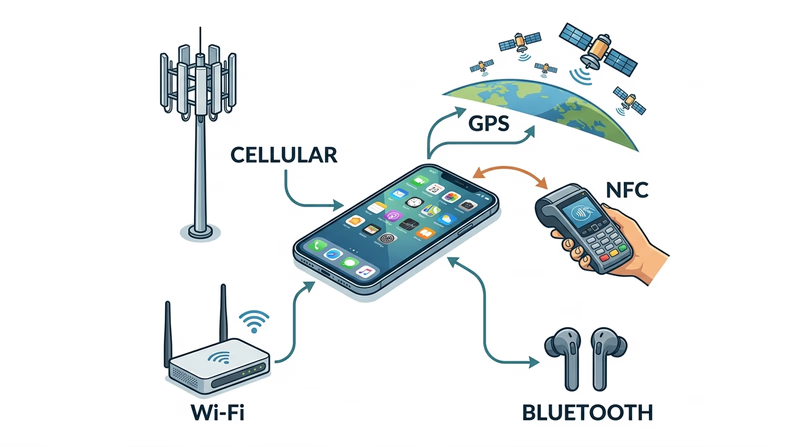
Requirement 7a: Cellular vs. Other Radio
| Feature | Cellular | Broadcast | Hobby (Amateur) |
|---|---|---|---|
| Architecture | Network of small, low-power cells connected to the internet backbone | Single high-power transmitter covering a wide area | Individual stations communicating directly or through repeaters |
| Infrastructure | Requires cell towers, switching centers, billing systems | Requires a broadcast tower and studio | Minimal — an antenna and a transceiver |
| Handoff | Seamlessly transfers your call between cell towers as you move | No handoff — you either receive the signal or you don’t | No handoff — you manually tune to a repeater or frequency |
| Two-way | Always two-way (full duplex — you can talk and listen simultaneously) | One-way (broadcast only) | Two-way (usually half-duplex — one person talks at a time) |
| Licensing | Carrier holds the license; users just buy service | Station holds the license; listeners need none | Each operator holds an individual license (except FRS) |
| Commercial | Yes — operated by for-profit companies | Yes — advertising-supported | No — commercial use is prohibited |
Key distinction: Cellular systems are networked — your phone connects to a nearby cell tower, which routes your call or data through a vast infrastructure to reach its destination. Broadcast and amateur radio are direct — the signal goes from transmitter to receiver without a network in between.
Requirement 7b: Airplane Mode
Airplane Mode is a phone setting that turns off all radio transmitters in the device — cellular, Wi-Fi, Bluetooth, and GPS (in some implementations). The phone can still function for non-radio tasks (calculator, camera, reading downloaded content), but it cannot send or receive any wireless signals.
Why It Exists
- Aviation safety: Aircraft navigation and communication systems operate on radio frequencies. While modern aircraft systems are well-shielded, regulations require passengers to disable transmitters during flight to eliminate any possibility of interference, especially during takeoff and landing.
- Regulatory compliance: The FCC prohibits the use of cellular phones in flight because a phone at altitude can connect to multiple cell towers simultaneously, disrupting the network’s frequency-reuse plan.
- Battery conservation: With all radios off, battery drain is minimal — useful in any situation where you need to conserve power.
- Focus and etiquette: Airplane Mode also serves as a “do not disturb” function in hospitals, theaters, meetings, or any setting where wireless signals or notifications are unwelcome.
Requirement 7c: Time, Location, and Elevation
Time
Your phone’s clock is synchronized using signals from the cellular network, which in turn is synchronized to atomic clocks. When your phone connects to a cell tower, it receives an extremely precise time signal. Additionally, GPS satellites each carry onboard atomic clocks, and your phone can use GPS time as a secondary source. This is why your phone’s clock is almost always more accurate than any wall clock or wristwatch.
Location (GPS)
GPS (Global Positioning System) uses a constellation of at least 24 satellites orbiting the Earth. Each satellite continuously broadcasts its position and the exact time. Your phone’s GPS receiver picks up signals from at least four satellites and calculates its position by measuring the tiny differences in arrival time from each satellite (a process called trilateration).
- Three satellites give you latitude and longitude (2D position).
- Four or more satellites give you latitude, longitude, and elevation (3D position).
Assisted GPS (A-GPS) speeds up the process by using cell tower data to give the GPS receiver a rough starting position, reducing the time to get a fix from minutes to seconds.
Elevation
Elevation comes from the GPS calculation (the vertical component of the 3D fix). It can also be supplemented by the phone’s barometric pressure sensor (many modern smartphones include one), which detects changes in altitude based on atmospheric pressure.
Requirement 7d: Cell Phones in Emergencies
Benefits
- Immediate access to 911 from almost anywhere with cellular coverage.
- E911 location data: When you call 911, your phone automatically transmits your approximate location to the dispatch center (using GPS and cell tower triangulation).
- Wireless Emergency Alerts (WEA): Your phone can receive tornado warnings, AMBER alerts, and presidential alerts pushed directly by FEMA — no app required.
- Camera and flashlight for documenting scenes and signaling.
- First aid information (if downloaded or cached) available without a data connection.
Limitations
- No signal, no help. Cell phones depend entirely on nearby cell towers. In wilderness areas, canyons, and remote locations, there may be no coverage at all.
- Cell towers fail. Natural disasters (hurricanes, earthquakes) and power outages can knock out cell towers when you need them most.
- Battery life is finite. A dead phone is useless. Cold weather drains batteries faster.
- Network congestion. During large-scale emergencies, cell networks become overloaded as thousands of people try to call simultaneously.
- GPS requires sky view. Indoor, underground, or in dense tree cover, GPS accuracy degrades significantly.
Requirement 7e: Wireless Charging
Wireless charging transfers electrical energy from a charging pad to a device without any physical cable connection. It uses electromagnetic induction — the same principle that makes a transformer work.
How It Works
- A charging pad contains a coil of wire. Alternating current flows through this coil, creating an oscillating magnetic field.
- The phone contains a matching receiver coil. When placed on the pad, the magnetic field induces an alternating current in the receiver coil.
- The phone’s electronics convert this current into the proper voltage and current to charge the battery.
Standards
- Qi (pronounced “chee”) is the most widely used wireless charging standard, supported by Apple, Samsung, Google, and most other phone manufacturers.
- MagSafe (Apple) adds magnets to align the phone with the charging coil for better efficiency.
Trade-offs
| Advantage | Limitation |
|---|---|
| Convenient — just set the phone down | Slower than wired charging (typically) |
| No wear on charging ports | Generates more heat than wired charging |
| Water-resistant devices benefit (no exposed port needed) | Phone and pad must be precisely aligned |
| Works through thin cases | Energy transfer is less efficient (some power is lost as heat) |
You’ve covered the full range of radio fundamentals — from safety to spectrum to cell phones. Now it’s time for the hands-on capstone: Requirement 8, where you choose one of five specialized radio options to explore in depth.
Req 8 — Choose Your Option
Requirement 8 is the hands-on core of the Radio merit badge. You choose one of five options and complete all sub-requirements within it. Read through all five before committing — each involves different equipment, skills, and time commitments.
Your Options
Req 8a — Amateur Radio: Learn about ham radio licensing, Q signals, emergency procedures, and transceiver types. Culminates in conducting (or simulating) a 10-minute amateur radio contact with proper call signs and logging.
Req 8b — Radio Broadcasting: Study FCC broadcast regulations, produce a half-hour radio program, log 15 broadcast stations, learn broadcasting terminology, and explore modern platforms like streaming and podcasts.
Req 8c — Shortwave & Medium-Wave Listening: Spend hours listening to shortwave and medium-wave stations during day and night, log them, map their locations, compare signal strengths, and demonstrate smartphone radio listening.
Req 8d — Amateur Radio Direction Finding: Learn about ARDF (fox hunting), build a simple directional antenna, participate in a fox hunt, and map how you located the hidden transmitter.
Req 8e — FRS & GMRS Walkie-Talkies: Compare FRS, GMRS, CB, and amateur radio, learn the rules and capabilities of FRS/GMRS radios, and use them on a hike, event, or team activity.
How to Choose
Choosing Your Option
Consider what's available and what excites you- Equipment access: Options A and D require access to amateur radio equipment (a local ham club can often help). Option B needs audio recording tools. Option C needs a shortwave receiver (or a web SDR). Option E just needs a pair of FRS/GMRS walkie-talkies.
- Local support: If your area has an active amateur radio club, Options A and D become much easier — club members love mentoring Scouts.
- Time commitment: Option C requires at least six hours of listening across multiple sessions (day and night). Option B requires producing and recording a program.
- Interest: If you’re drawn to communication and talking on the air, choose A or E. If you like media production, choose B. If you enjoy exploring and listening, choose C. If you want a physical outdoor activity, choose D.
- Accessibility: Option E (FRS/GMRS) has the lowest barrier to entry — no license required for FRS, and inexpensive radios are widely available.
Ready to explore your chosen option? Start with Option A below, or navigate directly to your choice using the sidebar.
Req 8a — Amateur Radio Overview
Amateur radio (“ham radio”) is the oldest and most versatile radio hobby. Hams communicate by voice, Morse code, and digital modes; they provide emergency communications when all other systems fail; they bounce signals off the moon, through satellites, and around the world via the ionosphere. This option walks you through the purpose, licensing, vocabulary, and practice of amateur radio.
What You’ll Complete
- Req 8a1 — Why Amateur Radio Exists: Learn why the FCC created the amateur service and what licensed hams can do on the air.
- Req 8a2 — License Classes: Understand the three amateur license levels — Technician, General, and Extra — and who administers the exams.
- Req 8a3 — Q Signals & Terms: Learn at least five Q signals or amateur radio terms used in everyday ham communication.
- Req 8a4 — Emergency Calls: Know how to make an emergency call on voice or Morse code.
- Req 8a5 — Transceivers & Repeaters: Compare handheld, mobile, and base station radios and understand how repeaters extend range.
- Req 8a6 — Make a Contact: Conduct a 10-minute real or simulated contact using proper procedures and log it.
Getting Started
If possible, contact a local amateur radio club before beginning these requirements. The American Radio Relay League (ARRL) maintains a club finder that can connect you with hams in your area. Many clubs offer “ham-in-a-day” events, field days, and mentoring specifically for Scouts.
Req 8a1 — Why Amateur Radio Exists
Why the FCC Created Amateur Radio
The FCC’s rules (Part 97) state five purposes for the amateur radio service:
- Advancing the radio art — Hams experiment with new technologies, antennas, and communication modes. Many innovations (including early packet radio and software-defined radio) were pioneered by amateurs.
- Emergency and disaster communications — When cell towers fall, power grids fail, and internet goes down, amateur radio still works. Hams provided critical communications during Hurricane Katrina, the September 11 attacks, and countless local emergencies.
- Training a pool of skilled operators — The nation benefits from having thousands of trained radio operators who can be mobilized in a crisis.
- International goodwill — Amateur radio connects people across borders, languages, and cultures through a shared technical hobby.
- Personal development — The amateur service encourages self-training, technical skill building, and lifelong learning.
What Licensed Hams Can Do
Once licensed, amateur radio operators can:
- Talk to other hams worldwide using voice (phone), Morse code (CW), and digital modes
- Participate in contests — timed competitions to make as many contacts as possible in a set period
- Work DX — pursue contacts with stations in rare or distant countries
- Operate satellites — several amateur radio satellites orbit the Earth and can be accessed with modest equipment
- Experiment with antennas and equipment — build, modify, and test radio gear
- Provide public service communications — support events like marathons, parades, and search-and-rescue operations
- Participate in emergency networks — organizations like ARES (Amateur Radio Emergency Service) and RACES (Radio Amateur Civil Emergency Service) coordinate ham volunteers for disaster response
- Bounce signals off the moon (EME/moonbounce) — an extreme technical challenge
- Communicate via digital modes — FT8, JS8Call, Winlink (email over radio), APRS (position tracking)
- Operate from unusual locations — mountain summits (Summits on the Air), parks (Parks on the Air), islands, and mobile stations
Req 8a2 — License Classes
The Three License Classes
| Feature | Technician | General | Extra |
|---|---|---|---|
| Exam | 35 multiple-choice questions | 35 multiple-choice questions (plus Technician) | 50 multiple-choice questions (plus General) |
| Difficulty | Basic radio theory, regulations, safety | Intermediate theory, more regulation detail | Advanced theory, complex signal processing |
| HF privileges | Limited (small portions of 10m, 15m, 40m, 80m) | Substantial (most HF bands) | Full (all amateur frequencies) |
| VHF/UHF privileges | Full | Full | Full |
| Typical first use | Local repeaters, public service, FM voice | Worldwide HF contacts, SSB voice, CW | Exclusive sub-bands, DX contest advantage |
| Minimum age | None | None | None |
| License term | 10 years (renewable) | 10 years (renewable) | 10 years (renewable) |
Progression Path
Most new hams start with the Technician license. It gives you full access to VHF and UHF frequencies, which means you can use local repeaters, participate in public service events, and communicate on the popular 2-meter and 70-centimeter bands. Many Scouts earn their Technician license during a single weekend study-and-test event.
The General license opens up HF (shortwave) frequencies, which is where worldwide long-distance communication happens. If you want to talk to someone on the other side of the planet, you need General class privileges.
The Extra license grants access to small exclusive portions of the HF bands that are less crowded and often used by experienced DXers and contesters.
Who Administers the Exams?
Amateur radio exams are not administered by the FCC directly. Instead, the FCC authorizes Volunteer Examiner Coordinators (VECs) — organizations of licensed amateurs who create, administer, and grade the tests.
The three major VECs are:
- ARRL VEC (American Radio Relay League) — the largest
- W5YI VEC
- Laurel VEC — notable for offering free exams (no session fee)
Exams are given by a team of at least three Volunteer Examiners (VEs) — licensed hams who have been accredited by a VEC. Sessions are held at ham clubs, libraries, Scout camps, and sometimes online.
Find an Amateur Radio Exam Session — ARRL Search for upcoming Volunteer Examiner sessions near you. Link: Find an Amateur Radio Exam Session — ARRL — https://www.arrl.org/find-an-amateur-radio-license-exam-sessionReq 8a3 — Q Signals & Terms
Q Signals
Q signals are three-letter abbreviations starting with “Q” that originated in maritime radio telegraphy. They save time and transcend language barriers. Each Q signal can be either a question (with a question mark) or a statement.
Here are the most commonly used Q signals in amateur radio:
| Q Signal | As a Question | As a Statement |
|---|---|---|
| QRZ | Who is calling me? | You are being called by… |
| QTH | What is your location? | My location is… |
| QSL | Can you acknowledge receipt? | I acknowledge receipt |
| QSO | Can you communicate with…? | I can communicate with… (also used as a noun: “a QSO” means a contact) |
| QRM | Are you being interfered with? | I am being interfered with (man-made interference) |
| QRN | Are you troubled by static? | I am troubled by static (natural noise) |
| QSY | Shall I change frequency? | Change frequency to… |
| QRV | Are you ready? | I am ready |
| QRP | Shall I decrease power? | Decrease power (also used to describe low-power operating) |
Common Amateur Radio Terms
Beyond Q signals, hams use many specialized terms:
- 73 — Best regards (a universal sign-off, never pluralized — “73” not “73s”)
- CQ — A general call seeking any station to respond (“CQ CQ CQ, this is W5ABC”)
- Ragchew — A long, casual conversation between operators
- Elmer — An experienced ham who mentors a newcomer
- Rig — A radio transceiver
- Shack — The room or space where a ham operates their station
- Pileup — Many stations calling one station simultaneously (common when a rare DX station is on the air)
- RST — Signal report system: Readability (1–5), Strength (1–9), Tone (1–9, for CW only)
- HT — Handheld transceiver (handie-talkie)
- Repeater offset — The frequency difference between a repeater’s input and output frequency
Req 8a4 — Emergency Calls
In a genuine emergency, amateur radio operators are authorized to use any frequency and any mode necessary to call for help — normal rules about band privileges are suspended when life or property is in immediate danger.
Voice Emergency Call
The international radiotelephone distress signal is “MAYDAY” (from the French m’aider — “help me”). For situations that are urgent but not immediately life-threatening, use “PAN-PAN” (from the French panne — “breakdown”).
How to Make a MAYDAY Call
- Tune to a commonly monitored frequency:
- 146.520 MHz — the national 2-meter FM simplex calling frequency
- 7.030 MHz or 14.300 MHz — HF voice emergency frequencies
- Any active repeater frequency in your area
- Transmit: “MAYDAY, MAYDAY, MAYDAY. This is [your call sign], [your call sign], [your call sign].”
- Give your location (as precisely as possible — coordinates, landmarks, or nearest town).
- Describe the nature of the emergency (injury, fire, lost, etc.).
- State what help you need (ambulance, rescue, relay to 911).
- Give the number of people involved and their condition.
- Say “Over” and listen for a response.
- If no response, repeat on another frequency.
Morse Code Emergency Signal
The international distress signal in CW is SOS: three dots, three dashes, three dots, sent as a single character with no spacing between the letters.
· · · — — — · · ·
Send SOS repeatedly, followed by your call sign and location information. On HF, 7.030 MHz is a common CW calling frequency.
Req 8a5 — Transceivers & Repeaters
Types of Transceivers
| Feature | Handheld (HT) | Mobile | Base Station |
|---|---|---|---|
| Size | Fits in one hand | Fits under a car dashboard | Desktop unit, often with separate components |
| Power | 1–8 watts | 25–75 watts | 100–1,500 watts (with amplifier) |
| Antenna | Small “rubber duck” or whip antenna | Vehicle-mounted antenna (mag-mount or permanent) | Outdoor antenna on mast or tower |
| Power source | Rechargeable battery | Vehicle battery (12V DC) | AC power supply |
| Typical bands | VHF/UHF (2m, 70cm) | VHF/UHF and/or HF | HF, VHF, UHF — full range |
| Range (simplex) | 1–5 miles (terrain dependent) | 5–30 miles | 30+ miles (VHF) to worldwide (HF) |
| Best for | Hiking, events, emergencies, portable use | Travel, commuting, mobile operation | Home station, DXing, contests |
Handheld Transceivers (HTs)
The most portable option. Every new Technician class ham typically starts with an HT. They’re ideal for local communication, repeater access, public service events, and emergency go-bags. The main limitation is low power and a small, inefficient antenna.
Mobile Transceivers
Designed to mount in a vehicle. Higher power and a better antenna location (roof-mounted) give significantly better range than an HT. Many hams operate mobile during their commute.
Base Stations
The full-capability station at home. A base station can include an HF transceiver for worldwide communication, a high-gain antenna system, and amplifiers. This is where serious DXing, contesting, and experimentation happen.
Amateur Radio Repeaters
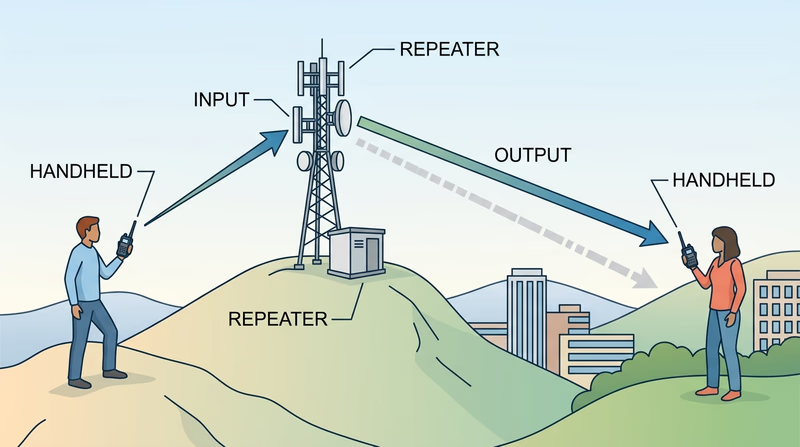
A repeater is an automated station, usually located on a hilltop or tall building, that receives a signal on one frequency and simultaneously retransmits it on another frequency at much higher power and from a much better location. This dramatically extends the range of low-power handheld and mobile radios.
How Repeaters Work
- You transmit on the repeater’s input frequency (e.g., 146.340 MHz).
- The repeater receives your signal, amplifies it, and retransmits it on the output frequency (e.g., 146.940 MHz) — typically with 50–100 watts from a hilltop antenna.
- Other operators listen on the output frequency and hear your signal clearly, even if they’re 30–50 miles away.
The difference between input and output frequencies is called the offset (typically +/- 600 kHz on 2 meters).
Why Repeaters Matter
Without repeaters, two handheld radios on VHF might only communicate 1–3 miles apart on flat terrain. Through a repeater, those same radios can communicate 30–50 miles or more. Repeaters are the backbone of local amateur radio communication.
Req 8a6 — Make a Contact
This is the capstone of Option A — you put everything you’ve learned into practice by conducting (or simulating) an actual radio contact.
Structure of a Typical Voice QSO
A standard amateur radio contact follows a predictable pattern:
- Call: “CQ CQ CQ, this is [your call sign], [phonetic call sign], calling CQ and standing by.”
- Response: The other station responds with both call signs.
- Exchange: After initial contact, exchange:
- Signal report (RST: Readability 1–5, Strength 1–9)
- Name and QTH (location)
- Equipment description (rig, antenna, power)
- Weather or other conversation
- Sign-off: “73, [their call sign], this is [your call sign], clear.”
Both stations must identify with their call signs at least every 10 minutes and at the end of the contact.
Logging Your Contact
Every contact should be recorded in a log. A proper log entry includes:
| Field | Example |
|---|---|
| Date | 2026-04-05 |
| Time (UTC) | 1430 |
| Frequency/Band | 146.520 MHz / 2m |
| Mode | FM Voice |
| Call sign of other station | W5XYZ |
| Signal report sent | 59 (readability 5, strength 9) |
| Signal report received | 57 |
| Name | John |
| QTH | Dallas, TX |
| Notes | Simulated contact for Radio MB |
The QSL Card Alternative
If you already hold an amateur radio license and have been active on the air, you may submit five QSL cards instead of doing a single 10-minute contact. QSL cards are postcards exchanged between operators to confirm a contact. Each card proves you made a real, logged contact with another ham.
You’ve completed Option A. Continue to the next section of Requirement 8 below, or jump ahead to Requirement 9 using the sidebar if you’ve finished your chosen option.
Req 8b — Broadcasting Overview
Option B puts you in the producer’s chair. You’ll study how broadcast radio is regulated, create your own radio program, listen critically to real stations, learn industry terminology, and explore modern alternatives to traditional broadcasting.
What You’ll Complete
- Req 8b1 — Broadcast Regulations: Discuss FCC broadcast rules including power levels, frequencies, and low-power station regulations.
- Req 8b2 — Produce a Program: Create and record a half-hour program schedule for fictional station “KBSA.”
- Req 8b3 — Log Broadcast Stations: Listen to and log 15 broadcast stations, analyzing format and audience for five.
- Req 8b4 — Broadcasting Terms: Explain at least eight commercial broadcasting terms.
- Req 8b5 — Alternative Platforms: Discuss internet streaming, satellite radio, and podcasts with your counselor.
Before You Start
You’ll need basic audio recording equipment — a smartphone with a voice recording app is sufficient. For logging stations, an AM/FM radio or a car radio will work. Consider listening during a road trip to capture a wider variety of stations.
Req 8b1 — Broadcast Regulations
Power Levels
The FCC assigns maximum power levels based on station class and location:
- AM stations: Range from 250 watts (Class D, daytime only) to 50,000 watts (Class A “clear channel” stations like WSB Atlanta or WGN Chicago). Many AM stations must reduce power or change antenna patterns at night to avoid interfering with distant stations.
- FM stations: Full-power commercial FM stations typically operate at 6,000–100,000 watts ERP (effective radiated power). Non-commercial educational stations may operate at lower power.
- Low Power FM (LPFM): 10–100 watts. Created by the FCC in 2000 to serve local communities — churches, schools, and community organizations.
Frequencies
- AM broadcast band: 535 kHz – 1,705 kHz (MF band). Channels are spaced 10 kHz apart.
- FM broadcast band: 88.0 – 108.0 MHz (VHF band). Channels are spaced 200 kHz apart. The range 88.0–91.9 MHz is reserved for non-commercial educational stations.
Low-Power Stations
LPFM (Low Power FM) stations are a special class created to give local voices access to the airwaves:
- Limited to 100 watts (LP100) or 10 watts (LP10)
- Must be non-commercial — no paid advertising
- Coverage area is typically a radius of about 3.5 miles
- Licensed to local non-profit organizations, educational institutions, and government entities
- Cannot be owned by entities that already hold other broadcast licenses
Part 15 devices are unlicensed transmitters allowed by FCC rules with extremely low power (a few hundred feet of range at most). These are sometimes used for localized broadcasting, like a holiday light display with a synchronized FM station.
Req 8b2 — Produce a Program
Planning Your Program Schedule
A professional radio program is carefully timed. Every second is accounted for. Here’s a sample 30-minute schedule you can adapt:
| Time | Segment | Duration |
|---|---|---|
| 0:00 | Station ID: “This is KBSA” | 0:10 |
| 0:10 | Welcome / show intro | 0:50 |
| 1:00 | Song #1 | 3:30 |
| 4:30 | DJ talk / song back-announce | 0:30 |
| 5:00 | Song #2 | 3:30 |
| 8:30 | Commercial break (2 ads × 0:30) | 1:00 |
| 9:30 | News update | 2:00 |
| 11:30 | Weather | 0:30 |
| 12:00 | Song #3 | 3:30 |
| 15:30 | Station ID (FCC requires ID at or near the top of each hour and half-hour) | 0:10 |
| 15:40 | DJ talk / topic segment | 1:20 |
| 17:00 | Song #4 | 3:30 |
| 20:30 | Commercial break (2 ads × 0:30) | 1:00 |
| 21:30 | Song #5 | 3:30 |
| 25:00 | Community calendar / PSA | 1:00 |
| 26:00 | Song #6 | 3:00 |
| 29:00 | Show outro / sign-off | 0:50 |
| 29:50 | Station ID | 0:10 |
Station Identification Rules
The FCC requires broadcast stations to identify with their call sign and city of license at the top of each hour and at a natural break closest to the top of each hour. For your program, include a station ID at or near the beginning and at or near the 15-minute mark.
A legal station ID sounds like: “This is KBSA, [City, State].”
Recording Tips
- Use a quiet space. Background noise ruins recordings. A closet full of clothes makes a surprisingly good improvised recording booth.
- Smartphone apps work. The Voice Memos app (iPhone) or a free recorder app (Android) produces acceptable quality.
- Speak clearly and at a consistent distance from the microphone (6–8 inches).
- Pre-record your music segments using royalty-free music or have them ready to mix in. (You can narrate around them.)
- Write a script for your news, commercials, and DJ segments. Real broadcasters use scripts — it’s not cheating, it’s professional practice.
- Time each segment with a stopwatch as you record. If your total is not exactly 30 minutes, re-record segments to adjust.
Req 8b3 — Log Broadcast Stations
How to Log a Broadcast Station
For each of your 15 stations, record:
| Field | Example |
|---|---|
| Call sign | WNYC |
| Frequency | 93.9 FM |
| Band | FM |
| City/State | New York, NY |
| Date/Time heard | 2026-04-05, 2:30 PM |
| What was airing | NPR news program |
Determining Format and Audience (for 5 stations)
For five of your 15 stations, add a deeper analysis:
Common formats:
- Country, Top 40/Pop, Classic Rock, Hip-Hop/R&B, News/Talk, Sports Talk, Public Radio (NPR), Classical, Religious, Spanish-language
Identifying format: Listen for 10–15 minutes. Note the style of music, the type of talk segments, the advertisers (who’s buying ads tells you who’s listening), and any format slogans (“Today’s Best Music,” “All News, All the Time”).
Identifying target audience: Who are the ads targeting? A station running ads for family minivans, insurance, and grocery stores is targeting a different audience than one running ads for energy drinks and video games. News/talk stations often target adults 35+; Top 40 stations target teens and young adults.
Tips for Getting 15 Stations
- Mix AM and FM. Include at least a few AM stations — they have a different character.
- Scan the dial slowly. You’ll find stations you didn’t know existed.
- Drive or travel. A car radio during a road trip can pick up many different stations as you move through different coverage areas.
- Try different times of day. AM stations change behavior dramatically between day and night due to propagation changes.
Req 8b4 — Broadcasting Terms
You need to explain at least eight of these terms. Here are all eleven mentioned in the requirement, plus a few extras:
| Term | Definition |
|---|---|
| Segue (SEG-way) | A smooth transition from one program element to the next without a pause — one song fading into the next, or talk flowing directly into music |
| Cut | An abrupt switch from one audio source to another; also refers to a single song or audio segment (“play that cut”) |
| Fade | Gradually reducing the volume of audio to silence (fade out) or gradually increasing from silence (fade in) |
| Continuity | The flow and consistency of programming — making sure elements connect smoothly and the station sounds cohesive |
| Remote | A broadcast originating from a location outside the studio — a live report from a sports event, concert, or grand opening |
| Emergency Alert System (EAS) | A national system that allows authorized officials to broadcast emergency alerts over radio and TV. Those distinctive alarm tones followed by a weather warning? That’s the EAS. |
| Network | A group of stations that share programming from a central source — NPR, iHeartMedia, and Cumulus are examples. A network affiliate carries some national programming while adding local content |
| Cue | A signal telling the DJ or technician to start an action — play a song, begin speaking, or start a commercial break. “You’re cued up” means ready to go |
| Dead air | Unintentional silence during a broadcast — considered one of the worst things that can happen on radio. Even a few seconds of dead air sounds like a technical failure |
| PSA (Public Service Announcement) | A short message broadcast for the public good at no charge — think anti-drug messages, seatbelt reminders, or community event promotions |
| Playlist | The scheduled list of songs or audio segments to be played during a program or daypart, usually determined by a program director |
Bonus Terms Worth Knowing
- Bumper — A short audio element (music or jingle) played between segments to maintain flow
- Liner — A short pre-recorded statement about the station (slogan, positioning) played between songs
- Daypart — A time segment of the broadcast day (morning drive, midday, afternoon drive, evening, overnight)
- Drive time — Peak listening periods: typically 6–10 AM and 3–7 PM when people commute
Req 8b5 — Alternative Platforms
Traditional broadcast radio — a tower transmitting over the airwaves to anyone with a receiver — is no longer the only way to deliver audio content. Three major alternatives have emerged:
Internet Streaming
What it is: Audio delivered over the internet in real time. Many traditional radio stations simultaneously stream their over-the-air broadcast online, and some stations exist only online with no broadcast tower at all.
How it works: Audio is encoded into a digital stream (using formats like AAC or MP3) and sent to listeners via apps or web browsers. Services like iHeartRadio, TuneIn, and Spotify host thousands of streams.
Advantages: Worldwide reach (anyone with internet can listen), no FCC frequency allocation needed, virtually unlimited number of “stations” possible, interactive features (song info, skip, save).
Limitations: Requires internet bandwidth, subject to buffering and latency, costs the station money per listener (bandwidth fees), not available without data coverage.
Satellite Radio
What it is: Subscription-based radio delivered via satellites in orbit. SiriusXM is the dominant provider in the U.S.
How it works: Content is uplinked to satellites, which rebroadcast it to receivers across the continent. Ground-based repeaters fill in coverage gaps in cities and tunnels.
Advantages: Nationwide coverage (no local station gaps during road trips), huge variety of channels (200+), no commercials on many music channels, consistent signal.
Limitations: Requires a subscription and a special receiver, signal can be blocked by buildings and dense tree cover, no local content (by design — it’s national/national).
Podcasts
What it is: On-demand audio content downloaded or streamed by the listener whenever they choose. Unlike radio (which is live or scheduled), podcasts are consumed on the listener’s schedule.
How it works: Creators record episodes and publish them to hosting platforms. Listeners subscribe through apps (Apple Podcasts, Spotify, Pocket Casts) and receive new episodes automatically.
Advantages: Complete creative freedom (no FCC content rules, no time constraints), anyone can create one with minimal equipment, listeners control when and how they listen, global distribution at near-zero cost.
Limitations: No live interaction, discoverability is challenging (millions of podcasts exist), no guaranteed audience, revenue depends on sponsorship or listener support.
Key Discussion Points for Your Counselor
- How do these platforms compete with traditional radio? Each serves a different listening context — car commute, workout, background at work, deep-dive listening.
- Is traditional broadcast radio dying? Not yet — it still reaches more Americans daily than any other audio platform, largely because of car radios and the fact that it’s free and requires no internet.
- What’s the future? The trend is toward personalization and on-demand content. But live, local, and free — traditional radio’s core strengths — remain powerful.
You’ve completed Option B. Continue browsing the other options below, or jump to Requirement 9 using the sidebar if you’ve finished your chosen option.
Req 8c — Shortwave Overview
Option C is about the magic of hearing voices from the other side of the world using nothing more than a receiver and an antenna. You’ll spend at least six hours listening to shortwave and medium-wave stations at different times of day, log what you hear, map the stations geographically, and discover how propagation changes between day and night.
What You’ll Complete
- Req 8c1 — Shortwave Listening Sessions: Four one-hour shortwave listening sessions (day and night), properly logged and mapped.
- Req 8c2 — Medium-Wave Listening: Two one-hour medium-wave (AM) listening sessions, logged and mapped.
- Req 8c3 — Compare Day & Night Logs: Analyze frequency and signal strength differences between day and night.
- Req 8c4 — Why Distant Stations Appear at Night: Explain the propagation science behind nighttime medium-wave DX.
- Req 8c5 — Smartphone Listening: Demonstrate listening to domestic and international broadcasts on a phone.
Equipment Options
You don’t need expensive equipment. Any of these will work:
- Dedicated shortwave receiver (portable models from manufacturers like Tecsun, Sangean, or C. Crane)
- Software-defined radio (SDR) — a $25 RTL-SDR USB dongle connected to a laptop
- WebSDR — free online receivers you can tune from your browser (try websdr.org or kiwisdr.com)
For medium-wave, any AM radio (including a car radio) works.
Req 8c1 — Shortwave Listening Sessions
Planning Your Sessions
You need four separate one-hour sessions, with at least one during daylight and one at night. Different times of day reveal different stations because the ionosphere changes with sunlight.
Suggested Schedule
| Session | Time | Bands to Try | What to Expect |
|---|---|---|---|
| 1 | Afternoon | 21 MHz, 17 MHz, 15 MHz | Higher bands active in daylight; European, South American stations |
| 2 | Evening | 9 MHz, 7 MHz | Transition; North American and European broadcasters |
| 3 | Late night | 5–6 MHz, 7 MHz, 9 MHz | Lower bands open; Asian, Pacific stations audible |
| 4 | Early morning | 11 MHz, 15 MHz | Pacific/Asian stations before dawn; African broadcasters |
How to Log Properly
For every station you identify:
| Field | Example |
|---|---|
| Date | 2026-04-05 |
| Time (UTC) | 0230 |
| Frequency | 9,580 kHz |
| Station | Radio Australia |
| Language | English |
| Signal | Strong / Moderate / Weak |
| Notes | News, some fading |
Mapping Your Stations
Plot each station’s transmitter location on a map or globe. Use Google Maps, Google Earth, or a physical map. You’ll likely end up with stations across multiple continents, showing just how far shortwave signals travel.
Req 8c2 — Medium-Wave Listening
Medium-Wave (AM Broadcast Band)
Medium-wave refers to the AM broadcast band: 535 kHz – 1,705 kHz. Any AM radio — including a car radio, a portable receiver, or even some smartphone apps connected to an SDR — will work.
What to Expect
Daytime Session
During the day, you’ll primarily hear local and regional stations within a few hundred miles. AM signals travel by ground wave during daylight, which limits range. You might hear 5–15 stations depending on your location.
Nighttime Session
At night, the ionosphere changes dramatically. The D layer (which absorbs MF signals during the day) disappears after sunset, allowing medium-wave signals to reach the E and F layers and bounce back over hundreds or thousands of miles. You may hear stations from across the continent — a station from 1,000+ miles away can come in clearly.
This dramatic difference between day and night is the entire point of this exercise. Your logs should show it clearly.
Logging Format
Use the same format as your shortwave logs:
| Field | Example |
|---|---|
| Date | 2026-04-06 |
| Time (local and UTC) | 11:30 PM CDT / 0430 UTC |
| Frequency | 1,120 kHz |
| Station | KMOX, St. Louis, MO |
| Signal | Strong |
| Notes | Sports talk, clear signal |
Map each station’s transmitter location after each session.
Req 8c3 — Compare Day & Night Logs
How to Compare Your Logs
Create a side-by-side comparison of your shortwave listening sessions:
What to Look For
Which frequencies had the strongest signals during the day? Higher shortwave frequencies (15–21 MHz) tend to be more active during daylight because the ionosphere is more strongly ionized by the sun, supporting refraction at higher frequencies.
Which frequencies had the strongest signals at night? Lower frequencies (5–9 MHz) tend to dominate at night. The D layer of the ionosphere, which absorbs lower-frequency signals during the day, disappears after sunset, allowing those signals to reach the higher F layer and propagate long distances.
Did any stations appear in one session but not another? A station that was clearly audible at 10 PM may be completely absent at 2 PM — or vice versa. This is normal and expected.
Did signal strength fluctuate during a session? Fading (QSB in ham terminology) is common on shortwave. The signal may cycle between strong and weak over periods of seconds to minutes as the ionosphere shifts.
Why Signals Change
The ionosphere is not static — it responds to:
- Sunlight: More ionization during the day, less at night
- Solar activity: Sunspots, solar flares, and coronal mass ejections can dramatically improve or destroy HF propagation
- Season: Summer and winter ionospheres behave differently
- Frequency: Each frequency has a “best” time of day for long-distance propagation
Req 8c4 — Why Distant Stations Appear at Night
The Science of Nighttime AM
The answer lies in the D layer of the ionosphere.
During the Day
The sun’s ultraviolet radiation creates a layer of weakly ionized gas called the D layer at about 40–55 miles altitude. This layer absorbs medium-wave (AM) signals before they can reach the higher, more reflective layers of the ionosphere. The result: AM signals can only travel by ground wave during the day, limiting their range to roughly 50–200 miles.
At Night
When the sun sets, the D layer rapidly disappears because it requires continuous solar radiation to sustain itself. Without the D layer acting as an absorber, medium-wave signals can now reach the E and F layers (60–200 miles altitude), which reflect the signals back to Earth. The signals can bounce between the ionosphere and the ground multiple times, traveling hundreds or thousands of miles.
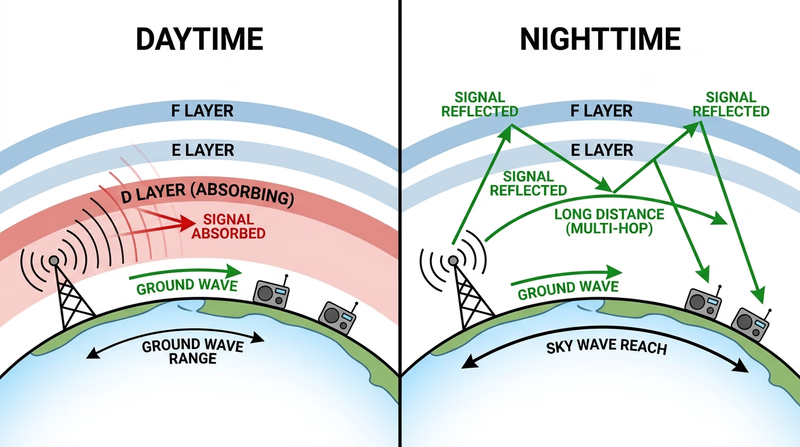
This is why:
- During the day, you hear only local AM stations.
- At night, you can hear AM stations from across the continent — and sometimes from other countries.
Why Some Stations Reduce Power at Night
The FCC requires many AM stations to reduce power or change antenna patterns at night specifically because of this propagation change. Without these restrictions, a 50,000-watt AM station in one city would interfere with stations on the same or adjacent frequencies hundreds of miles away. The nighttime regulations are designed to prevent this “co-channel interference.”
What Your Logs Should Show
Compare your daytime and nighttime medium-wave logs:
- Daytime: Mostly local stations, strong and steady signals.
- Nighttime: The same local stations plus distant stations that were absent during the day. The distant stations may fade in and out.
This difference is dramatic and unmistakable — it’s one of the most vivid demonstrations of radio propagation you can experience without any special equipment.
🎬 Video: Why Some AM Radio Stations Don't Work at Night — Half as Interesting — https://www.youtube.com/watch?v=61UqLXVJM7s
Req 8c5 — Smartphone Listening
How to Listen on a Smartphone
Modern smartphones don’t have traditional radio receivers (most lack even an FM chip). Instead, you listen to radio broadcasts via internet streaming — apps that connect you to live streams from stations around the world.
Recommended Apps
- TuneIn Radio — aggregates thousands of live radio streams worldwide; search by country, language, or genre
- Radio Garden — a globe-based interface where you spin the Earth and tap on green dots to hear live stations from that location
- iHeartRadio — primarily U.S. stations but includes some international content
- BBC Sounds — direct access to BBC World Service and BBC radio stations
- NHK World Radio — Japan’s international broadcast service
For Your Demonstration
Show your counselor that you can:
Find and play a domestic station — tune to a local or national U.S. radio station through a streaming app.
Find and play at least one international broadcast — listen to a station from another country. Good choices include:
- BBC World Service (UK) — English-language news and programming
- Deutsche Welle (Germany) — English and German broadcasts
- Radio France Internationale (RFI) — French and English
- NHK World (Japan) — English-language service
- All India Radio — multiple languages
Explain the difference between this internet-streamed listening and the over-the-air shortwave listening you did earlier. Key point: the smartphone is using the cellular or Wi-Fi internet connection, not receiving radio waves directly. The audio travels as digital data packets, not as an analog radio signal.
You’ve completed Option C. Continue to Option D below, or jump to Requirement 9 using the sidebar.
Req 8d — Direction Finding Overview
Option D is the most physically active radio option. Amateur Radio Direction Finding (ARDF), commonly called “fox hunting,” combines radio skills with orienteering — you use a directional antenna and receiver to locate hidden transmitters in the field. It’s part scavenger hunt, part radio science, part cross-country running.
What You’ll Complete
- Req 8d1 — What Is ARDF?: Understand what direction finding is and why it matters.
- Req 8d2 — Frequencies & Equipment: Learn the frequencies and gear used in fox hunting.
- Req 8d3 — Build a Directional Antenna: Construct a simple antenna for direction finding.
- Req 8d4 — Participate in a Fox Hunt: Use your antenna and a receiver to find a hidden transmitter.
- Req 8d5 — Map Your Hunt: Show on a map how you located the fox.
Getting Started
This option works best with help from a local amateur radio club. Many clubs run fox hunts as regular activities and can provide receivers, set up transmitters, and teach technique. Contact the ARRL or search for ARDF clubs in your area.
Req 8d1 — What Is ARDF?
What Is ARDF?
Amateur Radio Direction Finding (ARDF) is the sport of using a radio receiver and directional antenna to locate hidden transmitters (called “foxes”) placed in a field, park, or wooded area. Participants navigate to each transmitter as quickly as possible, combining radio skills with map reading and physical fitness.
The concept is simple: a directional antenna receives a stronger signal when pointed toward the transmitter. By rotating the antenna, you determine the direction of the signal, take a compass bearing, and walk (or run) toward it. As you get closer, the signal gets stronger — until you find the fox.
Why Direction Finding Matters
As an Activity
- Combines radio, orienteering, and fitness — appeals to Scouts who like both technology and the outdoors
- Teaches practical signal-hunting skills that apply to real-world interference tracking
- Develops problem-solving — you must interpret signal strength, terrain, and reflections to choose an efficient route
- Works at any skill level — from a casual walk in a park to a full-sprint competition through forest trails
As a Competition
ARDF is an internationally recognized sport governed by the International Amateur Radio Union (IARU). Competitions follow standardized rules:
- Five transmitters hidden in a defined area (typically 1–3 km apart in forests)
- Each transmitter broadcasts a unique identification pattern so you know which fox you’ve found
- Competitors carry a receiver, directional antenna, compass, and map
- The winner is the person who finds the most foxes in the shortest time
- National and world championships are held annually
Real-World Applications
The same skills used in fox hunting have serious practical applications:
- Finding sources of radio interference that disrupt emergency services or aviation
- Search and rescue — locating emergency beacons from downed aircraft or lost hikers
- Wildlife tracking — biologists use radio telemetry to track tagged animals
- Military signal intelligence — locating enemy transmitters
Req 8d2 — Frequencies & Equipment
ARDF Frequencies
International ARDF competitions use two frequency bands:
| Band | Frequency | Wavelength | Characteristics |
|---|---|---|---|
| 80 meters | 3.5 MHz | ~80 meters | Signals bend around obstacles; useful in dense forest. Harder to get precise bearings. |
| 2 meters | 144 MHz | ~2 meters | Line-of-sight propagation; sharp, precise bearings possible. Blocked by hills and buildings. |
For informal club fox hunts, any VHF or UHF frequency may be used — commonly 146 MHz (2 meters) or 440 MHz (70 cm).
Equipment
Receiver
A sensitive receiver that can tune to the fox’s frequency. For 2-meter hunts, a standard VHF handheld transceiver (HT) works. For 80-meter hunts, a dedicated shortwave receiver is needed. Many ARDF competitors use purpose-built receivers with an attenuator (a control that reduces sensitivity as you get closer to avoid signal overload).
Directional Antenna
The key piece of equipment. Common types:
- Yagi antenna (2 meters) — looks like a TV antenna with parallel elements on a boom. Gives a strong, directional signal pattern. You swing it side to side to find the direction of strongest signal.
- Tape-measure Yagi — a popular DIY version made from steel tape measures. Lightweight and collapsible.
- Loop antenna (80 meters) — a small loop of wire or tubing. Uses the antenna’s natural null (minimum signal direction) to determine bearing. Nulls are sharper than peaks, so loop antennas find direction by pointing toward the weakest signal.
- Adcock antenna — a pair of vertical elements used for 80-meter DF work.
Other Gear
- Compass — for taking bearings once you determine signal direction
- Map of the hunt area — for plotting bearings and planning routes
- Attenuator — essential for close-range work; without it, the signal is so strong near the fox that your antenna can’t determine direction
- Comfortable shoes — you’ll be walking or running through terrain
Req 8d3 — Build a Directional Antenna
The Tape-Measure Yagi (2 Meters)
The most popular Scout-friendly ARDF antenna project is the tape-measure Yagi — a three-element directional antenna made from inexpensive steel tape measures and PVC pipe. It’s lightweight, collapsible, and effective.
Materials
- 3 steel tape measures (at least 40 inches each) — dollar store tape measures work fine
- 1 PVC pipe, 3/4" diameter, about 36" long (the boom)
- 3 PVC cross fittings or hose clamps to mount the tape-measure elements
- 1 BNC or SO-239 connector (to connect the coax cable)
- Short length of RG-58 coax cable with appropriate connector for your receiver
- Electrical tape, zip ties, or hose clamps
- A hacksaw for cutting PVC
Element Dimensions (for 146 MHz)
| Element | Length | Position on Boom |
|---|---|---|
| Reflector | 41.5 inches | 0 inches (back end) |
| Driven element | 35 inches (two halves, 17.5" each, with gap at center) | 12 inches from reflector |
| Director | 33 inches | 24 inches from reflector (12 inches from driven) |
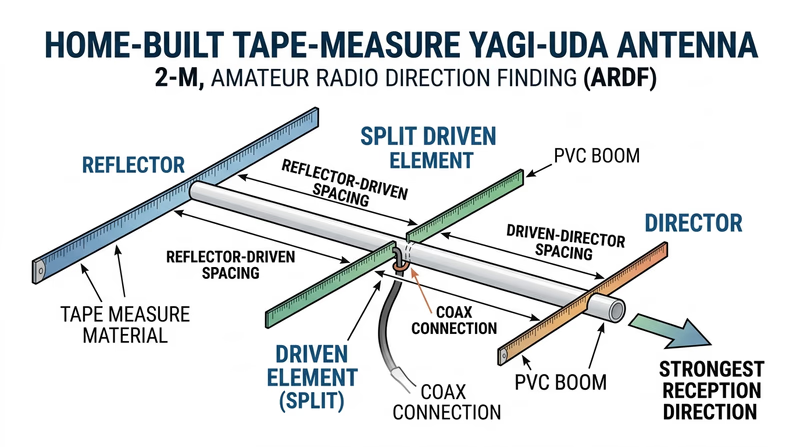
Assembly Steps
- Cut three tape-measure strips to the lengths above. Round or tape the cut ends to prevent sharp edges.
- Mount each strip to the PVC boom at the positions listed, using cross fittings or hose clamps. Elements should be perpendicular to the boom.
- The driven element is split into two halves with a gap at the center. Connect the coax cable center conductor to one half and the shield to the other half.
- Attach the coax connector and run a short cable to your receiver.
- Test: Point the antenna at a known VHF signal source and verify that the signal is strongest when the director end points at the source.
🎬 Video: Tape Measure Yagi Beam Antenna - Ham Radio Q&A — KB9VBR Antennas — https://www.youtube.com/watch?v=BmHoQrDfw-0
Req 8d4 — Participate in a Fox Hunt
How a Fox Hunt Works
- A hidden transmitter (“fox”) is placed somewhere in the hunt area. It transmits a signal on a known frequency — usually a repeating tone, Morse code identifier, or voice message.
- You start from a known location with your directional antenna and receiver (HT).
- Rotate your antenna slowly. The signal is strongest when the antenna’s main lobe (the director end of a Yagi) points directly at the fox.
- Take a compass bearing in the direction of strongest signal.
- Walk toward the fox. Periodically stop, take new bearings, and adjust your route.
- As you get close, the signal gets very strong. Use an attenuator (or detune your receiver, or remove the antenna and use just the receiver’s body) to avoid signal overload.
- Find the fox! It’s typically a small transmitter hidden under a bush, in a bag, or behind an obstacle.
Tips for Your First Hunt
- Start simple. A beginner hunt might use a single fox in an open park within a quarter-mile radius. More advanced hunts use multiple foxes over miles of terrain.
- Practice rotating your antenna before the hunt. Swing it slowly in a full circle and note where the signal peaks and where it nulls (drops to minimum). Get comfortable reading these patterns.
- Use terrain clues. If the signal seems to come from behind a hill, the fox is likely on the other side. Signals can reflect off buildings and hillsides, so always take multiple bearings from different locations.
- Work with a buddy. Two people with antennas at different locations can triangulate the fox’s position much faster than one person alone.
- Don’t rush. Stop frequently, listen carefully, and take deliberate bearings. Precision beats speed for beginners.
Req 8d5 — Map Your Hunt
Creating Your Fox Hunt Map
After your hunt, produce a map that shows your counselor exactly how you used your receiver and antenna to locate the fox. This demonstrates that you understood the process, not just that you stumbled across the transmitter.
What to Include
The hunt area — a printed or hand-drawn map of the park, field, or campus where the hunt took place. Include landmarks (trails, buildings, trees, fences).
Your starting position — mark it clearly with a label.
Bearing points — mark each location where you stopped to take a bearing. At each point, draw an arrow showing the direction your antenna indicated the strongest signal.
Your route — draw a line showing the path you walked between bearing points.
The fox’s location — mark the transmitter’s actual position.
Triangulation — if you took bearings from two or more positions, draw lines from each bearing point in the direction of the signal. The lines should converge near the fox’s actual location. This intersection is the triangulation point — the estimated position based on your bearings.
Map Tips
- Use a printed satellite or topographic map of the area (Google Maps, Google Earth, or a trail map) as your base.
- Use different colors: one for your route, one for bearing arrows, one for the fox location.
- Note the time and signal strength at each bearing point if you recorded them.
- If your bearings didn’t converge perfectly, that’s okay — note why (reflections off buildings, terrain blocking, or operator error). Imperfect results with honest analysis are more impressive than suspiciously perfect results.
You’ve completed Option D. Continue to Option E below, or jump to Requirement 9 using the sidebar.
Req 8e — FRS & GMRS Overview
Option E is the most accessible of the five options — you probably already own or have access to a pair of FRS/GMRS walkie-talkies. These are the radios you see at campouts, on ski slopes, at theme parks, and in warehouses. This option asks you to understand what they are, how they compare to other radio services, and then actually use them in a real-world activity.
What You’ll Complete
- Req 8e1 — FRS vs. GMRS vs. Others: Compare FRS, GMRS, CB, and amateur radio.
- Req 8e2 — FRS/GMRS Details: Understand licensing, frequencies, power, antennas, range, uses, and emergency applications.
- Req 8e3 — Use Radios in the Field: Use FRS or GMRS radios during a hike, event, or team activity and discuss what you learned.
Equipment Needed
A pair of FRS/GMRS walkie-talkies. These are widely available for $20–$50 per pair at outdoor retailers, electronics stores, and online. Popular brands include Motorola, Midland, and Cobra. Many Scout troops already have a set.
Req 8e1 — FRS vs. GMRS vs. Others
FRS vs. GMRS vs. CB vs. Amateur Radio
| Feature | FRS | GMRS | CB | Amateur (Ham) |
|---|---|---|---|---|
| License | None required | FCC license required ($35, no exam) | None required | FCC license required (exam) |
| Frequency | 462/467 MHz (UHF) | 462/467 MHz (UHF) | 26.965–27.405 MHz (HF) | Multiple bands (HF through microwave) |
| Max power | 2 watts | 50 watts | 4 watts (AM), 12 watts (SSB) | Up to 1,500 watts |
| Antenna | Fixed, non-removable | Removable; external antennas allowed | Removable; external antennas allowed | Any type |
| Range | 0.5–2 miles typical | 1–25+ miles (with repeaters/external antennas) | 3–10 miles typical | Local to worldwide |
| Repeaters | Not allowed | Allowed | Not typically used | Widely used |
| Commercial use | Allowed (limited) | Allowed | Not allowed | Not allowed |
| Users | Families, hikers, events | Families, businesses, outdoor recreation | Truckers, hobbyists, rural communication | Hobbyists, emergency, experimentation |
Key Differences
FRS (Family Radio Service)
- Designed for casual, short-range communication — the “disposable” walkie-talkie service.
- No license, no exam, no paperwork. Buy a pair of radios and start talking.
- Power is limited to 2 watts, and you cannot replace or upgrade the antenna — it must be the fixed antenna that came with the radio.
- Range is severely limited by these restrictions — realistic range is about 0.5–2 miles in typical terrain.
GMRS (General Mobile Radio Service)
- A step up from FRS — more power, better antennas, and repeater access.
- Requires an FCC license ($35, valid for 10 years, covers your entire immediate family, no exam).
- Up to 50 watts of power on some channels, and you can use external antennas mounted on vehicles or elevated locations.
- Repeater access dramatically extends range — a GMRS repeater on a hilltop can give you 25+ miles of coverage.
🎬 Video: FRS VS GMRS: A Radio Service Comparison Guide — BridgeCom Systems, Inc — https://www.youtube.com/watch?v=cuqPawftFhQ
How They Differ from CB
CB operates on completely different frequencies (HF band near 27 MHz), uses different modulation (AM or SSB), and has a distinct culture rooted in trucking and rural communication. CB has no license requirement but is limited to 4 watts AM.
How They Differ from Amateur Radio
Amateur radio offers vastly more power, frequencies, modes, and capabilities — but requires passing an examination and obtaining an individual license. Hams can experiment, build equipment, and communicate worldwide. FRS and GMRS are appliance-level services — you use them as-is without modification.
Req 8e2 — FRS/GMRS Details
This requirement has seven parts (a through g). Prepare to discuss all of them with your counselor.
(a) Licensing
FRS: No license of any kind is needed. Anyone can use an FRS radio immediately after purchase.
GMRS: Requires an FCC license. The license costs $35, is valid for 10 years, requires no examination, and covers the licensee plus their immediate family members. Apply online at the FCC’s Universal Licensing System (ULS).
(b) Frequencies and Encoding
Both FRS and GMRS use frequencies in the UHF band around 462 and 467 MHz. They share 22 channels:
- Channels 1–7: Shared FRS/GMRS (up to 2W FRS, up to 5W GMRS)
- Channels 8–14: FRS-only (0.5W maximum)
- Channels 15–22: Shared FRS/GMRS (up to 2W FRS, up to 50W GMRS)
Information is encoded using FM (frequency modulation). Many radios also support CTCSS (Continuous Tone-Coded Squelch System) — sub-audible tones that allow your radio to filter out transmissions from other users on the same channel. These are the “privacy codes” advertised on consumer radios (though they provide no actual privacy — anyone can hear you; the codes just filter what your radio plays through the speaker).
(c) Transmit Power
- FRS: Maximum 2 watts on channels 1–7 and 15–22; maximum 0.5 watts on channels 8–14.
- GMRS: Up to 5 watts on channels 1–7; up to 50 watts on channels 15–22. Repeater input channels (467 MHz) allow up to 50 watts.
More power generally means greater range, but the relationship is not linear — doubling power does not double range. Antenna quality and height matter more than raw power for UHF signals.
(d) Antennas
- FRS: Must use the fixed, non-removable antenna that comes with the radio. This is a deliberate FCC restriction to limit range and keep FRS as a short-range, casual service.
- GMRS: May use removable and external antennas — vehicle-mounted, base-station, or elevated antennas. This is the single biggest practical advantage of GMRS over FRS.
(e) Effective Range and Limitations
Advertised range: Consumer walkie-talkies are often marketed with claims like “35-mile range.” These numbers are misleading — they represent theoretical maximum range under perfect conditions (mountain peak to mountain peak, no obstacles, maximum power).
Realistic range:
- FRS: 0.5–2 miles in typical terrain (buildings, trees, hills)
- GMRS with handheld: 1–5 miles
- GMRS with external antenna: 5–25+ miles
- GMRS through a repeater: 25–50+ miles
What limits range:
- Terrain: Hills, buildings, and dense forest absorb and block UHF signals
- Power: Lower power = shorter range
- Antenna height: Higher antennas “see” farther over the horizon
- Antenna quality: A fixed rubber-duck antenna is much less efficient than an external antenna
(f) Common Everyday Uses
- Family communication at theme parks, campgrounds, ski resorts
- Hiking and trail communication (checking on group members ahead/behind)
- Event coordination (Scout activities, community events, races)
- Construction and work sites (GMRS with license)
- Hunting and fishing groups
- Neighborhood watch coordination
- Road trips (car-to-car communication in a convoy)
(g) Emergency Use
FRS and GMRS radios can be valuable in emergencies:
- When cell networks are overloaded or down (natural disasters, large events), walkie-talkies still work — they don’t depend on any infrastructure.
- GMRS Channel 20 (462.675 MHz) is widely recognized as an informal emergency/travel channel.
- No infrastructure needed — if you have charged batteries and a clear line of sight, you can communicate.
- Limitations: Short range means you may not reach emergency services directly. They’re best for coordinating within your group, not for calling 911.
Req 8e3 — Use Radios in the Field
Activity Ideas
Choose one (or more) of these scenarios:
On a Hike
- Distribute radios to the front and back of the hiking group.
- Practice clear communication: “Trail group to sweep, we’re stopping at the next creek crossing. Over.”
- Test range: have one person walk ahead and report signal quality at increasing distances.
- Note how terrain affects range — does the signal fade when one person goes around a bend or into a valley?
At a Scout Event
- Use radios to coordinate between activity stations, the parking area, and the first aid tent.
- Assign channels and call signs to different groups.
- Practice proper radio etiquette: wait for the channel to be clear before transmitting, keep transmissions brief, use “over” and “out” correctly.
In a Team Game
- Set up a radio-based scavenger hunt or capture-the-flag with teams communicating by walkie-talkie.
- This tests real-time tactical communication — keeping messages short, clear, and useful under time pressure.
What to Discuss with Your Counselor
After your activity, be prepared to discuss:
- What worked well? Could you communicate when you needed to?
- What were the limitations? Where did range fail? Did terrain block signals? Was battery life an issue?
- How did radio etiquette matter? What happened when two people tried to talk at the same time?
- How does this compare to cell phones? What could walkie-talkies do that phones couldn’t (or vice versa)?
- What would you do differently next time? Better channel discipline, higher ground for relay, more spare batteries?
You’ve completed Option E. Now it’s time for the final requirement — exploring radio careers or the hobby side of radio.
Req 9 — Choose Career or Hobby
The final requirement asks you to look beyond the badge itself. Choose one of two paths: research a professional career in radio, or explore radio as a hobby or volunteer service.
Your Options
Req 9a — Research a Radio Career: Pick one radio-related career and research the training, education, costs, job prospects, salary, duties, and advancement opportunities. Present your findings to your counselor.
Req 9b — Radio as Hobby or Service: Explore how you could use radio as a lifelong hobby or volunteer service. Research training, licensing, expenses, and supporting organizations. Discuss short- and long-term goals with your counselor.
How to Choose
Choosing Your Path
Consider what interests you most- Career curiosity: If you’re interested in engineering, broadcasting, telecommunications, or public safety, choose 9a.
- Hobby interest: If you’ve been excited by the hands-on aspects of this badge and want to keep going (especially if Option A or E sparked something), choose 9b.
- Both are valuable: 9a gives you practical career research skills. 9b gives you a plan for personal development.
Req 9a — Research a Radio Career
Radio-Related Careers to Consider
| Career | What They Do |
|---|---|
| RF Engineer | Designs radio systems, antennas, and wireless networks for telecommunications companies, military, or aerospace |
| Broadcast Engineer | Maintains and operates the technical equipment at radio and TV stations |
| Telecommunications Technician | Installs, maintains, and repairs wireless network infrastructure (cell towers, microwave links) |
| Radio Broadcaster / DJ | Hosts on-air programming, selects music, conducts interviews |
| Emergency Dispatcher (911) | Coordinates emergency response using radio communication systems |
| Spectrum Manager | Works for the FCC, military, or large organizations to manage radio frequency allocation |
| Satellite Communications Engineer | Designs and operates satellite communication systems |
| Wireless Network Engineer | Plans and optimizes Wi-Fi, 5G, and other wireless data networks |
| Avionics Technician | Maintains radio, navigation, and communication systems in aircraft |
| Audio Engineer | Records, mixes, and produces audio for broadcast, music, film, and podcasts |
What to Research
For your chosen career, find answers to:
- Training and education: What degree, certification, or license is required? (Associate’s degree? Bachelor’s? FCC commercial license? Specific certifications?)
- Costs: How much does the required education cost? Are there scholarships or employer-sponsored training programs?
- Job prospects: Is this field growing, stable, or declining? Where are the jobs located?
- Salary: What’s the starting salary? What can an experienced professional expect? (The Bureau of Labor Statistics at bls.gov is a reliable source.)
- Job duties: What does a typical workday look like?
- Advancement: What does career progression look like? Can you specialize or move into management?
Research Methods
- Internet search: Bureau of Labor Statistics (bls.gov), professional association websites, job listing sites
- Interview: With parent/guardian permission, contact a professional in the field. Prepare 5–10 questions in advance.
- Site visit: Tour a radio station, cell tower facility, or telecommunications company.
Req 9b — Radio as Hobby or Service
Radio Hobby Paths
| Hobby/Service | What It Involves |
|---|---|
| Amateur radio (ham) | Earn a Technician license, buy an HT, join a local club, get on the air |
| DXing | Hunt for distant stations on shortwave or amateur bands — a global treasure hunt |
| Contesting | Compete in timed events to make as many contacts as possible |
| ARDF / Fox hunting | Combine radio with orienteering in outdoor direction-finding competitions |
| Satellite operation | Communicate through amateur radio satellites using modest equipment |
| Parks on the Air (POTA) | Activate national and state parks by operating a portable radio station from the park |
| Emergency communication (ARES/RACES) | Volunteer to provide backup communications during disasters and public events |
| SKYWARN | Volunteer as a trained weather spotter, reporting severe weather via radio to the National Weather Service |
| Podcasting | Create and distribute audio content on topics you care about |
| Software-defined radio (SDR) | Experiment with radio signals using inexpensive USB receivers and free software |
What to Research
- Training and licensing: What license or certification do you need? (Technician exam for ham radio? SKYWARN spotter training? No license for SDR receive-only?)
- Expenses: What equipment do you need and what does it cost? (An HT can cost $30–$300; an SDR dongle costs $25; a contest-grade HF station costs thousands.)
- Organizations: Who supports this hobby or service?
- ARRL (American Radio Relay League) — the national association for amateur radio
- ARES (Amateur Radio Emergency Service) — emergency communication volunteers
- POTA (Parks on the Air) — portable operation program
- Local ham radio clubs — social, educational, and technical support
Setting Goals
Discuss with your counselor:
Short-term goals (next 6 months):
- Earn your Technician license?
- Buy your first radio?
- Join a local club?
- Attend a ham radio field day event?
Long-term goals (1–5 years):
- Upgrade to General class license for worldwide HF communication?
- Build your own antenna system?
- Volunteer for ARES and serve your community?
- Pursue DXCC (contact 100+ countries)?
- Start a podcast?
You’ve completed all the requirements for the Radio merit badge. Head to the Extended Learning section for ideas on where to go next.
Extended Learning
Congratulations!
You’ve earned the Radio merit badge — one of the oldest badges in Scouting, and one that connects you to a tradition stretching back to Marconi’s first spark. You now understand more about the invisible world of radio waves than most adults ever will. You can read a spectrum chart, explain how your phone finds your location, identify propagation modes, and discuss the difference between AM and FM with real understanding.
But here’s the thing about radio: the badge is just the beginning. The spectrum is vast, the technology is constantly evolving, and the community of radio enthusiasts is one of the most welcoming in any hobby.
Dig Deeper
Get Your Ham License
If you haven’t already, earning your Technician amateur radio license is the most impactful next step. The exam is 35 multiple-choice questions, study materials are free online (hamstudy.org, arrl.org), and many clubs offer free testing through the Laurel VEC. With a license, you can get on the air and start making real contacts.
Explore Software-Defined Radio
For about $25, an RTL-SDR USB dongle and free software (SDR#, CubicSDR, or GQRX) turn your laptop into a radio receiver covering 24 MHz to 1.7 GHz. You can listen to aircraft communications, weather satellites, amateur radio, and more — all from your desk.
Build Something
Radio is a builder’s hobby. Start with simple projects:
- A tape-measure Yagi antenna (covered in Req 8d3)
- A crystal radio — a receiver that requires no batteries, powered entirely by the incoming radio wave
- A QRP (low-power) transmitter kit — transmit with 5 watts or less and see how far your signal reaches
Attend Field Day
ARRL Field Day (held the fourth weekend of June every year) is the largest amateur radio event in the country. Clubs set up temporary stations in parks and fields, operate for 24 hours, and welcome visitors. It’s the perfect way to experience ham radio firsthand with no commitment.
Try This Next
- Join your local amateur radio club. Find one at arrl.org/find-a-club.
- Activate a park for POTA. Parks on the Air (parksontheair.com) lets you operate a portable station from any national or state park.
- Listen to the International Space Station. The ISS has an amateur radio station (call sign NA1SS) and sometimes makes scheduled contacts with schools and Scout groups.
- Try a contest. The ARRL Rookie Roundup is designed specifically for new operators — low pressure, lots of friendly contacts.
- Volunteer with ARES. Your local Amateur Radio Emergency Service team provides backup communications for disasters and public events. Training is free and the experience is invaluable.