Req 3 — Wave Propagation
Understanding propagation — how radio waves get from point A to point B — is the key to knowing why you can hear a station in Japan on a shortwave radio at midnight but not at noon. This requirement covers the three main propagation modes, the role of time-signal stations WWV and WWVH, and the difference between local and distant (DX) stations.
Requirement 3a: Propagation Diagram
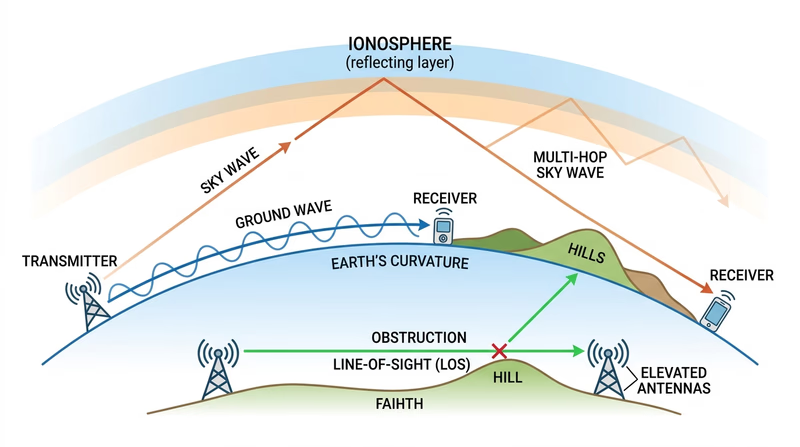
Your diagram should show three distinct propagation modes:
Ground Wave
- How it works: The radio wave follows the curve of the Earth’s surface, bending along the ground.
- Frequencies: Primarily MF (AM broadcast band, 300 kHz – 3 MHz).
- Range: Up to several hundred miles, depending on power and terrain. Range is greater over saltwater (which conducts well) than over dry land.
- On your diagram: Draw a curved line hugging the Earth’s surface from a transmitter tower to a receiver.
Sky Wave (Ionospheric Propagation)
- How it works: HF radio waves travel upward, hit the ionosphere (a layer of electrically charged particles 50–250 miles above the Earth), and are refracted (bent) back down to Earth. They can bounce between the ionosphere and the ground multiple times, crossing thousands of miles.
- Frequencies: Primarily HF (3 – 30 MHz). The exact frequencies that propagate depend on solar activity, time of day, and season.
- Range: Regional to worldwide — a low-power HF transmitter can reach the other side of the planet under the right conditions.
- On your diagram: Draw a wave going up from the transmitter, bouncing off a labeled “ionosphere” layer, and coming back down to a distant receiver. Show at least one “hop.”
Line of Sight
- How it works: VHF and UHF waves travel in straight lines. They pass through the atmosphere without bending significantly, so they can only reach receivers that have a clear, unobstructed path to the transmitter.
- Frequencies: VHF (30 – 300 MHz), UHF (300 MHz – 3 GHz), and microwave.
- Range: Typically limited by the horizon — about 30–50 miles for a tower-mounted antenna, much less for a handheld radio on flat ground. Tall buildings, mountains, and the curvature of the Earth itself block these signals.
- On your diagram: Draw a straight dashed line from a transmitter on a hill or tower to a receiver, with the Earth’s curve shown below. Optionally show a blocked path where terrain interrupts the signal.
Requirement 3b: WWV and WWVH
WWV (Fort Collins, Colorado) and WWVH (Kauai, Hawaii) are time-and-frequency stations operated by the National Institute of Standards and Technology (NIST). They broadcast continuously on 2.5, 5, 10, 15, and 20 MHz.
What They Broadcast
- Precise time announcements (voice and tones) synchronized to the U.S. atomic clock.
- Solar and geophysical alerts — reports on solar activity, geomagnetic conditions, and radio propagation forecasts, updated every few hours.
How They Help Shortwave Listeners
- Propagation check: If you can hear WWV clearly on 10 MHz but not on 20 MHz, you know the ionosphere is supporting propagation at 10 MHz but not at the higher frequency right now. This tells you which shortwave bands are likely to be active.
- Solar reports: The solar flux index and geomagnetic activity numbers broadcast by WWV directly predict HF propagation conditions. High solar flux generally means better long-distance HF conditions; disturbed geomagnetic conditions mean poor propagation.
- Baseline reference: Because WWV’s power and frequency are precisely known, the strength and quality of its signal give you a quick read on current band conditions without needing to search for other stations.
🎬 Video: Radio Propagation 101 — Dan Vanevenhoven — https://www.youtube.com/watch?v=yShlAl2kMZw
Requirement 3c: DX vs. Local
Local station: A station close enough that its signal reaches you via ground wave or direct line of sight. You can usually hear it reliably any time of day with a strong, clear signal. Your local AM and FM stations are local.
DX (distant) station: A station far enough away that its signal reaches you via sky wave propagation — bouncing off the ionosphere. “DX” comes from the telegraphic shorthand for “distance.” DX signals are often weaker, subject to fading, and may only be receivable under certain conditions (typically at night for MF, and depending on solar conditions for HF).
Why the Distinction Matters
Hearing a local FM station isn’t remarkable — the signal is designed to reach you. Hearing a shortwave broadcast from Australia or a medium-wave AM station from 1,000 miles away is an achievement that depends on understanding propagation, timing, and band conditions. Much of the excitement in radio hobbying comes from “working DX” — making contact with or receiving signals from distant, unexpected sources.
Now you understand how waves travel and how to predict what you’ll hear. Next, you’ll learn how those waves actually carry information — from Morse code to 5G.