Req 5 — Equipment & Devices
This requirement moves from theory to hardware. You’ll learn the difference between block diagrams and schematics, draw a station block diagram, catalog the radio devices you use every day, and understand two important applications: NOAA Weather Radio and RFID.
Requirement 5a: Block Diagrams vs. Schematics
| Feature | Block Diagram | Schematic Diagram |
|---|---|---|
| Purpose | Shows the overall flow and organization of a system | Shows the exact electrical connections between individual components |
| Level of detail | High-level; each block represents a major functional stage | Component-level; shows every resistor, capacitor, transistor, and wire |
| Symbols | Simple labeled boxes connected by arrows | Standardized electronic symbols (zigzag for resistor, parallel lines for capacitor, etc.) |
| Who uses it | Anyone trying to understand how a system fits together | Engineers and technicians who need to build or repair the circuit |
| Analogy | A road map showing cities and highways | A street-by-street navigation guide showing every turn |
For your counselor: A block diagram is like describing a recipe by listing the steps (“chop vegetables, heat oil, stir-fry, plate”). A schematic is like listing every ingredient, measurement, temperature, and timing detail.
🎬 Video: How to Read a Schematic — RimstarOrg — https://www.youtube.com/watch?v=_HZ-EQ8Hc8E
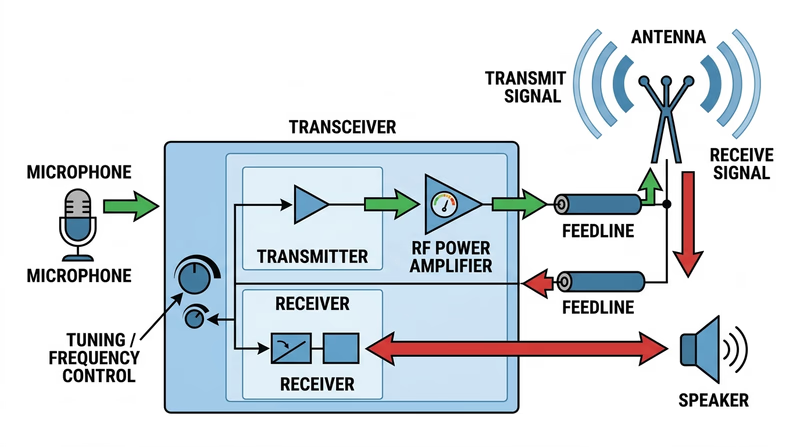
Requirement 5b: Radio Station Block Diagram
Here’s what each component does:
| Component | Function |
|---|---|
| Microphone | Converts sound waves (your voice) into an electrical audio signal |
| Transmitter | Takes the audio signal and modulates it onto a radio-frequency carrier wave |
| Amplifier | Boosts the modulated RF signal to a power level sufficient to reach distant receivers |
| Feedline | A cable (typically coaxial cable) that carries the amplified RF signal from the transmitter to the antenna with minimal loss |
| Antenna | Converts the electrical RF signal into electromagnetic waves that radiate into space |
| Receiver | Captures incoming radio waves via the antenna and demodulates them back into an audio signal |
| Speaker | Converts the electrical audio signal back into sound waves you can hear |
| Transceiver | A combined transmitter and receiver in one unit — most modern ham radios are transceivers |
Drawing Your Diagram
- Start with the microphone on the left.
- Draw an arrow into the transceiver box (which contains both the transmitter and receiver).
- From the transceiver, draw an arrow through an amplifier box.
- From the amplifier, draw an arrow through the feedline to the antenna.
- Show the return path: antenna → feedline → transceiver (receiver section) → speaker.
- Label every box and every arrow showing signal flow direction.
Requirement 5c: Consumer Radio Devices
You interact with radio-based devices far more often than you probably realize. Here’s a starter list — aim for at least 10 items in your counselor discussion:
Analog or mixed:
- AM/FM car radio
- Garage door opener
- Baby monitor (some models)
- Walkie-talkies (FRS/GMRS)
Digital:
- Smartphone (cellular, Wi-Fi, Bluetooth, GPS, NFC)
- Laptop (Wi-Fi, Bluetooth)
- Smart TV (Wi-Fi)
- Wireless earbuds/headphones (Bluetooth)
- Smartwatch/fitness tracker (Bluetooth, sometimes cellular)
- Wi-Fi router
- Video game controller (Bluetooth or proprietary wireless)
- Keyless car entry / push-button start (RFID/low-power radio)
- Contactless payment (NFC)
- Drone controller (2.4 GHz or 5.8 GHz radio)
- Home security system (wireless sensors)
- Smart home devices (Wi-Fi, Zigbee, Z-Wave)
- GPS navigation unit
- Satellite radio receiver (SiriusXM)
- NOAA Weather Radio
Requirement 5d: NOAA Weather Radio
NOAA Weather Radio (NWR) is a nationwide network of radio stations broadcasting continuous weather information directly from the National Weather Service. It operates on seven VHF frequencies between 162.400 MHz and 162.550 MHz.
How It Alerts You
- Continuous broadcast: NWR stations transmit 24/7, providing current conditions, forecasts, and hazard information for your area.
- SAME technology: Specific Area Message Encoding (SAME) allows weather radios with SAME capability to remain silent until a warning is issued for your specific county or region. When a tornado warning, severe thunderstorm warning, flash flood, or other hazard is issued, the radio automatically activates and broadcasts the alert — even at 3 a.m.
- All-hazards alerting: NWR also broadcasts non-weather emergencies like AMBER alerts, chemical spills, and national security events through the Emergency Alert System (EAS).
Why It Matters for Scouts
Cell phone alerts depend on cell towers — which can fail during the very storms that create emergencies. A dedicated NOAA Weather Radio works on batteries, receives signals from high-power transmitters, and is designed to wake you up when danger is approaching. Many Scout leaders carry one in their camp kit.
Requirement 5e: RFID
RFID (Radio-Frequency Identification) uses radio waves to read information from a small electronic tag attached to an object or embedded in a card.
How It Works
- An RFID reader emits a radio signal.
- An RFID tag (a tiny chip plus an antenna) receives the signal.
- Passive tags (no battery) use the energy from the reader’s signal to power up and transmit their stored data back. Active tags (with a battery) can transmit over longer ranges.
- The reader captures the tag’s response and processes the data.
Everyday Uses
- Contactless payment (tap-to-pay credit cards, Apple Pay, Google Pay — these use NFC, a form of RFID)
- Building access cards (keycard entry to offices, hotels, dorm rooms)
- Retail inventory tracking (tags on clothing and merchandise)
- Library book checkout (self-checkout stations read RFID tags embedded in books)
- Pet microchips (a passive RFID tag injected under the skin, readable by a vet’s scanner)
- Toll collection (E-ZPass and similar systems in your car’s windshield)
- Luggage tracking (airlines increasingly use RFID tags on checked bags)
- Passport chips (the small gold symbol on the cover of modern U.S. passports indicates an embedded RFID chip)
You’ve now covered the hardware, devices, and services that make radio practical. Next, you’ll learn who controls the airwaves — and why that matters.