Req 7 — Cellular Technology
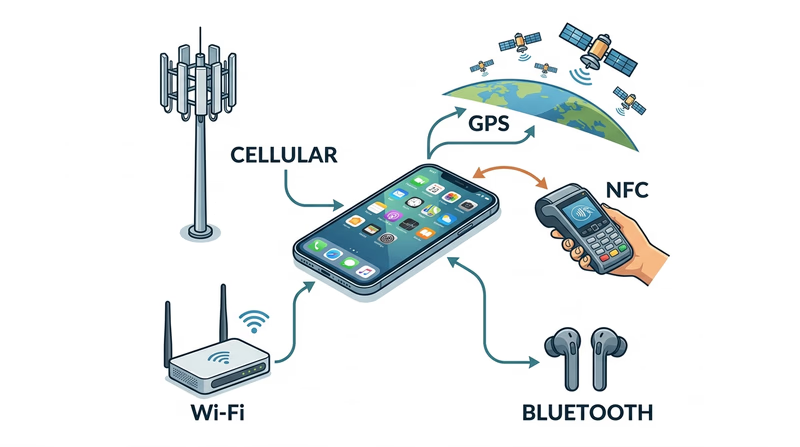
Your cell phone is the most sophisticated radio device most people will ever own. It contains multiple radio systems working simultaneously — cellular, Wi-Fi, Bluetooth, GPS, and NFC — all in a package that fits in your pocket. This requirement asks you to understand how cellular technology differs from other radio systems, what Airplane Mode does, how your phone knows the time and your location, its role in emergencies, and how wireless charging works.
Requirement 7a: Cellular vs. Other Radio
| Feature | Cellular | Broadcast | Hobby (Amateur) |
|---|---|---|---|
| Architecture | Network of small, low-power cells connected to the internet backbone | Single high-power transmitter covering a wide area | Individual stations communicating directly or through repeaters |
| Infrastructure | Requires cell towers, switching centers, billing systems | Requires a broadcast tower and studio | Minimal — an antenna and a transceiver |
| Handoff | Seamlessly transfers your call between cell towers as you move | No handoff — you either receive the signal or you don’t | No handoff — you manually tune to a repeater or frequency |
| Two-way | Always two-way (full duplex — you can talk and listen simultaneously) | One-way (broadcast only) | Two-way (usually half-duplex — one person talks at a time) |
| Licensing | Carrier holds the license; users just buy service | Station holds the license; listeners need none | Each operator holds an individual license (except FRS) |
| Commercial | Yes — operated by for-profit companies | Yes — advertising-supported | No — commercial use is prohibited |
Key distinction: Cellular systems are networked — your phone connects to a nearby cell tower, which routes your call or data through a vast infrastructure to reach its destination. Broadcast and amateur radio are direct — the signal goes from transmitter to receiver without a network in between.
Requirement 7b: Airplane Mode
Airplane Mode is a phone setting that turns off all radio transmitters in the device — cellular, Wi-Fi, Bluetooth, and GPS (in some implementations). The phone can still function for non-radio tasks (calculator, camera, reading downloaded content), but it cannot send or receive any wireless signals.
Why It Exists
- Aviation safety: Aircraft navigation and communication systems operate on radio frequencies. While modern aircraft systems are well-shielded, regulations require passengers to disable transmitters during flight to eliminate any possibility of interference, especially during takeoff and landing.
- Regulatory compliance: The FCC prohibits the use of cellular phones in flight because a phone at altitude can connect to multiple cell towers simultaneously, disrupting the network’s frequency-reuse plan.
- Battery conservation: With all radios off, battery drain is minimal — useful in any situation where you need to conserve power.
- Focus and etiquette: Airplane Mode also serves as a “do not disturb” function in hospitals, theaters, meetings, or any setting where wireless signals or notifications are unwelcome.
Requirement 7c: Time, Location, and Elevation
Time
Your phone’s clock is synchronized using signals from the cellular network, which in turn is synchronized to atomic clocks. When your phone connects to a cell tower, it receives an extremely precise time signal. Additionally, GPS satellites each carry onboard atomic clocks, and your phone can use GPS time as a secondary source. This is why your phone’s clock is almost always more accurate than any wall clock or wristwatch.
Location (GPS)
GPS (Global Positioning System) uses a constellation of at least 24 satellites orbiting the Earth. Each satellite continuously broadcasts its position and the exact time. Your phone’s GPS receiver picks up signals from at least four satellites and calculates its position by measuring the tiny differences in arrival time from each satellite (a process called trilateration).
- Three satellites give you latitude and longitude (2D position).
- Four or more satellites give you latitude, longitude, and elevation (3D position).
Assisted GPS (A-GPS) speeds up the process by using cell tower data to give the GPS receiver a rough starting position, reducing the time to get a fix from minutes to seconds.
Elevation
Elevation comes from the GPS calculation (the vertical component of the 3D fix). It can also be supplemented by the phone’s barometric pressure sensor (many modern smartphones include one), which detects changes in altitude based on atmospheric pressure.
Requirement 7d: Cell Phones in Emergencies
Benefits
- Immediate access to 911 from almost anywhere with cellular coverage.
- E911 location data: When you call 911, your phone automatically transmits your approximate location to the dispatch center (using GPS and cell tower triangulation).
- Wireless Emergency Alerts (WEA): Your phone can receive tornado warnings, AMBER alerts, and presidential alerts pushed directly by FEMA — no app required.
- Camera and flashlight for documenting scenes and signaling.
- First aid information (if downloaded or cached) available without a data connection.
Limitations
- No signal, no help. Cell phones depend entirely on nearby cell towers. In wilderness areas, canyons, and remote locations, there may be no coverage at all.
- Cell towers fail. Natural disasters (hurricanes, earthquakes) and power outages can knock out cell towers when you need them most.
- Battery life is finite. A dead phone is useless. Cold weather drains batteries faster.
- Network congestion. During large-scale emergencies, cell networks become overloaded as thousands of people try to call simultaneously.
- GPS requires sky view. Indoor, underground, or in dense tree cover, GPS accuracy degrades significantly.
Requirement 7e: Wireless Charging
Wireless charging transfers electrical energy from a charging pad to a device without any physical cable connection. It uses electromagnetic induction — the same principle that makes a transformer work.
How It Works
- A charging pad contains a coil of wire. Alternating current flows through this coil, creating an oscillating magnetic field.
- The phone contains a matching receiver coil. When placed on the pad, the magnetic field induces an alternating current in the receiver coil.
- The phone’s electronics convert this current into the proper voltage and current to charge the battery.
Standards
- Qi (pronounced “chee”) is the most widely used wireless charging standard, supported by Apple, Samsung, Google, and most other phone manufacturers.
- MagSafe (Apple) adds magnets to align the phone with the charging coil for better efficiency.
Trade-offs
| Advantage | Limitation |
|---|---|
| Convenient — just set the phone down | Slower than wired charging (typically) |
| No wear on charging ports | Generates more heat than wired charging |
| Water-resistant devices benefit (no exposed port needed) | Phone and pad must be precisely aligned |
| Works through thin cases | Energy transfer is less efficient (some power is lost as heat) |
You’ve covered the full range of radio fundamentals — from safety to spectrum to cell phones. Now it’s time for the hands-on capstone: Requirement 8, where you choose one of five specialized radio options to explore in depth.