Req 8a5 — Transceivers & Repeaters
Types of Transceivers
| Feature | Handheld (HT) | Mobile | Base Station |
|---|---|---|---|
| Size | Fits in one hand | Fits under a car dashboard | Desktop unit, often with separate components |
| Power | 1–8 watts | 25–75 watts | 100–1,500 watts (with amplifier) |
| Antenna | Small “rubber duck” or whip antenna | Vehicle-mounted antenna (mag-mount or permanent) | Outdoor antenna on mast or tower |
| Power source | Rechargeable battery | Vehicle battery (12V DC) | AC power supply |
| Typical bands | VHF/UHF (2m, 70cm) | VHF/UHF and/or HF | HF, VHF, UHF — full range |
| Range (simplex) | 1–5 miles (terrain dependent) | 5–30 miles | 30+ miles (VHF) to worldwide (HF) |
| Best for | Hiking, events, emergencies, portable use | Travel, commuting, mobile operation | Home station, DXing, contests |
Handheld Transceivers (HTs)
The most portable option. Every new Technician class ham typically starts with an HT. They’re ideal for local communication, repeater access, public service events, and emergency go-bags. The main limitation is low power and a small, inefficient antenna.
Mobile Transceivers
Designed to mount in a vehicle. Higher power and a better antenna location (roof-mounted) give significantly better range than an HT. Many hams operate mobile during their commute.
Base Stations
The full-capability station at home. A base station can include an HF transceiver for worldwide communication, a high-gain antenna system, and amplifiers. This is where serious DXing, contesting, and experimentation happen.
Amateur Radio Repeaters
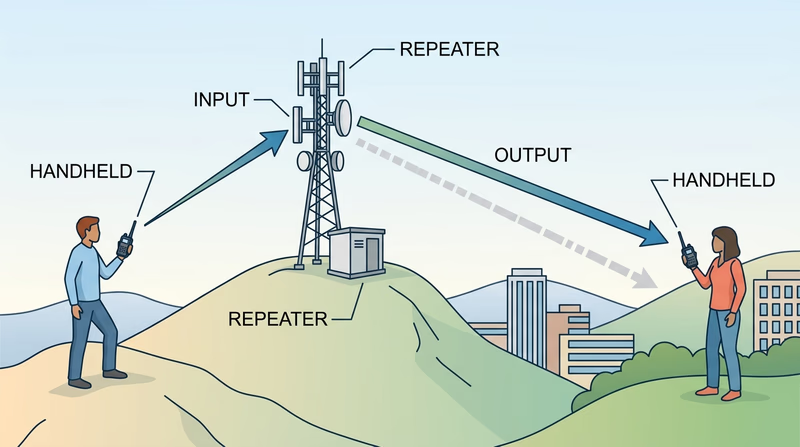
A repeater is an automated station, usually located on a hilltop or tall building, that receives a signal on one frequency and simultaneously retransmits it on another frequency at much higher power and from a much better location. This dramatically extends the range of low-power handheld and mobile radios.
How Repeaters Work
- You transmit on the repeater’s input frequency (e.g., 146.340 MHz).
- The repeater receives your signal, amplifies it, and retransmits it on the output frequency (e.g., 146.940 MHz) — typically with 50–100 watts from a hilltop antenna.
- Other operators listen on the output frequency and hear your signal clearly, even if they’re 30–50 miles away.
The difference between input and output frequencies is called the offset (typically +/- 600 kHz on 2 meters).
Why Repeaters Matter
Without repeaters, two handheld radios on VHF might only communicate 1–3 miles apart on flat terrain. Through a repeater, those same radios can communicate 30–50 miles or more. Repeaters are the backbone of local amateur radio communication.