Req 8c4 — Why Distant Stations Appear at Night
The Science of Nighttime AM
The answer lies in the D layer of the ionosphere.
During the Day
The sun’s ultraviolet radiation creates a layer of weakly ionized gas called the D layer at about 40–55 miles altitude. This layer absorbs medium-wave (AM) signals before they can reach the higher, more reflective layers of the ionosphere. The result: AM signals can only travel by ground wave during the day, limiting their range to roughly 50–200 miles.
At Night
When the sun sets, the D layer rapidly disappears because it requires continuous solar radiation to sustain itself. Without the D layer acting as an absorber, medium-wave signals can now reach the E and F layers (60–200 miles altitude), which reflect the signals back to Earth. The signals can bounce between the ionosphere and the ground multiple times, traveling hundreds or thousands of miles.
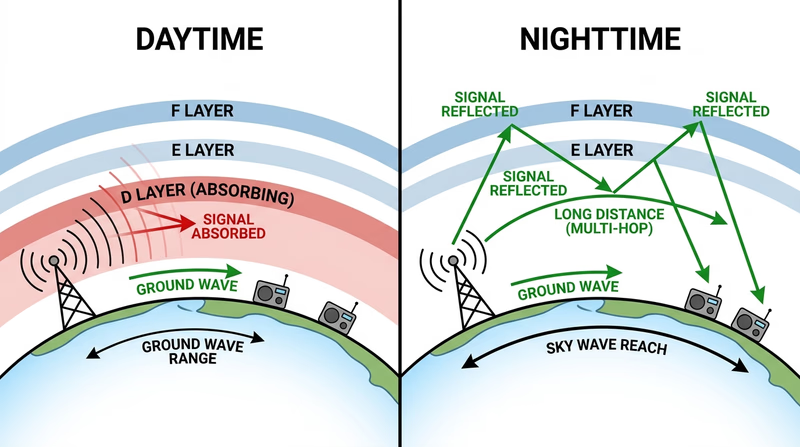
This is why:
- During the day, you hear only local AM stations.
- At night, you can hear AM stations from across the continent — and sometimes from other countries.
Why Some Stations Reduce Power at Night
The FCC requires many AM stations to reduce power or change antenna patterns at night specifically because of this propagation change. Without these restrictions, a 50,000-watt AM station in one city would interfere with stations on the same or adjacent frequencies hundreds of miles away. The nighttime regulations are designed to prevent this “co-channel interference.”
What Your Logs Should Show
Compare your daytime and nighttime medium-wave logs:
- Daytime: Mostly local stations, strong and steady signals.
- Nighttime: The same local stations plus distant stations that were absent during the day. The distant stations may fade in and out.
This difference is dramatic and unmistakable — it’s one of the most vivid demonstrations of radio propagation you can experience without any special equipment.
🎬 Video: Why Some AM Radio Stations Don't Work at Night — Half as Interesting — https://www.youtube.com/watch?v=61UqLXVJM7s