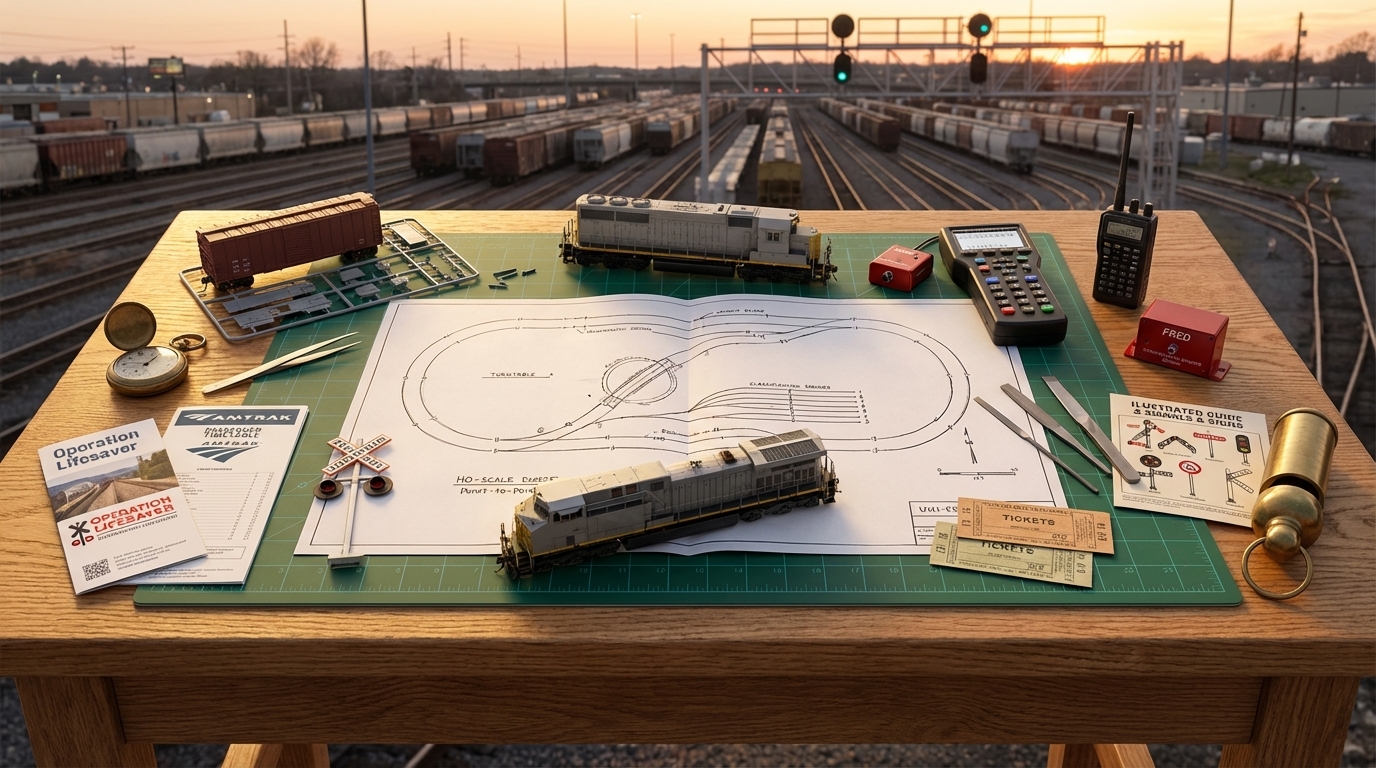
 Getting Started
Introduction & Overview
Overview
Railroading is one of the forces that built America. Trains moved settlers west, carried coal and steel to industrial cities, and connected coasts in ways that no other technology could match. Today railroads haul nearly a third of all freight moved in the United States and carry millions of commuters every day — quietly, efficiently, and with a smaller carbon footprint per ton-mile than any other land transport. This badge takes you inside how that system works.
Then and Now
Then
On May 10, 1869, a golden spike was driven at Promontory Summit, Utah, completing the first transcontinental railroad. What had taken months by wagon now took days by train. By 1900 the United States had more miles of railroad track than the rest of the world combined. Steam locomotives thundered over mountain passes, telegraph lines followed the rails, and entire towns sprang up wherever a depot opened. The railroad industry was the largest employer in the country and set the pace for everything from standardized time zones to modern corporate management.
Now
Steam is long gone, but the railroad is far from a relic. Seven Class I freight railroads — including BNSF, Union Pacific, CSX, and Norfolk Southern — operate a combined network of roughly 140,000 miles and move everything from grain and coal to automobiles and intermodal containers stacked two-high. Passenger rail through Amtrak connects 500+ cities, while urban transit agencies run light rail, subways, and commuter trains in every major metro area. Precision scheduled railroading (PSR), positive train control (PTC), and battery-electric locomotives are reshaping operations for the 21st century.
Get Ready!
You don’t need to live near a rail yard or own a model railroad to earn this badge. You need curiosity and a willingness to look carefully — at maps, at equipment, at how large systems are organized. Every town in America has a railroad story. Most still have tracks nearby. Keep your eyes open as you work through these requirements and you’ll start seeing the network everywhere.
Kinds of Railroading
Railroading is not one thing — it’s a family of related industries and activities. Here is how the major branches break down:
Freight Rail
Freight railroads are private businesses that own and operate their own track. They haul bulk commodities (coal, grain, chemicals, lumber), intermodal containers, automotive shipments, and much more. Class I railroads are the giants — each earns more than $500 million annually and operates thousands of miles of track. Regional and shortline railroads fill in the gaps, connecting smaller communities to the Class I network.
Passenger Rail
Amtrak is the national intercity passenger railroad, created by Congress in 1970 to preserve long-distance rail travel after private railroads stopped running passenger trains. Amtrak operates on tracks mostly owned by freight railroads, running corridor trains (like the Northeast Corridor between Boston and Washington) as well as long-distance routes like the California Zephyr and the Empire Builder.
Transit Rail
Urban and suburban rail transit moves commuters inside and between cities. The major forms include heavy rail subways (New York, Chicago, Washington D.C.), light rail lines (Portland, Denver, Dallas), and commuter rail systems (Metra in Chicago, LIRR in New York, Caltrain in the Bay Area). These systems are publicly funded and operated, designed for high-frequency service over shorter distances.
Hobby Railroading
Model railroading is one of the most popular hobbies in the country. Enthusiasts build scaled-down layouts representing real or imagined railroads, using scales from tiny Z (1:220) to room-filling G (1:22.5). Railfanning — photographing, tracking, and documenting trains — is another active community. Both hobbies develop real skills in history, geography, electronics, and engineering.
Next Steps
Requirement 1 asks you to choose three areas of railroad knowledge to dig into. The four options cover freight train types, railroad geography, car identification, and locomotive technology — all fundamental to understanding how the rail network functions. Read the overview page for Requirement 1 to decide which three are the best fit for you.