Req 1b — Mapping a Railroad System
This requirement asks you to study a real railroad as a complete system — not just its name, but its geography, its infrastructure, and its business. Think of it as building a mental map of one railroad’s world.
Step 1 — Choose Your Railroad
Class I railroads are the seven largest freight railroads in North America, each earning over $500 million in annual revenue:
| Railroad | Abbreviation | Primary Territory |
|---|---|---|
| BNSF Railway | BNSF | Western U.S., Pacific Northwest to Midwest |
| Union Pacific Railroad | UP | Western and Central U.S. |
| CSX Transportation | CSX | Eastern U.S., Southeast to Midwest |
| Norfolk Southern Railway | NS | Eastern U.S., Southeast and Appalachian region |
| Canadian National Railway | CN | U.S. Gulf Coast to Canada (operates in U.S.) |
| Canadian Pacific Kansas City | CPKC | Central U.S. corridor, Canada to Mexico |
| Soo Line / Canadian Pacific (merged) | — | See CPKC |
Regional railroads are mid-size freight railroads operating over shorter distances. Examples: Florida East Coast Railway, Kansas City Southern (now part of CPKC), Iowa Interstate Railroad.
Step 2 — Research the Four Elements
Once you pick your railroad, gather information on all four areas the requirement specifies:
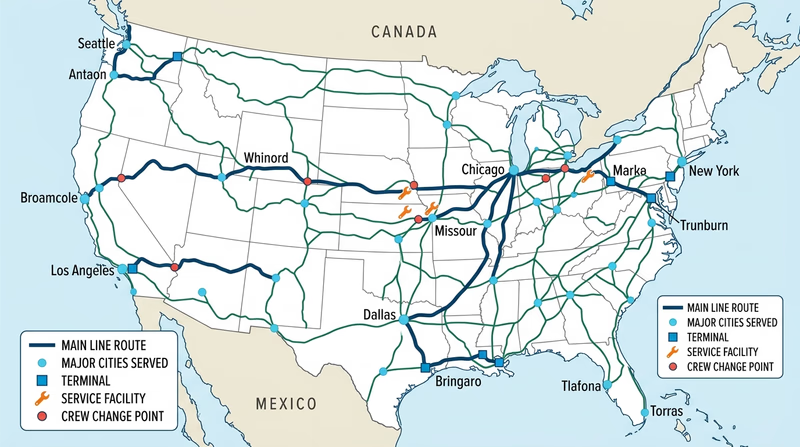
Major Cities Served
List the major metropolitan areas on the railroad’s route map. For a Class I, this will be a long list — focus on the biggest hubs. For BNSF, for example: Chicago, Kansas City, Denver, Los Angeles, Seattle, Portland, Minneapolis, Fort Worth.
Major Terminals
Terminals are facilities where trains are assembled, disassembled, or switched. The largest are classification yards, where cars are sorted by destination. Famous examples:
- Barstow, CA (BNSF) — a major intermodal and classification hub in the Mojave Desert
- North Platte, NE (Union Pacific) — Bailey Yard, the world’s largest railroad classification yard
- Selkirk, NY (CSX) — a major Northeast classification yard
Also note any intermodal terminals (where containers are transferred between trains and trucks) and automotive facilities (where new vehicles are handled).
Service Facilities
Service facilities are where locomotives are fueled, inspected, and repaired. Look for your railroad’s main locomotive shops and engine terminals. These are often located at division points along the main line.
Crew Change Points
Crews work under federal regulations that limit how many hours they can be on duty without rest. When a crew reaches their limit, a fresh crew takes over — this happens at a crew change point or division point. These towns typically have a small rail presence: a crew hotel (called a “bunkhouse” or “crew facility”), a small yard or siding, and sometimes a service track. On a 1,500-mile run, there might be five or six crew changes.
Major Commodities
What does your railroad primarily haul? Class I railroads tend to specialize:
- BNSF — coal (Powder River Basin), grain, intermodal containers
- Union Pacific — chemicals, intermodal, automotive, agriculture
- CSX — intermodal, coal, chemicals, automotive
- Norfolk Southern — intermodal, coal, metals, agricultural products
Step 3 — Putting It Together
You do not need to memorize every detail. Your counselor wants to see that you understand how the railroad functions as a network — that cities, terminals, crew points, and commodities are all connected. Try sketching a rough map of your chosen railroad’s main route with five to ten cities marked. Add a symbol for each major terminal and note the top two or three commodities alongside the lines.
Req 1b Research Checklist
- Chosen a specific Class I or regional railroad by name
- Listed at least five major cities served
- Identified at least two major terminals (classification yards or intermodal hubs)
- Described where service facilities are located
- Explained what crew change points are and named at least one on your railroad
- Listed the top two or three commodities the railroad hauls