Req 1d — How Locomotives Make Power
Modern locomotives are engineering marvels — not purely mechanical machines but hybrid electrical systems that convert fuel or grid power into precise traction. This requirement covers three distinct concepts: the diesel-electric drive system, dynamic braking, and radial steering trucks. Learn all three.
How a Diesel-Electric Locomotive Develops Power
Despite the name, a diesel locomotive does not connect its engine directly to the wheels. It is actually a diesel-electric: the diesel engine drives a generator (or alternator), which produces electricity, which powers electric traction motors mounted on each axle. Here is the sequence:
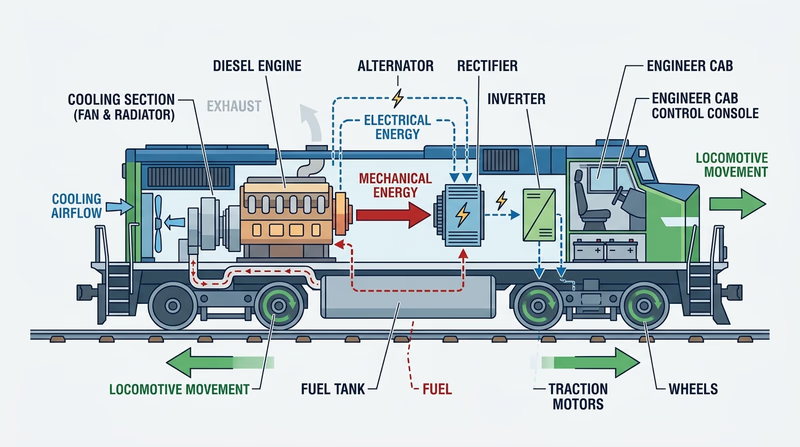
- Diesel engine — A large turbocharged diesel engine (typically 3,000–5,000 horsepower) burns fuel and produces mechanical rotation.
- Main alternator — The spinning diesel engine shaft turns a large alternator, converting mechanical energy into three-phase AC electricity.
- Rectifier / inverter — Electronic equipment converts and conditions the power for the traction motors.
- Traction motors — One or two AC or DC traction motors are mounted on each powered axle. They receive electrical power and convert it back into rotational force — torque — which spins the wheels.
- Wheelset — The traction motor’s torque is applied to the wheel through a gear reduction, giving the locomotive the ability to move enormous weight at low speed.
Why diesel-electric instead of direct mechanical drive? Electric motors deliver maximum torque at zero speed — exactly what you need to start a 15,000-ton train. A direct mechanical drivetrain would require an impossibly complex gearbox and clutch system. The diesel-electric arrangement elegantly solves the starting torque problem with off-the-shelf electrical components.
🎬 Video: How a Diesel-Electric Locomotive Works — Animagraffs — https://www.youtube.com/watch?v=cIQ0yIZgQeE
How an Electric Locomotive Develops Power
Electric locomotives work similarly to diesel-electrics, but skip the diesel engine entirely:
- They draw electricity from an overhead wire (catenary) or a third rail.
- Onboard transformers and inverters condition the voltage for the traction motors.
- The same AC traction motors drive the axles.
Electric locomotives produce no exhaust and can regenerate energy during braking (see dynamic braking below). They are common in high-speed and commuter rail in the U.S. Northeast Corridor, and dominant in European and Asian rail systems.
Dynamic Braking
Dynamic braking is a method of slowing a train by using the traction motors as generators. Here is how it works:
When the engineer selects dynamic braking, the traction motors are switched from motor mode to generator mode. The spinning wheels drive the motors, which now generate electricity. That electricity is routed to large resistor grids (banks of resistors mounted on the locomotive roof) where it is converted to heat and dissipated into the air. This braking force slows the train.
Why does this matter?
- Saves brake shoes and wheel treads. Friction brakes on each car wear out over time. Dynamic braking reduces how much the friction brakes are used, especially on long mountain descents.
- Controls speed on grades. On long downhill grades like the Rockies, a heavy loaded coal train needs continuous braking for miles. Dynamic braking can hold the train at a steady speed without overheating the brake shoes.
- Modern AC locomotives can also feed dynamic braking energy back into the electrical grid (regenerative braking) rather than wasting it as heat.
Radial Steering Trucks
A truck is the wheeled frame assembly under a rail car or locomotive — it carries the weight and transmits traction or braking to the rails. Most locomotives and cars have two trucks, one at each end.
A radial steering truck is a truck designed so the wheelsets can pivot slightly inward relative to each other as the truck enters a curve. This allows the wheels to follow the curve more naturally rather than being forced through it at a fixed angle.
Why it matters:
- Standard trucks with rigid wheelset spacing experience significant lateral force — called flange force — as the wheels are pushed through curves. This causes wear on both the wheel flanges and the rail.
- Radial steering trucks reduce this lateral force, which means:
- Less wear on wheels and rail
- Lower maintenance costs
- Better stability at speed
- The locomotive can navigate tighter curves more smoothly
Modern locomotives from GE (now Wabtec) and EMD (now Progress Rail) use radial steering trucks as standard equipment on high-horsepower units.
Req 1d Key Concepts Checklist
- Can explain diesel-electric drive in simple terms (engine → alternator → traction motors → wheels)
- Can describe why diesel-electric is used instead of direct mechanical drive
- Can define dynamic braking and explain what happens to the energy
- Can explain why dynamic braking is important on mountain grades
- Can define a truck (the wheel assembly under a locomotive)
- Can explain what radial steering trucks do differently from standard trucks and why that matters