Req 2 — Passenger Rail in America
Requirement 2 has two parts, both required. Part 2a takes you into the history and structure of Amtrak and asks you to plan a real trip using a timetable. Part 2b surveys all the forms of rail transit that move people in American cities. Together they give you a complete picture of passenger rail in the United States.
Requirement 2a
Why Amtrak Was Created
By the 1960s, private railroads had been losing money on passenger trains for decades. Freight was profitable; passengers were not. Railroads had to run passenger trains under their common-carrier obligations, even when the trains ran nearly empty. One by one, railroads petitioned the Interstate Commerce Commission to discontinue routes. Passenger service across the country was deteriorating rapidly.
In 1970, Congress passed the Rail Passenger Service Act, which created Amtrak (a contraction of “American track”). Amtrak launched on May 1, 1971, taking over the operation of most intercity passenger trains. The private railroads paid to join the program and handed off their passenger obligations; in return they could focus entirely on freight. The federal government would fund the losses.
Today Amtrak is a government-owned corporation (not a federal agency, but dependent on federal funding) that operates about 300 trains per day to more than 500 destinations in 46 states. It carries roughly 30 million passengers per year.
Planning Your Rail Trip
To complete 2a, you need to plan a specific trip between two cities at least 500 miles apart and present these details to your counselor:
- The departure city and destination city
- The train number and name (e.g., Train 3 — the Southwest Chief)
- Departure time from your origin city
- Arrival time at your destination
- Type of service you want (coach seat, roomette, bedroom, business class, etc.)
How to Find Amtrak Schedule Information
- Go to amtrak.com and use the trip planner to search your route
- Note the train number and name from the search results (e.g., Train 49/50 — Lake Shore Limited)
- Record the departure time listed for your origin station
- Record the scheduled arrival time at your destination
- Decide on your service class: Coach (seats), Roomette (private room for 1–2, includes meals), Bedroom (larger private room), Business Class (Acela/Northeast Corridor), or Sleeper
- Note the distance to confirm it is at least 500 miles
Sample trips over 500 miles:
- Chicago, IL → New York City, NY — Train 48 (Lake Shore Limited), ~960 miles
- Los Angeles, CA → Seattle, WA — Train 14 (Coast Starlight), ~1,380 miles
- Washington, D.C. → Chicago, IL — Train 29 (Capitol Limited), ~780 miles
- New Orleans, LA → New York City, NY — Train 20 (Crescent), ~1,380 miles
Service Types Explained
| Service Class | What You Get | Notes |
|---|---|---|
| Coach | Reclining seat, overhead storage | Most affordable; no meal included |
| Business Class | Wider seat, at-seat service | Available mainly on NEC and some corridor trains |
| Roomette | Private room for 1–2, fold-down beds, meals included | Available on long-distance trains |
| Bedroom | Larger private room, full bathroom, meals included | More spacious for overnight trips |
| Accessible Bedroom | Roomette-sized accessible room | Requires disability documentation |
🎬 Video: Amtrak Map USA: Understand America’s Train Routes — T1D Wanderer — https://www.youtube.com/watch?v=anKNW1YHBoU
Requirement 2b
Rail transit is not one thing — it is a family of systems, each designed for a different scale of city and density of ridership. Know the distinctions between the main types.
Heavy Rail (Rapid Transit / Subway)
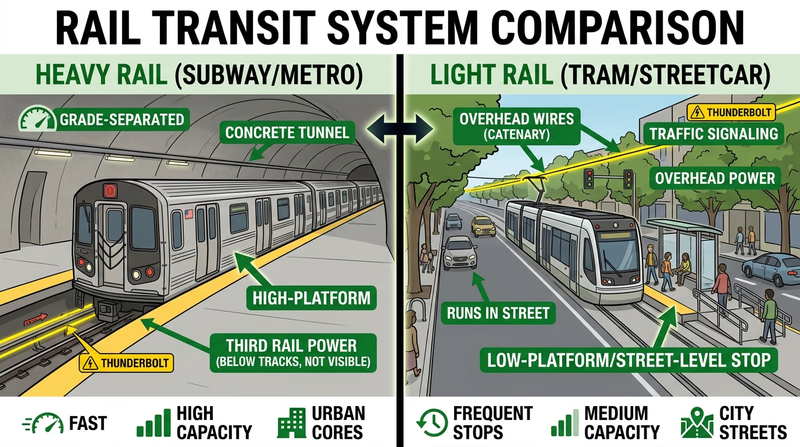
What it is: High-capacity electric rail that operates on fully grade-separated track — meaning it never shares a street or highway with cars. Runs in subways, elevated structures, or dedicated surface corridors.
Characteristics: Very high frequency (trains every 2–5 minutes at peak), high capacity (600–1,200 passengers per train), powered by third rail or overhead catenary.
Examples in the U.S.: New York City Subway, Chicago L, Washington Metro (WMATA), BART (San Francisco Bay Area), Boston T (Red/Blue/Orange/Green Lines).
Light Rail Transit (LRT)
What it is: Electric rail that can share streets at grade level (running in traffic or in a mixed-traffic lane) as well as operate on dedicated rights-of-way. Lower capacity than heavy rail but more flexible and less expensive to build.
Characteristics: Typically single or two-car trains, quieter than heavy rail, can stop at pedestrian-level platforms.
Examples: Portland MAX, Dallas DART, Denver RTD, Salt Lake City TRAX, Minneapolis Metro Green Line.
Commuter Rail
What it is: Rail service that connects outlying suburbs and satellite cities to a central urban area, primarily for daily work commuters. Usually runs on tracks shared with or adjacent to freight railroads. Longer trip distances than subway or light rail.
Characteristics: Diesel or electric locomotives pulling bi-level or single-level coaches, stations spaced 3–10 miles apart, peak-hour oriented schedules.
Examples: Metra (Chicago), LIRR (Long Island to New York City), NJ Transit Rail, Caltrain (San Jose to San Francisco), MARC (Maryland/D.C. area).
Streetcar / Trolley
What it is: Low-speed electric rail that runs entirely in mixed traffic on city streets, at pedestrian-scale. Smaller and slower than light rail. Focuses on short-hop urban circulation rather than commuting.
Examples: Portland Streetcar, Kansas City Streetcar, New Orleans St. Charles streetcar line (the oldest continuously operating streetcar line in the world).
Monorail
What it is: A rail system that runs on a single beam, either suspended beneath it (hanging monorail) or balanced on top. Most common in amusement parks and airports, but a few city systems exist.
Examples: Seattle Monorail (short tourist/city link), Las Vegas Monorail (resort corridor), Disney’s WEDway/PeopleMover systems.
Automated People Movers (APM)
What it is: Driverless computer-controlled vehicles running on fixed guideways, usually within a large facility. Common in major airports to connect terminals.
Examples: Chicago O’Hare Airport ATS, Atlanta Hartsfield-Jackson Plane Train, Miami International Airport MIA Mover.
Maglev (Magnetic Levitation)
What it is: A system that uses magnetic fields to lift and propel vehicles — no wheels or rails in contact. Nearly silent, extremely low friction, capable of very high speeds. Currently operational in Japan (SCMaglev) and China (Shanghai Transrapid).
U.S. status: No operational maglev passenger line exists in the U.S. as of 2026, but projects have been proposed for the Northeast Corridor.
Req 2b Review Checklist
- Heavy rail (subway) — grade-separated, high capacity, third rail or catenary
- Light rail — can run at grade on streets, smaller trains, flexible routing
- Commuter rail — suburb-to-city, longer distances, peak schedules, shared freight track
- Streetcar / trolley — street-running, short trips, pedestrian scale
- Monorail — single-beam, limited U.S. examples
- Automated people movers — driverless, airport/campus use
- Maglev — no contact with track, very high speed potential